

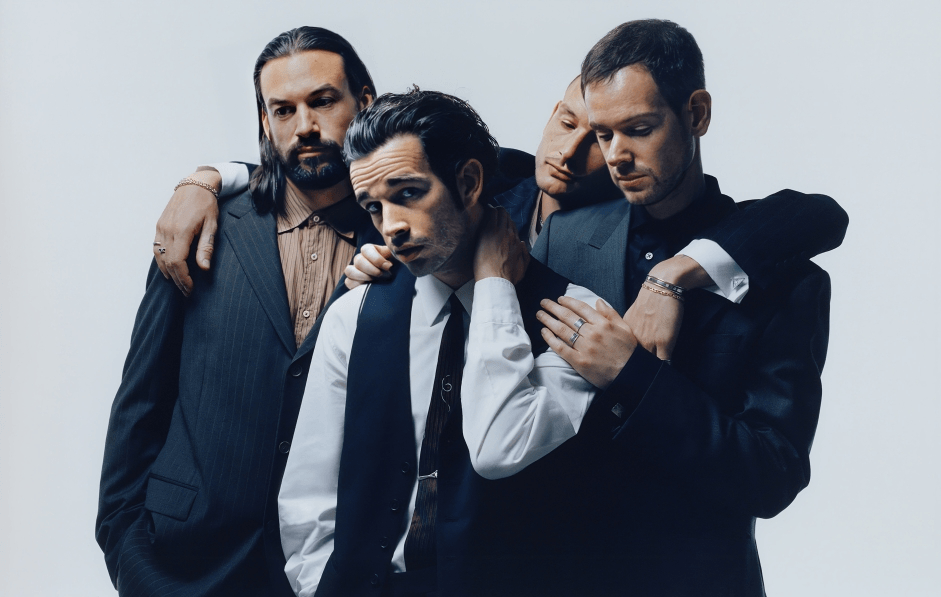


The 1975 released their fifth studio album, “Being Funny in a Foreign Language,” on Oct. 14. It was written by lead singer Matty Healy and drummer George Daniel, and produced by Jack Antonoff, full of romance, cynicism and hope. Four singles preceded the album’s release: “Happiness,” “Part of the Band,” “All I Need to Hear” and “I’m in Love with You” — all of which were met with success.
In a grandiose mash of retro ‘80s synthesizer, pop instrumentals, emotional saxophone, energetic high hats and long lines of trailing lyrics, the album focuses on themes like politics, love, culture and a splash of Matty Healy’s self obsession. The album dips into the folk genre near the end of the tracklist, but it mainly stays rooted in the 1975’s trademark of retro pop, smooth and sonorous, yet catchy and energetic sounds.
Even though “Being Funny In a Foreign Language” is quite a bit shorter than the band’s previous albums, clocking in at 11 songs, and spanning a total of 42 minutes, it is not lacking in the excess that the band is known for. This album is a lot. A lot of sound, a lot of words and a lot of meaning. Whether that’s a good thing or a bad thing is really up to the listener.
The main focus of the album is love — the necessity of love, finding love and keeping love. “Happiness,” for example, is focused on the overwhelming joy that comes from being in love. Its main line “Show me your love why don’t you” is repeated in a tone so happy it’s on the verge of tears.
Written during the pandemic, the band had a lot more time to write and reflect about what they were writing than they have ever had before. In addition, the members are reaching their 30s.
As a result, this is their most focused and intentional album by far. In an interview with Vulture, Healy discussed this new emphasis on morality, in contrast to the glamor of songwriting in his 20s.
“What’s harder is to go up onstage and say something that you mean, and it [may] not have a punchline, and it may be attempting to deliver some moral message. Which is a bit lofty and maybe a bit pretentious if you think that you have the ability to do that,” Healy said.
Whether or not Healy has the ability to comment on morality is an interesting question.
In “Looking for Somebody to Love,” Healy inserts The 1975 into a conversation that feels too complex for a pop song. The song comments on the necessity of love by showing the mental state of someone without it. He writes, “The boy with the plan and the gun in his hand was looking for somebody to love.” This line suggests that mass shooters commit these heinous acts because they are not loved in the way a human needs to be. This is a unique and thought-provoking way to look at shootings, and to an extent, the song speaks the truth. However, it feels a little too easy to adopt an all you need is love attitude towards an issue as complex as mass shootings.
Healy also relies on internet fads as an attempt to document the culture of today. There are several references to pop culture that are used to characterize people in the songs. For example, in “Part of the Band” Healy sings, “I know some ‘vaccinista tote bag chic baristas.’ Sitting east on their communista keisters / Writing about their ejaculations.”
At first glance, these lyrics feel so stereotyped that it seemed Healy was critiquing the people who make these comments, but this lyric is genuine. In one line he stereotypes pro-vaxxers, baristas and communists in a lazy, reductionist fashion, adding no further development of the song’s meaning except possibly to demonstrate Healy’s ability to rhyme. This line is an attempt to portray an entire culture in one song, to minimal success. In order to capture something so intricate and complicated, Healy forces himself to rely on these broad stereotypes and looks ignorant of its nuance in the process.
The opening song “The 1975” does a better job of fulfilling the album’s mission of morality and cultural involvement. It begins with a serious, engaging instrumental that announces that something important is going to be said. The album touches on the pain of being separated from loved ones. Healy comments on the mind numbing effects of social media in the opening song, “I’m feelin’ apathetic after scrolling through hell / I think I’ve got a boner, but I can’t really tell.” This line puts you right back into the pandemic’s jarring apathy for virtual suffering — it reflects the deadening of life caused by social media. It’s relatable and discomforting. The song finishes with the repetition of “I’m sorry if you’re living and you’re seventeen,” poignantly communicating that maybe now isn’t a great time to be young. The listener is left feeling sorrowful, yet with many thoughts.
The 1975 shine through their pop songs about love. In “Oh Caroline,” a hopeful and loving boy band tune, the singer talks about the need to be with that one person you can’t live without. The best line reads, “I’ll try anything that you wanna / I’ll find myself in the moonlight.” It’s cheesy and cliché but its simplicity and piano rolls make it fun to listen to. It’s not trying to encapsulate anything more than a good time.
Although there are moments where “Being Funny in A Foreign Language” takes on a mission bigger than it’s capable of fulfilling, the album does not disappoint. It is the most original The 1975 has been, as well as the most consistent, combining ‘80s-style retro and pop music genres in a way that only they could pull off.
Emma McCandless is an Entertainment Intern for the fall 2022 quarter. She can be reached at emccandl@uci.edu.

Interested in becoming an intern or a contributing writer for the Entertainment section?
Contact us at entertainment@newuniversity.org!