


Editor’s Note: This article contains spoilers for “Pearl.”
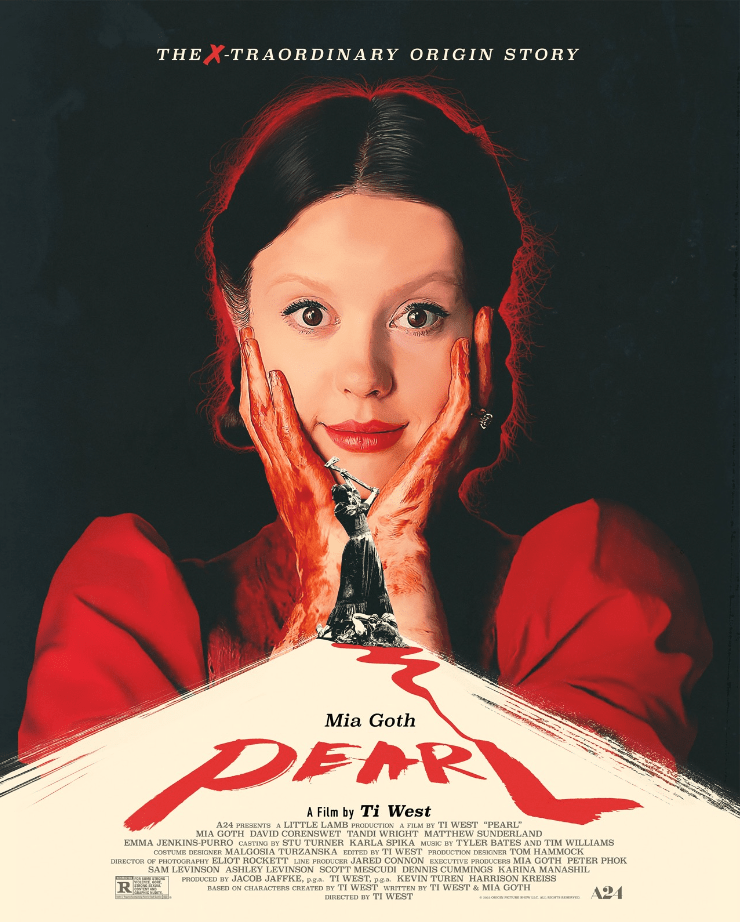
“Pearl,” directed by Ti West and released on Sept. 16, is the origin story of a girl who romanticizes a glamorous lifestyle as a dancer, but her life on the farm clashes with her dreams and ultimately turns her into a bloodthirsty killer.
In the world of Pearl (Mia Goth), the grass is greener and the skies are bluer than ever. The film begins with a beautiful score as the barn doors swing open like stage curtains, revealing the dreamy headspace of our protagonist and the colorful atmosphere of her home in 1918. The over-the-top, classic fairytale music accompanied with campy transitions, vintage fonts and vibrant colors allow the film to really embrace its dream-like, old-Hollywood aesthetic. For viewers who grew up watching vintage VCR commercials, it feels as if one is about to witness a princess story. However, that couldn’t be further from the truth.
The film opens with Pearl twirling and dancing around in her bedroom to the music in her head until her mother, Ruth (Tandi Wright), shuts it all down. Pearl shares a Carrie-like dynamic with her mother, and the film does not stray too far away from this classic horror trope. Pearl also has to take care of her infirm father (Matthew Sunderland), who is unable to speak or move as his daughter transforms into a terrifying killer.
Living life on the farm stifles the young star’s dreams — the only golden ticket she has is an upcoming audition at the church for a dance troupe.

Held back from the life she’s always wanted, Pearl finally begins her killing spree.
While Pearl murders both of her parents to eliminate any obstacles, there are characters that provide her with opportunities to pave her own way to fame. However, their deaths result as a byproduct of Pearl’s unhealthy coping mechanism with rejection.
One of these characters is The Projectionist (David Corenswet). He encourages Pearl to follow her dreams while she is young. It is only when he recognizes Pearl’s transparent lies as a red flag that he attempts to politely reject her romantically. In a rather humorous scene — one that is trending on Tiktok and has been deemed “relatable” — Pearl has a full-blown meltdown and murders him with a pitchfork.
These killings further prove how Pearl processes her rejection and suppressed life. As a cathartic yet unhealthy coping mechanism, she relies on murdering the people who humor the potential of her life on the farm as a permanent reality.
Her perseverance to be liked, praised and adored by the rest of the world is somewhat admirable. Pearl immediately continues her pursuit and throws on her mother’s period-accurate red dress for her audition. At the church, Pearl stands out like a sore thumb in her blood-red attire, distinguishing her from the lineup of other women dressed in beiges and blues.

This is when Pearl’s fantasies and vivid imagination shine as a visual treat for the audience. The curtains behind her reveal an imaginary World War I-inspired backdrop with red, white and blue fireworks as Pearl delivers a campy dancing number to “Hot-House Rag.” With her cartoonish expressions, her performance is captivating and truly, as she claimed, “the best dancing [she’s] ever done.” Still, her charm fell flat as the judges desired someone more all-American with originality and ‘X-factor.’
Pearl returns to the farm with her sister-in-law, Mitsy (Emma Jenkins-Purro), and Mia Goth delivers one of the film’s biggest highlights. In a 9-minute, single-shot monologue, Pearl confesses her deepest insecurities and intent to kill.
Even with her childlike cheeks and round button nose, Goth’s emotive and eerie performance leaves the audience on the edge of their seats as we anticipate her next violent move. The horror genre is friendly with the storytelling technique of a suspenseful slow-burn sequence, and “Pearl” is no stranger to that.
Perhaps this final kill is Pearl’s turning point as she accepts her life of mediocrity and embraces her violent nature before murdering Mitsy with an axe.

The film enters its last minutes with a slow, creepy sequence of Pearl preparing a disturbing dinner. Here, the film fully embraces its artistic direction as we watch these events unfold in a vertically mirrored scene that contorts the shapes of each shot, resembling an “X” shape.
The parallels this film shares with “X” come as a treat to any audience who enjoyed the grindhouse terror of its predecessor. While “Pearl” is not overly saturated with gory images and scenes, it explores similar thematic elements and expands on the narrative of this series as a prequel.
The film ends with Howard returning home from the war to be greeted by a roasted pig swimming in a pool of maggots, the decaying corpses of his parents-in-law, and a hauntingly forced smile from his wife.

This unforgettable shot lasts for what feels like an eternity when the end credits appear in front of Pearl’s sunny disposition as she holds her smile through tears.
When Pearl offers the world her strongest efforts and talents, her dreams are pulled from beneath her, birthing a homicidal murderer. Yet somehow, the ax-wielding, pitchfork-stabbing, daydreaming Pearl is nonetheless loveable, and dare some say, relatable.
While its predecessor “X” marks the spot, “Pearl” is no less of a gem.
Raymond Dinh is an Arts & Entertainment intern for the Fall 2022 quarter. He can be reached at raymontd@uci.edu .

Interested in becoming an intern or a contributing writer for the Entertainment section?
Contact us at entertainment@newuniversity.org!