


As UC Irvine empties during the summer, a 15-ton portable Elizabethan-style theater stands between Langson Library and the Gateway Study Center looking over Aldrich Park.
Marked by its distinct red swan logo, the New Swan Theater has hosted the New Swan Shakespeare Festival each year since its debut in summer 2012. The festival brings to life a vision first proposed by UCI’s Department of Drama when the university was founded.
The open-air theater has two levels, with seats arranged in a 270-degree circle around the stage.
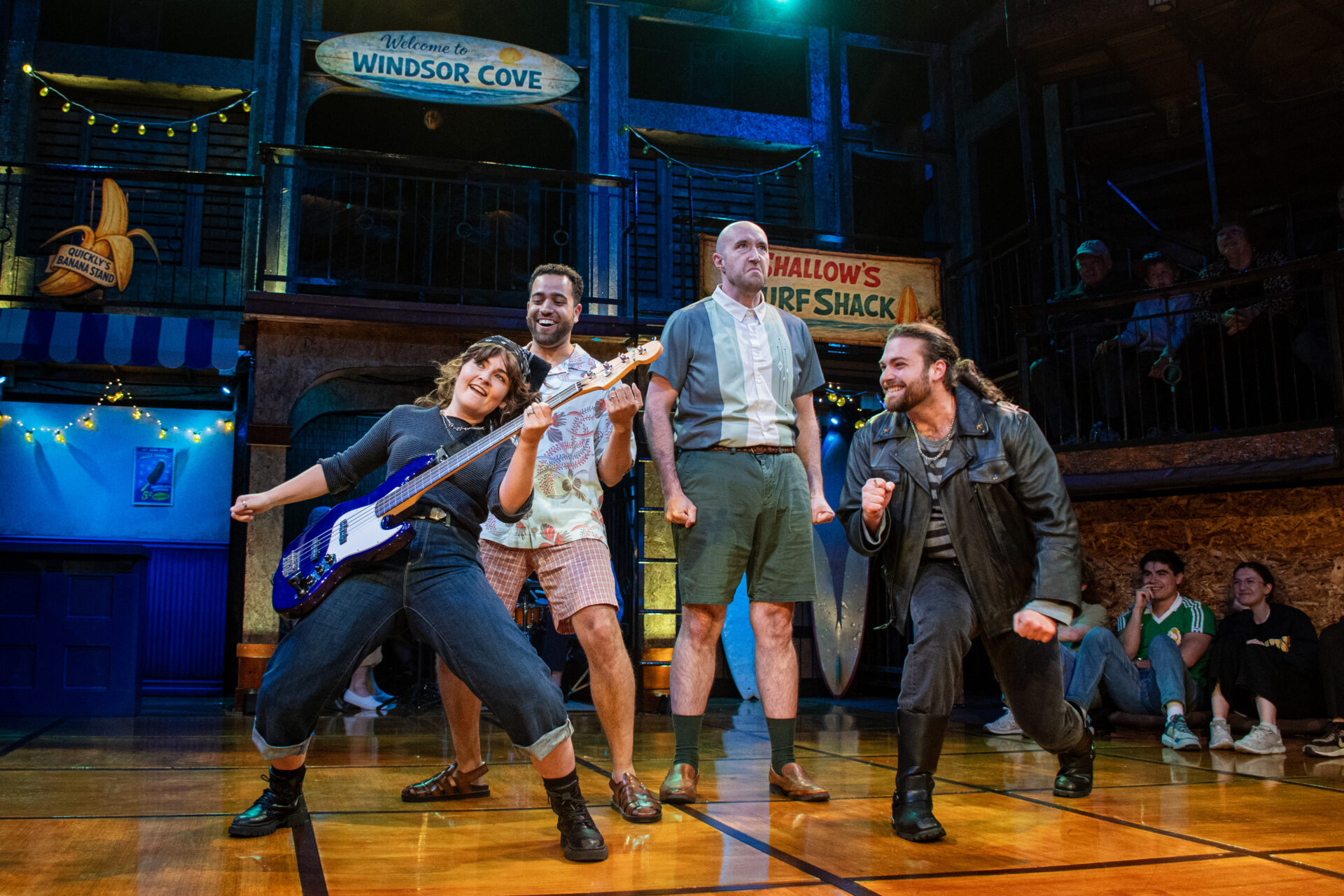
The 2026 season is the festival’s 14th year and features two productions. The first production is “The Merry Wives of Windsor Cove,” a musical adaptation of William Shakespeare’s “The Merry Wives of Windsor” set in a 1950s Southern California surf town. The second production is “Romeo & Juliet,” adapted to a Dust Bowl community in Verona, Kansas, during the Great Depression. From July 7 through August 30, the two productions are performed in alternating repertory at 8 p.m.
As performance time approached, audience members began to gather outside the theater. While ticket holders waited to enter, about 15 people lined up in a student rush line near the theater steps, hoping to claim any seats left unfilled after ticket holders had entered.
Among those waiting in the student rush line was Marco Lorenzo-Giguere, a ballet dancer with the National Choreographers Initiative at the nearby Irvine Barclay Theater. He said that one of his fellow dancers attended the festival last year, leading other dancers to come this year.
“The student rush line is a good opportunity for people to fill up the seats,” Lorenzo-Giguere told New University. “It’s a great opportunity for other students to come see it for free. If anyone’s a little bit strapped for cash, it’s a really great little thing that you could do.”
A few minutes later, a bell signaled that the performance was about to begin. After ticket holders had taken their seats, Lorenzo-Giguere and another person from the rush line entered the theater and were seated free of charge.
Before the performance began, the play’s director Eli Simon welcomed the audience from center stage.
“There are no cellphones in the ’50s,” Simon joked before the performance, reminding the audience to silence and put away their phones.
In the director’s notes in the playbill, Simon explained why he set “The Merry Wives of Windsor” in a Southern California beach town: “Just as Shakespeare’s audience felt at home in sleepy Windsor, I wanted to create a world we know.”
As the show began, performers entered the stage wearing colorful beachwear-inspired costumes, singing and dancing throughout the production. Anne Page, now reimagined as a champion surfer, carried a surfboard onto the stage and performed while balancing on it, mimicking the motion of riding waves.
Simon wrote in the director’s note that “the ’50s was an age of hope, promise and dreams, when rock and roll was born and people really did sing and dance spontaneously.”
The New Swan Theater’s seating surrounds the stage, allowing performers to interact closely with audience members throughout the play. At one point, Johnny Falstaff, one of the characters, ducks into an empty seat near the front rows and tells nearby audience members not to reveal his location. Near the end of the performance, staff members distributed beach balls for the audience to throw toward the stage when encouraged by one of the characters.
After the performance, audience members shared their reactions.
Joyce Hays, a retired English teacher, attended the show with Sarah Wright, a fellow English teacher. Both were raised in Southern California.
“This was very relatable,” Hays told New University. “I grew up on the beach as a kid, and so this was a beach. I was not alive during the ’50s, but I remember all those movies.”
For Wright, the adaptation also has an educational value.
“Adaptation brings in a new audience, and it makes it more approachable for someone who might turn away from just the thought of Shakespeare just in a classroom,” Wright told New University.
Lorenzo-Giguere also emphasized how the student rush line makes theater more accessible to students.
“When you create art, it’s always nice to engage with the entire community, not just people who usually have time on their hands,” Lorenzo-Giguere said. “You can really feel like you are putting something out into the world that’s being seen by everyone.”
Chloe Mo is a Features Intern for the summer 2026 quarter. She can be reached at chloem7@uci.edu.
Edited by Aditya Biswas and Elizabeth Gregg.

