

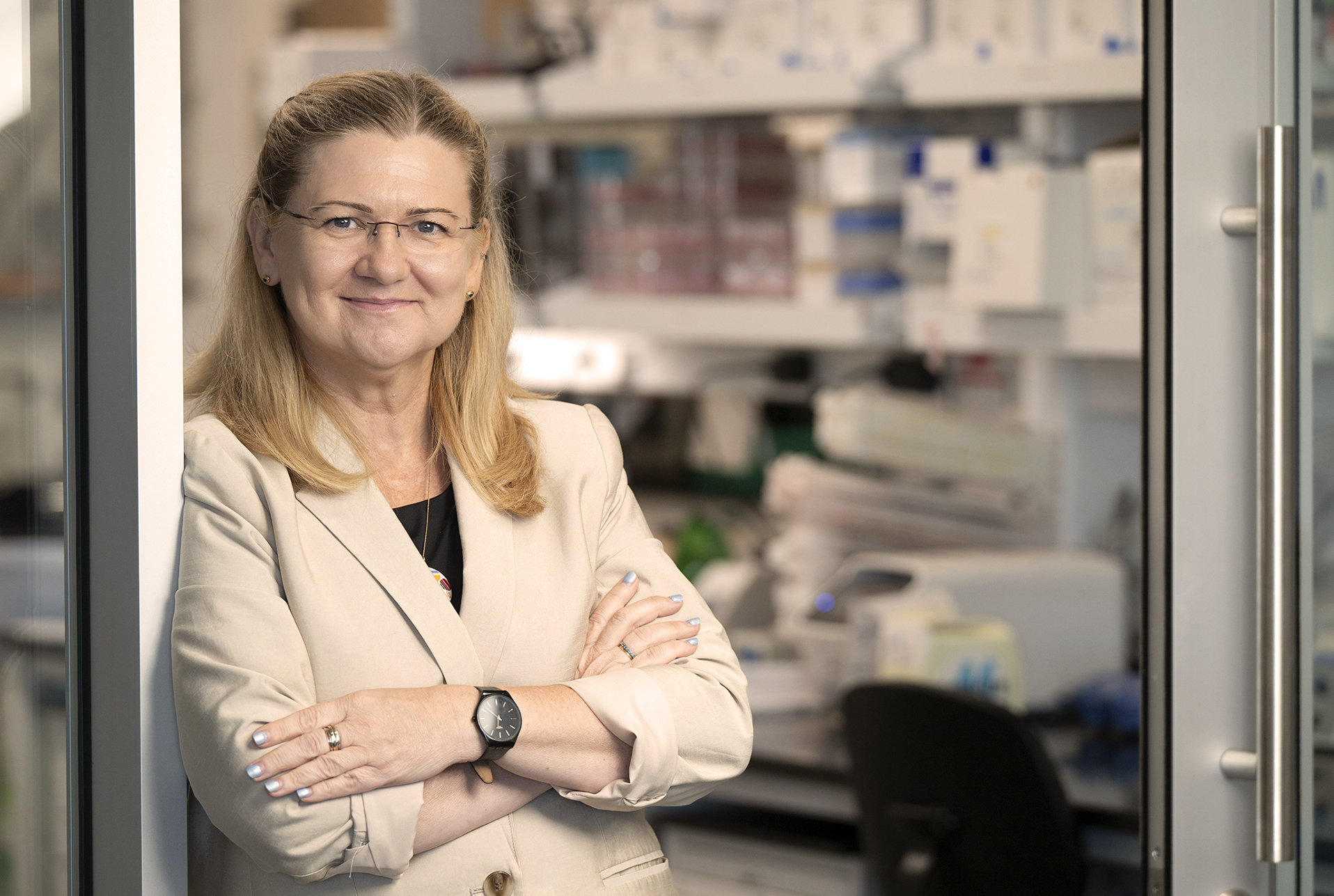

In her laboratory at the UC Irvine School of Medicine, Dr. Dorota Skowronska-Krawczyk performs groundbreaking research on the molecular mechanisms of age-related diseases on the eyes. Her recent work explores how omega-3 supplements can improve eye health and what Greenland sharks can reveal about the aging process.
Before conducting the research she is known for today, Dr. Skowronska-Krawczyk was a curious student in Poland who constantly asked why.
She recalls discovering her love for science at 10 years old, while sitting in a biology class.
During a lesson about a bird’s role in the ecosystem, Dr. Skowronska-Krawczyk became fascinated by how science reveals the connections that support life. She notes that this early curiosity about how living systems work together later shaped her interest in the complex interactions that occur within cells.
“I know it sounds very cliché, that I always wanted to be a scientist,” Dr. Skowronska-Krawczyk told New University.
Describing her later schooling, Dr. Skowronska-Krawczyk said she was the kind of student who always read the books for her classes the summer before, simply because she wanted to understand and learn more.
She still keeps some of her high school notebooks in her office, written neatly in Polish. Leafing through the pages, the notes serve as a reminder of her genuine love for science.
Although she knew she wanted to be a scientist, Dr. Skowronska-Krawczyk was not exactly sure where her path would lead, an uncertainty shared by many young adults facing the future.
Relating a similar reality familiar to many other first-generation, international UCI students, Dr. Skowronska-Krawczyk shared how she experienced the pressure of her parents’ high expectations.
With few people around her attending university, her parents hoped she would become a doctor. Unlike in the U.S., where medical school follows an undergraduate degree, Polish students typically choose between a four-year university program or medical school.
Dr. Skowronska-Krawczyk ultimately made her choice to pursue her M.D., and shares that she didn’t regret it. Even at a young age, she was confident in her love for research and learning through hands-on experiences.
“I don’t regret this. I think if I still had an M.D., I would still be a researcher,” Dr. Skowronska-Krawczyk said.
After college and her time in medical school, Dr. Skowronska-Krawczyk came to UC San Diego. Moving with her husband, she described how her choice of where to live in the United States was based on finding a place where both she and her partner felt comfortable and could pursue their research.
Now at UCI, Dr. Skowronska-Krawczyk leads research in a laboratory under her own name.
She described the laboratory as being much larger and quite different from the one where she first discovered her love of science in Poland.
Reflecting on the growth of her laboratory, Dr. Skowronska-Krawczyk said she is grateful for her own curiosity and tendency to ask why from a young age.
“I have plenty of questions, and that’s good, because if you don’t have questions, you don’t have a laboratory.” Dr. Skowronska-Krawczyk told New University.
Because she continues to ask many questions, she reported that her lab has made two primary discoveries so far.
First, they found that stress-based damage is specific to an individual organ, like the eye, rather than affecting the entire body. Second, they have also discovered the role of polyunsaturated fatty acids and how they support eye health.
But how does her research actually make it out of the laboratory? Though most people can take an interest in her work, it can be difficult to actually communicate findings to the general public.
Wanting to keep her work fun and approachable, Dr. Skowronska-Krawczyk promotes the selection of her research by STAT Madness — which ranks research universities like college basketball teams — and she shares her research with reporters.
By talking to reporters about her recent findings on Greenland sharks, her research gained unprecedented coverage beyond the scientific community.
Dr. Skowronska-Krawczyk and her colleagues identified that DNA repair-associated genes are expressed in the retina, helping maintain retinal strength and integrity over the long life of the Greenland shark.
These sharks’ long lifespans of almost 400 years drew interest from both the scientific community and the general public — with the open-access article receiving more than 30,000 views and the original short-form video receiving 51,000 views.
Dr. Skowronska-Krawczyk’s story and research serves as an inspiring example for medical and STEM students. By following their passions and exploring their interests, students may make unexpected discoveries they can one day share with the world.
Amelia Kirkegaard is a Features Intern for the winter 2026 quarter. She can be reached at akirkega@uci.edu.
Edited by Aditya Biswas and Annabelle Aguirre

