


This February, UC Irvine commemorated Black History Month (BHM) with a series of events that brought together students, faculty, staff and alumni to celebrate Black identity and culture.
Organized by various groups, the events included cultural wellness initiatives, performances, and academic discussions on equity, identity and the historical contributions of Black artists and scholars.
The programming aligned with the national observance of Black History Month, which began as Negro History Week in 1926 and founded by historian Carter G. Woodson to promote the study of Black contributions to U.S. history. The week expanded into a month-long celebration in 1976, following nationwide recognition of Black History Month by President Gerald Ford, who urged Americans to honor the often-overlooked achievements of Black leaders, artists and innovators.
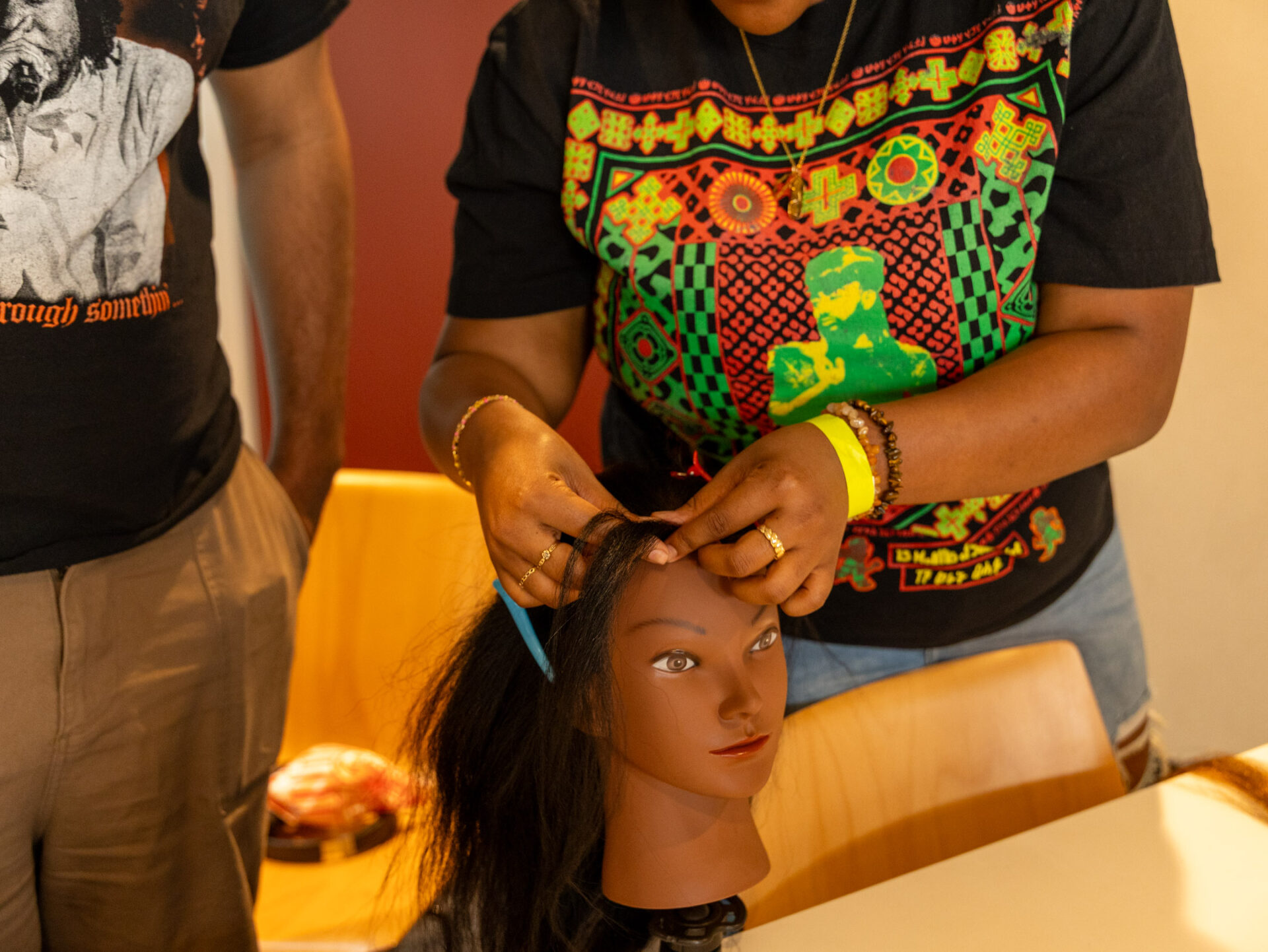
On campus, the month kicked off with a Black Haircare and Wellness event on Feb. 1. Organized by the Black Faculty and Staff Association (BFSA), the event brought together graduate and undergraduate students as well as local Black businesses and families for an afternoon dedicated to self-care, education and cultural celebration. The event drew over 200 attendees — in the context of Black students making up roughly 2% of the UCI graduate and undergraduate population of over 60,000 students.
Attendees enjoyed complimentary professional hair services from volunteer stylists and ClipDart Barbers, along with live braiding demonstrations by stylist Cherish Wylie and scalp consultations with Dr. Sophia Ederaine, a resident dermatologist.
The BFSA provided authentic New Orleans cuisine as guests participated in interactive craft stations and listened to live music from KUCI DJs. Attendees could also enter raffles featuring products from Beyoncé’s haircare line CÉCRED, Tracee Ellis Ross’s Pattern Beauty products, bonnets, brushes, setting scarves and more.
Thais Bouchereau, BFSA vice president and associate director of special programs in Graduate and Family Housing, described the event as a space for community-building.
“It was all about also celebrating traits associated with textured hair that has been historically stigmatized or discriminated against,” Bouchereau told New University.
In addition to celebrating cultural identity, the event aimed to provide students with practical resources for caring for their hair in everyday life.
“We had a lot of students who say, ‘Hey, where do I go in Irvine to get my locks taken care of or where can I find products?’ A lot of that isn’t available.” Bouchereau said. “So, in addition, we wanted to be able to connect our students with local barbers and stylists who knew how to take care of hair.”
The event not only exposed students to trusted professionals, but also gave them the skills and confidence to care for their hair themselves.
“When you walk into a place and you know they don’t know how to trim your hair, they don’t know how to care for your hair, you’re at a loss as to what to do,” Bouchereau said, noting that a polished appearance can make a difference in situations like job interviews, where self-assurance and confidence is key.
Another BHM event included a campus-wide open mic hosted by the Black Student Union (BSU) on Feb. 5, where students shared poetry, music and stories inspired by community justice.
On Feb. 11, the Black Alumni Chapter (BAC) and BSU participated in the University of California Black Alumni Council (UCBAC) conference to network and discuss ongoing initiatives supporting equity and representation on campus.
The following day, the UC Irvine Cross-Cultural Center hosted an MLK Symposium, which featured keynote speaker Dean of Counseling and Guided Pathways at L.A. City College Dr. Jerell Hill who advocates for educational equity, and a performance by the West African Dance Group.
Also on Feb. 12, UCI and guest jazz faculty celebrated the 100 Years of Music, Wisdom, and Community Centennial Celebration of Miles Davis and John Coltrane with a concert and panel discussion.
Alongside these headline events, smaller community gatherings took place across campus, including BAC-BSU mixers and BSU hiking trips.
For UC Irvine, Black History Month is more than a calendar observance. It’s a reflection of decades of community-building and cultural engagement on campus.
BAC President Lolita Brown Fletcher, who graduated from UCI in 1984, reflected on her time as a student and described her experience as both fulfilling and complex, considering the realities of attending a predominantly white campus.
“I enjoyed my experience because I was the kind of student who jumped in and built my support network around me,” Fletcher told New University. “When you have a group of friends around you, you feel like ‘this place is mine, and I belong here,’ but if you don’t do that, you can feel very isolated in a predominantly white university.”
Fletcher noted that Black students still made up only a small fraction of the campus population — a reality that often meant being one of the only Black students in a classroom.
At that time, students relied on organizations, campus events and activism to find support and solidarity as they confronted incidents of anti-Black bias.
The sense of community and advocacy that Fletcher experienced continues to shape Black student experience on campus, even as students navigate a new set of challenges in today’s political climate.
“This generation is seeing what the civil rights movement was like, as this administration tramples on our civil rights,” Fletcher said. “I’d like to see them working with some of the other organizations on campus, because it’s not just black rights being trampled on, it’s you know, Latino rights, globally being trampled on, and LGBTQ+ are being trampled on, and educational rights are being trampled on, women’s rights are being trampled.”
Current BSU President and third-year political science and criminology double major Eunique Sherow spoke to recent incidents of discrimination on campus, where she alleges the College Republicans at UCI spread targeted hate speech on Ring Road.
“They had signs like ‘do Black lives really matter’ and signs of like ‘Black privilege is real’ or something like that. They came on campus, and they were spewing hate speech,” Sherow told New University.
Sharow later said, “it was just a very discouraging day to be a Black student on campus that day.”
Despite these challenges, she emphasized the ways BSU has cultivated a strong and supportive community at UCI.
“The connections and the people that I [met through] BSU, I can definitely say I will have lifelong friendships,” Sherow said. “And every year I’m able to connect with the underclassmen. It just warms my heart that even just walking through Ring Road, or walking on campus, and they see me, we just smile, and we wave at each other.”
Mya Romero is a Features Intern for the winter 2026 quarter. She can be reached at myajr@uci.edu.
Edited by Avery Rosas, Emery Ramirez and Joshua Gonzales

