

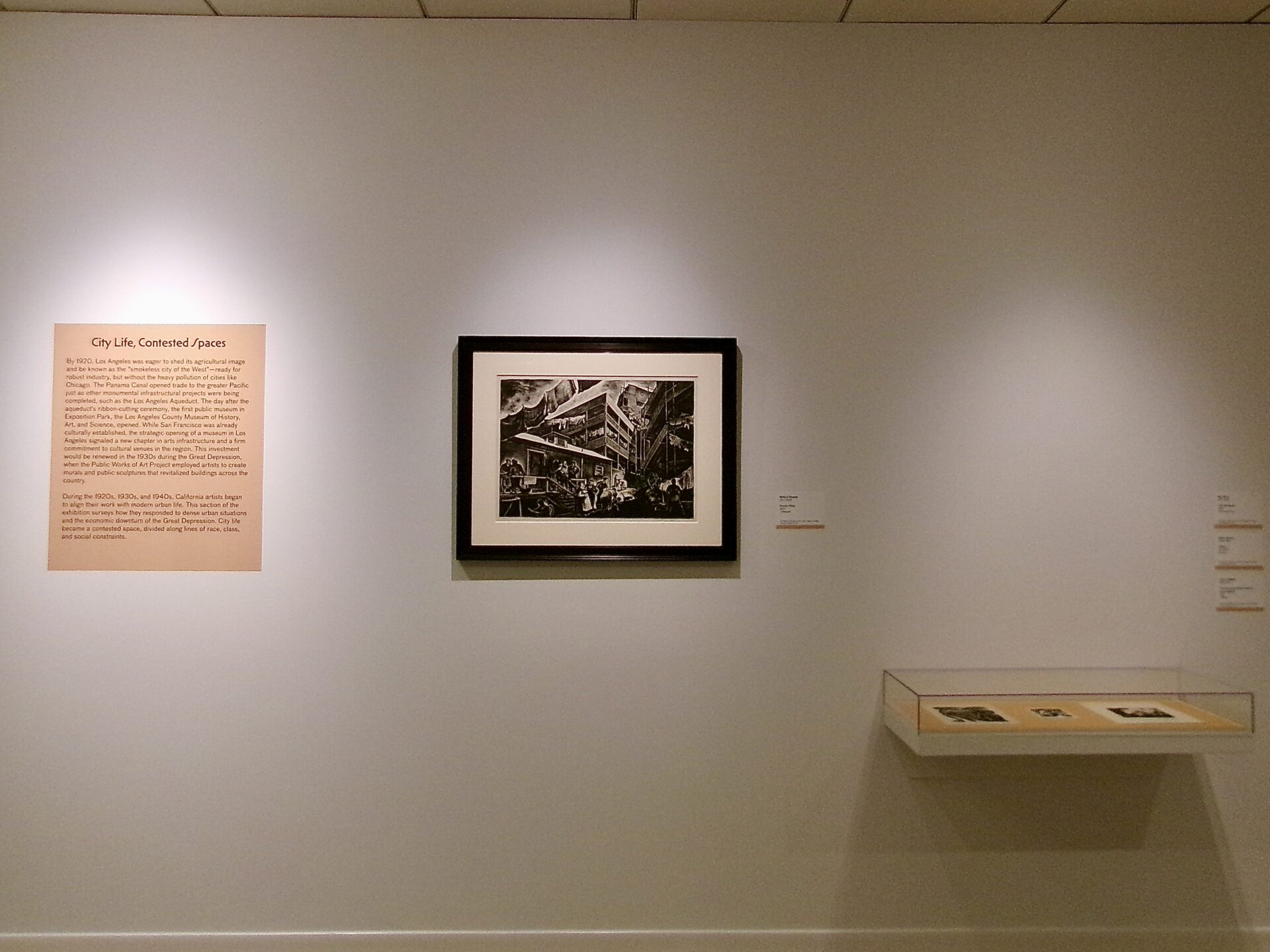

The exhibition “At Home in Sunlight: A State In Motion, 1897 – 1940,” at the UC Irvine Langson Orange County Museum of Art is now open for visitors, running from Jan. 1 through May 16.
“At Home in Sunlight” depicts California in constant change and motion. The exhibition highlights unprecedented growth reflected in cultural productions, urban development and booming populations due to immigration, particularly within the cities of San Francisco and Los Angeles.
The exhibition is a natural departure from the previous exhibit held in the same space, “Habitat: Making the California Environment,” curated by UCI Professor James Nisbet, which emphasized the state’s natural landscapes and the environmental impact of human activity. In contrast, “At Home in Sunlight” focuses on urban spaces, the people who lived and worked there and the perspectives of the artists who depicted them.
Exhibition curator and second-year master of fine arts student SeeVa Dawne Kitslis said the goal of the exhibition was to center the people of California.
As museum-goers enter the exhibit, they encounter small paintings that depict the World Fairs in both San Diego and San Francisco from the turn of the century.
The grand architecture and vibrant colors in these paintings highlight the modernity of these fairs, parks and cities, which drew visitors from across the United States and abroad.
These paintings guide visitors through the gallery space, designed to evoke a train track, with turns and corners serving as spokes and turnpikes along the exhibition.
Each painting gives the impression of a glance out the window of a speeding train, with sweeping vistas in oil and watercolor depicting the approach into a city. As museum-goers follow the exhibition’s forked paths, the works begin to overlap and intertwine, reflecting the motion of the modern urban landscape.
As the exhibition continues, visitors are presented with the works of California regionalist painters, who focused on the realities of their surroundings and captured them in watercolors, chosen for their portability and quick drying time. Industrial elements appear alongside natural scenes, such as smoke stacks rising over the San Francisco neighborhood Hunters Point, illustrating the transformation of California from rural simplicity to an industrialized, urbanized environment.
Despite these changes, many of these painters repeatedly returned to these natural sites, anchoring their work in recognizable landscapes.
Kitslis said this repetition resonated with her, citing Donna Schuster’s depiction of Japanese immigrants working at the Port of San Pedro, Calif.
Thinking of herself and Schuster, Kitslis told New University, “artists sometimes, like, we’re drawn to the same things. We’re drawn to the same places, and how time is not human … We’re sort of refreshing that curiosity again or something like that.”
One of Kitslis’ favorite pieces in the exhibition is the “Bunker Hill Tenement” lithograph painted by Millard Sheets. The piece depicts the density of urban life through tightly compressed illustrations of people, buildings and daily activity.
The building’s stacked composition suggests various layers of residential and urban development. Works throughout the exhibition, including portrayals of Chinese and Mexican immigrant workers, document communities often left out of traditional historical narratives.
By centering these groups, these paintings reveal their lasting impact on California’s cultural identity.
Rather than focusing solely on industrial imagery such as smokestacks and trains, Kitslis said California regionalist painters acknowledged the role of immigrant labor in the state’s development.
“California we know now and the Los Angeles we know now is built on immigrant labor. And that is something that I think artists of that time period were just seeing.” Kitslis told New University.
The “Breakdown/Breakthrough: Art and Infrastructure” section of the exhibit, curated by Dr. Michaëla De Lacaze Mohrmann, further highlights the presence of immigrant communities. A recently acquired photograph, “Slipping Into the Darkness,” by Ruben Ochoa shows the roots of an invasive tree pushing through a concrete sidewalk.
The enlarged photograph is intentionally placed lower to the ground, positioning viewers at street level, aligning with the perspective of a pedestrian.
The work critiques the limited efforts of Los Angeles officials to build infrastructure and a system that supports residents. At the same time, it highlights the resilience of immigrant populations, who have established deep roots in the city despite systemic challenges.
Museum-goers can explore the perspectives of California regionalist painters by viewing the exhibits or participating in interactive activities, such as creating a postcard with their own description of California.
Amid the fast pace of modern life, “At Home in Sunlight” encourages viewers to slow down and consider how people find home in a constantly shifting city.
Amelia Kirkegaard is a Features Intern for the winter 2026 quarter. She can be reached at akirkega@uci.edu.
Edited by Aditya Biswas, Annabelle Aguirre

