


Editor’s Note: This article was corrected for accuracy on May 5, 2024.
It was a cold, cloudy day at the UCI Gaza Solidarity Encampment as protesters maintained their “liberation zone” at the Physical Sciences Quad for the sixth day.
In the early afternoon, a man was escorted from campus by police after a disturbance in front of the encampment. The man appeared to be taking photos of the inside the encampment, after which two protesters attempted to cover his camera with black umbrellas. The man fell and then exclaimed that he was pushed to the ground. Two UCIPD officers then took the man to the side and later escorted him off of campus.
An encampment protester, who requested anonymity, told New University that they believed the man was trying to take photos of protesters’ faces.
“We all rushed because we want to protect our camp. We’re on high alert, high security because of what we’ve seen on other campuses and we’re not sure who can actually protect us,” they said. “Right now we’re depending on ourselves to protect our people, our camp. We want to stay here because we want our demands to be met.”

Photo by Laiyla Santillan / Staff
“The man pushed someone and then claimed that person was pushing them…We tried to block him from taking pictures of us and videos. The police came and took him away to see what’s up,” the protester said.
In Washington, The Seattle Times reported that Evergreen State College removed their encampment after a Memorandum of Understanding (MOU) agreement was reached between the Evergreen Gaza Solidarity Encampment and university administration on April 30.
According to the MOU, four committees consisting of both student and professional staff will be created to address policy questions regarding investments, grants and police activity on campus. Of the committees, the Investment Policy Disappearing Task Force will address divestment from “companies that profit from gross human rights violations and/or the occupation of Palestinian territories,” while the Grant Acceptance Policy Disappearing Task Force will judge grant funding based on criteria regarding free speech and oppression.
Today at UCI, protest organizations posted their programming schedule for the sixth day of the encampment. In the afternoon, encampment leaders gave safety training lessons to student protesters.
“We’re gonna do safety training for members because we are on high alert. We want all our members to be safe and to know all the precautions that we want to take,” the protester said.
A teach-in featuring guest speakers was also scheduled in the evening at the Physical Sciences Lecture Hall. However, the building was closed and the session was held outside of the encampment near Rowland Hall instead.
Four private security staff stood outside the entrances of the Physical Sciences Lecture Hall. According to protesters, security staff said that the lecture hall is always closed on weekends and that the building is currently on “lockdown.” The neighboring Rowland and Frederick Reines Halls, however, remained open.
Speakers at the event, Dr. Rasul Miller, Dr. Sohail Daulatzai, Sheikh Mohammed Faqih, and Ameena Qazi, taught about student activism on the frontlines and how to support college activism. Qazi was the first to speak and emphasized student movements for Palestinian liberation.
“The student movement became a home for the Palestinian community, and is what allowed Palestinians to feel a connection to back home and to continue to be part of this larger body that was functioning from the near diaspora,” Qazi said, describing the influence of the General Union of Palestine Students (GUPS).

Photo by Laiyla Santillan / Staff
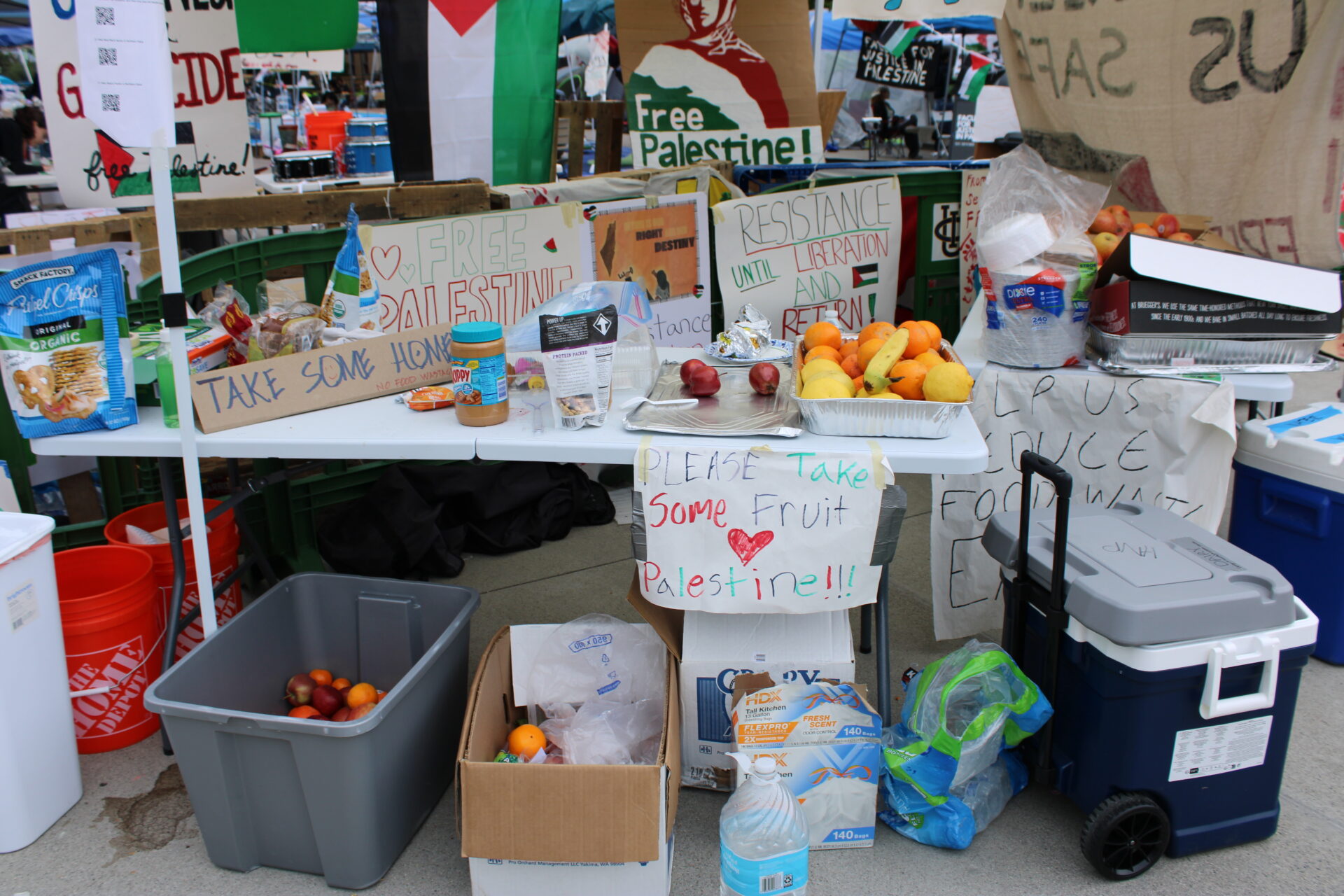
UCI Divest also gave an update on Instagram stating that donations, especially food, are no longer needed. Protest leaders instead requested donations of time and physical presence at the encampment.
“We’re very very grateful for all the support — student and community support,” the protester said.
Outside of the encampment, New University spoke with a community member, who requested anonymity, who was making an oil painting of the World Press Photo of the Year: a depiction of a Palestinian woman holding her deceased five-year-old niece.

Photo by Skylar Paxton / Staff
“I think art has always been a way for people to sort of express what might not be conventional or permissible by the authority,” they said. “And, it’s a way for us to communicate on so many different levels and spectrums… You know, we have our words, but images also can hit emotions in such an important and impactful way.”
Northern Gaza is currently in a famine, according to the head of UN’s World Food Programme. Gaza truce talks between Hamas and Israel in Egypt continue, yet Israel plans to launch a ground invasion into the city of Rafah, located in the southern part of the Gaza Strip.
“This image could be anybody. It could be your mom, it could be me, holding someone that they love who’s dead in their arms,” the community member said. “And, I think when you look at a painting, you sort of internalize it and relate to it and that’s why I’m doing it.”
Skylar Paxton is an Opinion Apprentice. She can be reached at paxtons@uci.edu.
Edited by Beatrice Lee and Mohammad Samhouri

