

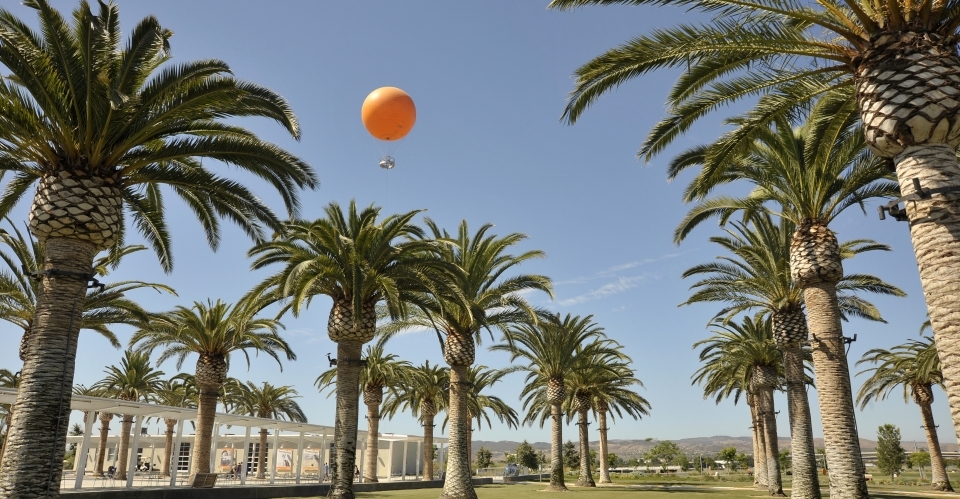


Irvine’s parks decorate the city with its well-maintained greenery, providing recreational reprieve for many households. According to The Trust For Public Land’s ParkScore Index (TPL), Irvine’s park system ranks eighth in the country and second in California as of 2022, placing it with similar standing to San Francisco and Seattle.
Metrics, such as the parks’ acreage, accessibility to residents, quantity of investment and amenities, as well as equitable access to varying demographics according to race and income, were used to determine a score of 76.6 out of 100. However, despite such notable ranking, Irvine’s Great Park remains an outlier.
While Great Park currently has over 450-acres of developed parkland, it harbors a couple shortcomings. Its investments have failed to produce the idyllic natural haven it was envisioned to be. Amenities emphasized by the ParkScore index such as basketball hoops, dog parks, playgrounds, senior centers, splash pads seem miniscule to the scale of vision of the original Great Park master plan.
The park is within a 10 minute walking distance of several neighborhoods in the vicinity — an important metric of accessibility in the ParkScore Index. Yet, the single family houses within these areas have median costs of around $1.5 million dollars. This lends itself to very little equitable access in terms of income.
The Great Park, under the management of the Irvine City Council, has the capacity to live up to its potential. Regardless, the realities of the park are misrepresented by the scores given by the TPL. The multitude of issues existing within its development history cannot be observed merely through a set of rudimentary metrics.
Residents living in neighborhoods surrounding Orange County’s Great Park, located in central Irvine, have for years expressed contempt towards the Mello-Roos tax they pay to maintain the park’s current amenities. The Great Park Communities Facility District (CDF) special tax has property owners pay an additional 2% tax with a perpetual tax term that will operate indefinitely.
According to the Voice of OC, the park has been a continuous burden for neighborhood residents who bear the costs of the park’s tumultuous development process.
As of the fiscal year 2020-21, the special tax has accumulated over $25 million in revenue. It is being used to maintain roads, utilities, conservation efforts, and fund new infrastructure for the park. Residents claim they receive little benefit from it and would prefer other services such as a grocery store or a shopping district.
In response to the outcry, the Irvine City Council voted unanimously to enforce a Great Park Task Force in May 2022. The four-month initiative sought to evaluate the needs of residents and usher in a new master plan for Great Park that is more mindful of the neighborhoods surrounding it.
Since then, nearly half of the original members of the task force have resigned under claims that the committee accomplished “little to no work.” On the contrary, the city has stated that the task force proved useful in improving the park’s parking plans. Those who made resignations remained firm that they had little to no input in such plans.
The Great Park, formerly the El Toro Marine Corp Air Base, was originally proposed as an ambitious plan that would rival New York’s Central Park.
The master plan, spanning over 1300-acres, was designed by urban designer Ken Smith and approved by the city council in 2007 under the mayorship of Larry Agran. It proposed for the park to become an ecological wonder with a vast two-mile-long canyon, wildlife habitat preserves, rivers and lake systems, museums, botanical gardens and a memorial park.
Fourteen years later, the park resembles a sports complex with 24 soccer fields, four softball fields, six baseball fields, and a basketball court. Currently, there are over 750-acres of undeveloped parkland.
Stretched across the center of the park is a walkable timeline that serves both as the principal walkway for visitors as well as a historical timeline etched into the concrete, documenting major events through WWII. It serves as a homage to the park’s military roots. A hangar stands to memorialize the old air force base, and the Arts Center continues to host a multitude of community events for families. Visitors may also board the Great Park Balloon, a giant orange air balloon, for a view of the city from above. Over the years, the master plan has proposed dozens of projects with few yielding much progress.
The park’s legislative history has been marred by controversy stemming from political inconveniences and corruption. Previously the El Toro Marine Corps air base, the area served as a facility to train pilots and aircrew personnel during World War II. It was discontinued in 1999 and put up for public auction by the U.S. Navy. Before annexing the parcel of land, The Irvine City Council began negotiating the base’s future from 2000-2002.
During this time, the city of Irvine faced a political firestorm as they tried to figure out what to do with the new land. Residents in Newport wanted the base to become an airport because they detested the noise produced from John Wayne Airport and believed a new international airport would reduce air traffic coming from the former.
Irvine residents, however, did not want an airport for similar noise-related reasons. Siding with the Irvine residents, Agran spearheaded Measure W, a ballot referendum limiting the development of the abandoned base to “non-aviation uses, including a multi-purpose central park, open space, nature preserve, universities and schools, cultural facilities and other interim and long-term uses described herein.” The measure eliminated the potential of an airport, and in its place established a park. Measure W was eventually passed and gained popularity among Irvine residents.
After the city of Irvine gained complete annexation of the 4,700-acre property in 2003, a “master plan” was adopted by the Great Park Corporation working under the direction of the Irvine City Council in 2007. The plan would create a 1,347-acre urban park as a community gathering place for all residents twice the size of New York’s Central Park.
The park ran into the first of many hurdles in its funding. Agran told the New University that the park was supposed to be financed under a tax increment financing (TIF) provision that allows full funding for the park without the addition of new taxes.
However, Governor Jerry Brown quickly struck the proposal down in 2011 –– leaving the city to resort to negotiations with FivePoint, a housing development corporation. The city permitted FivePoint to construct high-value single-family homes around the vicinity of the park to collect adequate property taxes for maintenance and future improvements.
“They proved to be an unreliable partner which slowed the project considerably,” Agran said.
From there, FivePoint seized control of the development, removing transparency in funding as decisions were being left to a private entity.
By 2013, the city council voted 3-2 to give over half of the development rights to FivePoint in exchange for the construction of thousands of additional homes around the vicinity of the park, further delaying its development. The votes were cast on party lines, with three conservative council members — Jeffery Lalloway, Christina Shea and Mayor Steven Choi — in favor and two liberals — Agran and Beth Krom — against it.
Consequently, the development of the park was conducted based on private interests rather than the original public-focused master plan. The original plans of constructing ecological reserves were gradually shelved with no clear budget or set development plan.
Agran also came under fire after an audit produced by political auditing firm Hagen, Streiff, Newton & Oshiro (HSNO) accused him of mishandling $250 million worth of development contracts and understating the costs of development during the park’s planning from 2005 to 2012.
HSNO was paid over $778,000 by the conservative majority in the city council to conduct this report. According to Agran, the ordeal was a political scheme to defame him. The firm’s claims were challenged during an investigation by the state accounting board which revealed that it had “failed to comply with professional standards, engaged in numerous acts of negligence and disseminated false and misleading information.” HSNO was later forced to relinquish its accountancy license and pay over $1 million.
“So that [audit] was all just a political effort that ultimately resulted in confirming that my stewardship over the Great Park was not only appropriate but free of any questionable financial problems whatsoever,” Agran said.
A more recent controversy involves the proposed veterans cemetery and park that was to be constructed in the Amended and Restated Development Agreement (ARDA) site, a 125-acre parcel of land that was originally designated to FivePoint for construction of golf courses.
The ARDA was later returned to the city and the plan for a veterans cemetery won in a ballot initiative and received popular support in 2018. However, FivePoint and the conservative council members worked in tandem to advocate for a relocation of the cemetery to Anaheim Hills in order to leave room for other interests in the site.
“I am the lone member on the city council who continues to fight for the Veterans Memorial Park and Cemetery approved by the voters, while the other council members don’t want a cemetery out there at all,” Agran argued.
However, Great Park’s development has been recently reignited. The Five Point Amphitheater, a temporary concert stage operated by Live Music, underwent negotiations for relocation within the park earlier this year.
The Irvine City Council signed an exclusive agreement with Live Nation to probe the park for a suitable 30-acre land plot for a new and permanent concert venue, a demand that many residents asked for. Construction and operation have been approved by both parties and is set to replace the FivePoint Amphitheater as of October 2022. The concert venue will have a 14,000 person capacity and costs are projected to climb to $130,000.
The city council also approved the Framework Plan which will commence the development of the botanical garden and veterans memorial garden at the ARDA site as of July 2022. It will improve the park’s sports facilities by adding a gym and an aquatics center.
They plan to utilize an estimated $600 million in preliminary funds but have yet to establish a detailed layout of the proposal. These projects had been envisioned since the park’s conception in 2007 and this plan could represent a renewed focus on the fulfillment of the original master plan.
Despite a long road of development ahead, Agran remains hopeful that the master plan will come to fruition.
“The project is now back on track … its finances are very solid and we anticipate we will be moving pretty rapidly over the next five to ten years,” Agran said.
The city of Irvine remains focused on the development of the Cultural Terrace laid out in the Framework Plan and the permanent concert venue as of October 2022.
Kane Hong is a City News Staff Writer. He can be reached at kanelh@uci.edu.

Interested in becoming an intern or a contributing writer for the City News section?
Contact us at citynews@newuniversity.org!