




“Minari” is a semi-autobiographical fictional piece written and directed by Lee Isaac Chung which was released on Feb. 12. It follows a Korean family tirelessly working to achieve the American dream and despite its unusual setting, the film accurately depicts the universality of the Korean-American immigrant experience.
“I felt like I was reading a story where I really understood and knew the characters from a personal standpoint,” said “Minari” producer Christina Oh regarding her first time reading the film’s screenplay. “A lot of the emotionality in the story and a lot of the humanity on display was something that I was immediately drawn to.”
Though I’m a daughter of Korean immigrants who was born and raised in Orange County, I was never taught to speak Korean, which consequently led me to never share a deep conversation with my Korean-speaking grandparents. Even with my disconnect, I was drawn to tears throughout the movie.
Like Oh, who also did not grow up on a farm in Arkansas as the film’s director Lee Isaac Chung had, I immediately related with the characters.
The sentiments associated with being an outsider — a hyper-focused work ethic, prideful patriarchs, the closeness of family, Christianity as a source for community and sacrificing relationships in the hopes of one day achieving stability — undeniably trickle down generations and transcend the variety of circumstances that Korean-American immigrants face.
I watched this film with my family in my second viewing, knowing it would get a strong reaction out of them. As expected, when I put this film on, my father (who typically only watches action movies and golf) could not take his eyes off of the screen. He’s not a fan of dramas, finding them to be “corny” and overly emotional.
“It reminds me of my family,” he said, never breaking his focus from a scene in which Jacob Yi (Steven Yeun) and his wife Monica (Han Ye-ri) argue about financial stability and risk in their small trailer home.
My father’s family landed in Los Angeles on June 19, 1971. According to him, the U.S. government restricted Korean immigrants to bring $300 per person. So my grandparents and their five children left Korea with a sum of $2,100, spent $200 on the way over, and had to make do with whatever was left.
My grandma claims she cried every night for months after shifting her whole life to this strange and foreign place, struggling to be a strong role model for her five children.
This feeling of being an outsider, of cultural and psychological isolation, is viscerally portrayed in “Minari.”
Jacob moves his family from their California community to a plot of land in rural Arkansas. He goes in all or nothing with his dream of owning a large farm, hoping to take over a largely untapped market selling Korean produce.
Their new town is a “hillbilly” place, as Jacob calls it, where there are barely any other Koreans or any other minorities in sight. It is just acres and acres of farmland in white rural America. The landscape is a physical representation of the cultural seclusion the family faces after their move.

In a desperate attempt to achieve the elusive American dream, Jacob has tunnel vision. In one scene, the family drives out of their rural town to seek a medical diagnosis when their young son David has a severe heart condition. Afraid his produce will wilt in the hot car, Jacob brings a box of the goods into the doctor’s office. Jacob appears constantly anxious due to his hopes that his meeting with a potential vendor after the doctor’s visit will go well.
This intense focus on success strains Jacob and Monica’s relationship, as Monica keenly observes that their emotional wellbeing is only cared for when they are making money.
“At the hospital, you chose the farm over our family … We can live together when things are good, but when they’re not, we fall apart?” pleads Monica.
“Let’s just stop, okay. Now, we can make money and live without worries,” Jacob said in his attempts to rationalize.
In a hard-hitting moment, with tears welled up in her eyes, Monica responds, “So you’re saying … We can’t save each other but money can?”
This scene accurately depicts the motivating sentiment behind so many Korean-American families to obtain financial stability over emotional connection and intimacy, which so often tears them apart.
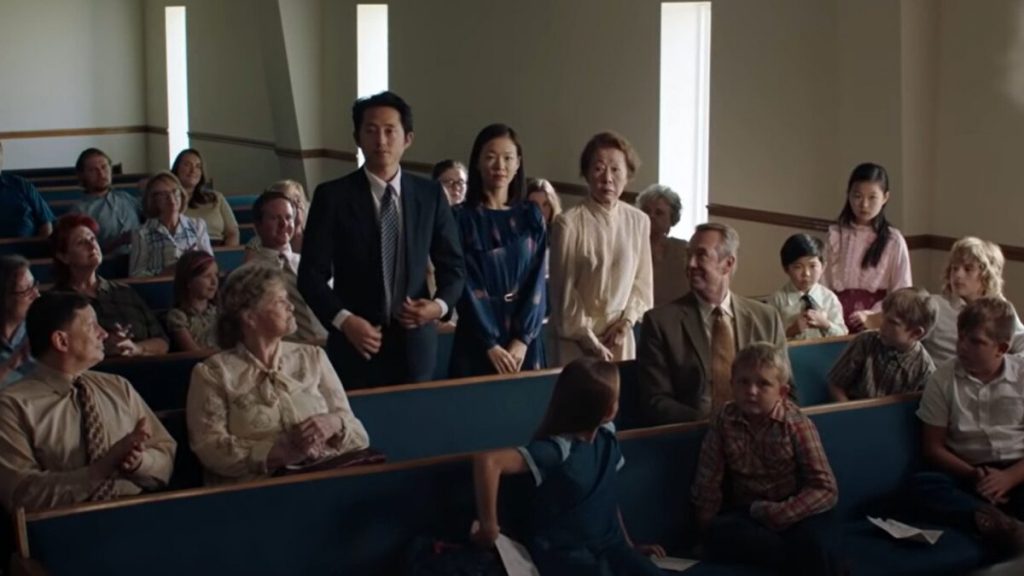
Despite the film’s depiction of an American family attempting to achieve the American dream, a central part of America’s identity, it is only eligible for the foreign-language category in the Golden Globes.
The Hollywood Foreign Press Association (HFPA) dictates that “any film with at least 50% of non-English dialogue goes into the foreign language category.” Films nominated for this category are typically from other countries.
A24 and Chung had no choice in this nomination, which gave rise to controversy regarding the film’s ineligibility for submission into other best picture categories.
Every Korean-American person I have talked to about their views on this film has shared a similar opinion: that they felt an unexplainable instant emotional connection to the characters and their story. This proves that Chung’s film realistically captured this universal sentiment of Korean-American immigrants, something that has never been done before in mainstream American cinema.
Maybe one day, the immigrant experience will be considered essentially American by mainstream media outlets and this will be reflected by prestigious film awards shows.
Many Korean-Americans deeply resonated with “Minari.” Although the film’s recent Golden Globes nomination does not indicate this, the immigrant story is undeniably central to America’s identity and should be presented as so in mainstream media.
Jacqueline Lee is an Entertainment Intern for the Winter 2021 quarter. She can be reached at jacqusl4@uci.edu.

Interested in becoming an intern or a contributing writer for the Entertainment section?
Contact us at entertainment@newuniversity.org!