

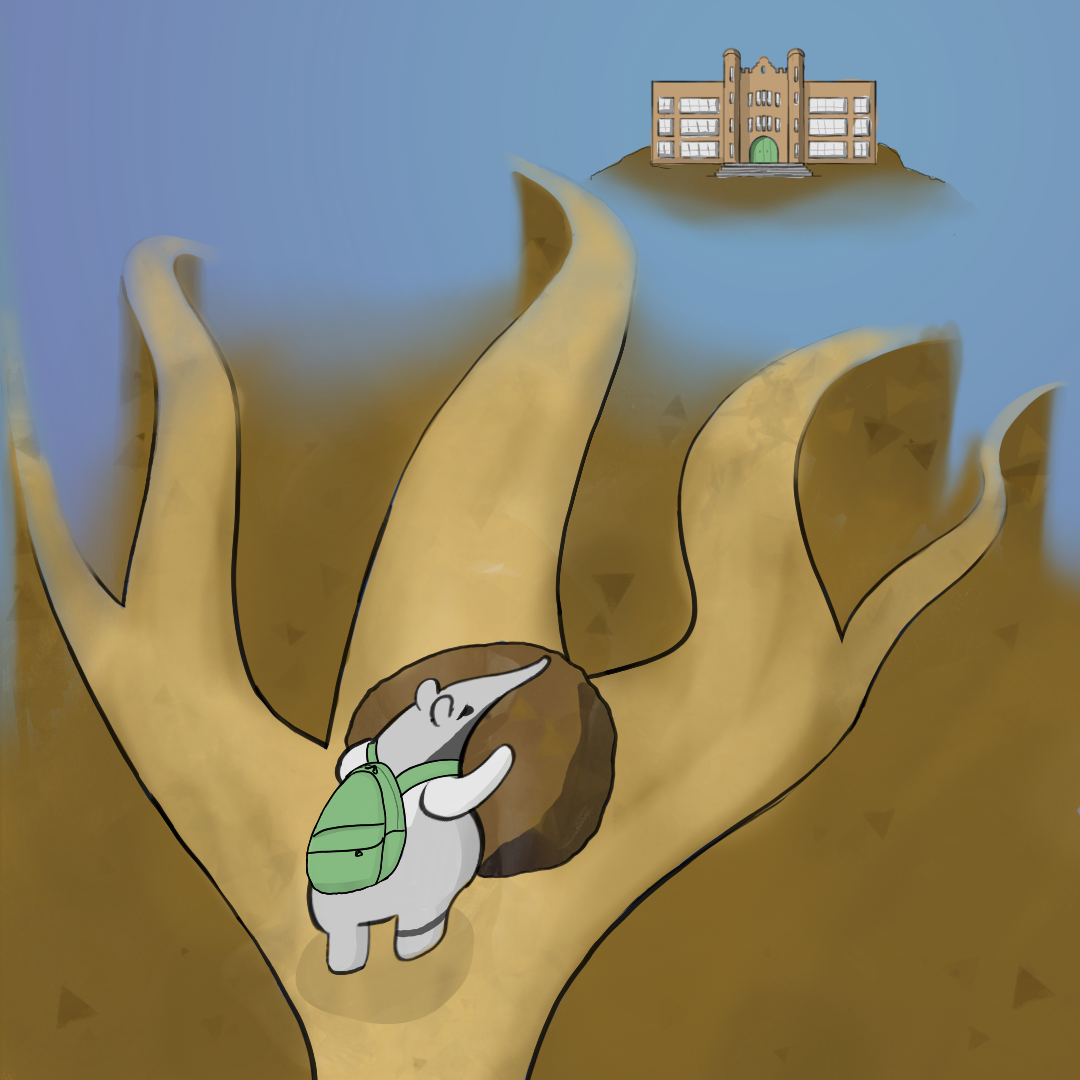

Albert Camus will often enter students’ lives incidentally through a classroom text or a casual recommendation.
Camus speaks to a stage of life when people are expected to explain themselves before they fully understand themselves. Students, especially those in late high school and early college, are constantly asked to justify their choices: Why this major? Why this path? Who are you becoming? Camus’ philosophy reveals that the desire for meaning can feel stronger than meaning itself, shaping how people explain their lives even when no final answer fully satisfies that desire.
The appeal is rarely about the claim that life lacks ultimate meaning — in fact, existentialism is something that Camus himself vehemently opposed to being labeled as. People walk away noticing how badly they want life to have meaning, and how that desire shapes almost everything they do. Camus withholds any final answer and makes questioning harder to escape, showing how the absence of resolution deepens the desire for meaning and shapes the way people experience their lives.
In “The Myth of Sisyphus,” he describes the concept of “absurdity” as the confrontation between a human longing for meaning and a world that offers no final answer. Sisyphus is punished by the gods to roll a massive boulder up a hill for eternity, only for it to fall back down each time he nears the top. The task has no final purpose, yet it continues, fully seen. The desire for meaning and explanation does not fade when it goes unmet. It remains, pressing itself against a reality that does not resolve it. Camus does not treat this desire as something that will eventually be satisfied, nor as something to eliminate. He insists on keeping both the intensity of the human need and the silence of the world in view at once. The absurd emerges from that ongoing tension. For students, this image can feel familiar with much of young adulthood organized around repeated effort through assignments, applications, decisions and explanations that are supposed to lead somewhere. This desire for an ultimate meaning to all the repetition does not fade when it goes unmet, but remains as a pressure against a reality that provides no resolution.
Camus questions the demand for meaning more in his novel “The Stranger.” The main character, Meursault, goes beyond being emotionally distant into disrupting something people rely on without realizing it. He attends his mother’s funeral with a kind of emotional flatness, entering into a casual relationship and eventually committing a seemingly senseless act of murder on a beach. He does not turn his experiences into a coherent story, and his trial becomes as much about his failure to explain himself properly as it is about what he has done. To those reading Meursault’s story, this detail lands because they know how often life is evaluated through explanation. Meaning isn’t just something people search for internally, but something that is expected of them. And when someone doesn’t provide it, everything feels off.
Many will often feel drawn to Camus when reading “The Stranger” or “The Myth of Sisyphus,” but not from fully understanding his philosophical arguments. The connection comes from recognizing a pattern they’ve already been living in. People have a constant need to explain their life choices and to have a reason ready when someone asks why they have chosen the life they have. Even when those explanations feel incomplete, the need to give them doesn’t go away.
For students, Camus feels especially close because life begins to require justification. Choices that often felt tentative start to acquire consequences, and uncertainty suddenly has to be concrete in its purposefulness. A personal decision becomes something others expect to understand. Under that pressure, the search for meaning becomes less abstract and more immediate. Camus captures the discomfort of having to make life sound coherent while still living through its unfinishedness. From this pressure, people frame their choices as part of some larger purpose.
Camus’ works suggest that freedom lies in recognizing the absence of ultimate meaning and continuing to live anyway. Sisyphus’ persistence and Meursault’s refusal to fabricate meaning reveal the same central tension in Camus’ work. Both figures show what it looks like to want meaning while never fully securing it.
That is what actually sticks with people. Yes, life does not have a clear, ultimate meaning, but with it comes another realization that the drive to find that meaning never really lets up. It keeps shaping how students explain themselves and how they justify their choices. And once they notice that, it’s hard to go back to thinking of meaning as something they either have or don’t have.
What lingers, then, is a shift in attention. The question of meaning remains, yet it no longer stands alone. Alongside it is an awareness of the constant pressure to ask that question in the first place. Camus stays with so many people because he makes that pressure feel visible without pretending it can be resolved. The search for meaning continues, but it carries a different weight. It becomes less about finding the perfect answer and more about recognizing why the need for an answer feels so powerful at all.
Jacqueline Lee is an Opinion Intern for the spring 2026 quarter. She can be reached at jacquhl3@uci.edu.
Edited by Riley Schnittger

