

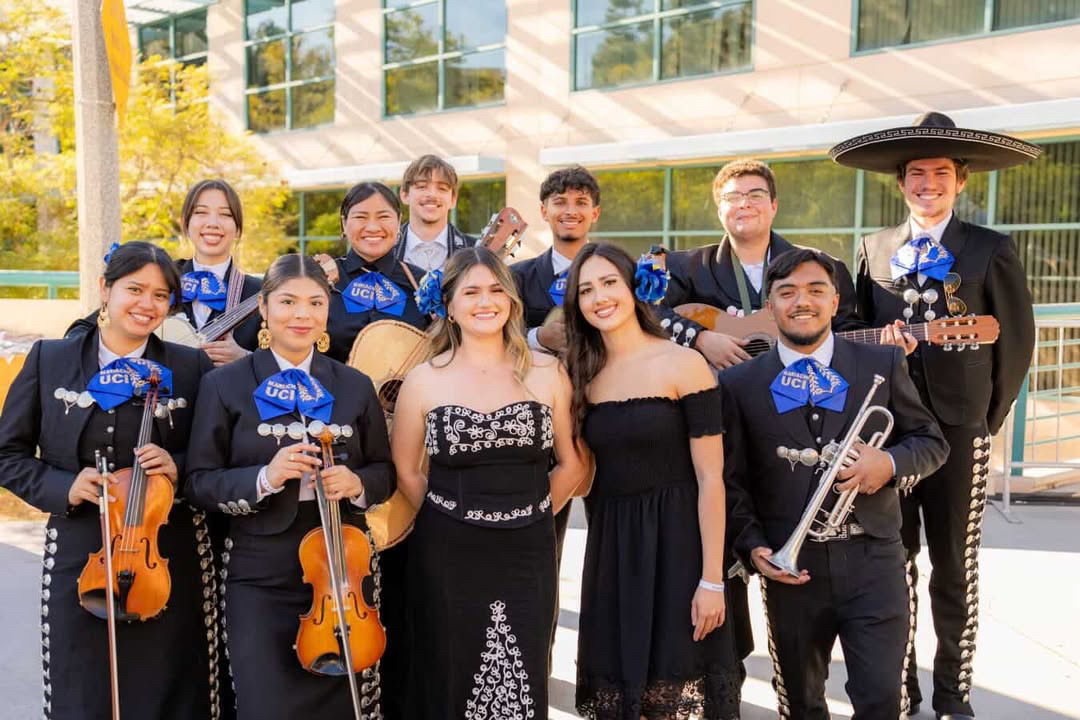

This past Valentine’s season, Mariachi Orgullo de UCI went viral. A single video promoting their serenatas — live musical performances delivered to someone’s home — received 1.3 million views on TikTok and 530,000 on Instagram Reels on Feb. 2. The group’s Instagram following also jumped from roughly 900 followers to nearly 9,500 within a few weeks.
As a result, the 15-member student ensemble — and UCI’s first mariachi group — spent the two weeks from Feb. 1 through Feb. 14 performing 79 serenatas across campus and neighboring cities — more than triple the 22 they managed last year.
On Valentine’s Day alone, they started playing at 7:30 a.m. and didn’t stop until 9 p.m.
Since then, the group has been gaining the attention of major news outlets such as ABC7, CALÓ News and Telemundo.
Mariachi Orgullo de UCI was founded in April 2024, born out of a Google Form and a flyer with a QR code.
Third-year history and psychological sciences major Teddy Douglas has been with the group since day one and is now its vice president.
As a first-year student in 2024, Douglas was looking to join a mariachi group. When his roommate mentioned seeing flyers around campus, he rushed outside, scanned the QR code on the Mariachi Orgullo flyer and the rest, as he put it, is history.
Of the roughly 12 student musicians who responded to the flyer, only some had experience with mariachi music. Douglas had none. Classically trained as a jazz musician through high school, he had never performed mariachi before, but he had given it thought.
“I was raised in a household that did not necessarily celebrate its cultural side as much as I think it could have,” Douglas told New University. “I did not grow up speaking Spanish.”
Mariachi, he decided, was his way to explore something that had always been just out of reach.
Second-year mechanical engineering major and treasurer Giovanni Ponce-Lucatero found his way to mariachi by accident.
Ponce-Lucatero picked up the trumpet in fifth grade and spent the next nine years playing jazz and concert music.
When he arrived at UCI, he was looking for a jazz club. Ponce-Lucatero walked up to Mariachi Orgullo’s booth at Anteater Involvement Fair (AIF) to ask if they knew of any ways to get involved with jazz.
Douglas, who had been in a similar position his first year, told Ponce-Lucatero that the only real option was to audition for an ensemble and that the deadline had already passed.
“I was like, ‘Oh, I missed my opportunity,’ but while saying that, I kind of realized the whole reason I chose to play trumpet when I was in fifth grade was because I would hear a lot of mariachi music or salsa around the house,” Ponce-Lucatero told New University.
He filled out Mariachi Orgullo de UCI’s interest form that afternoon.
For both Douglas and Ponce-Lucatero, the appeal of the group goes beyond the music. UCI’s student body is majority Asian, despite Southern California’s large Latino population — a reality that makes moments of Latino cultural visibility feel more charged.
The group’s popularity, Douglas said, comes down to a combination of talented, experienced musicians and the kind of exposure that most collegiate mariachi groups never get.
As brutal and stressful as the Valentine’s season was for the group, they expressed gratitude for being able to share Latino culture with the UCI community.
Running the group is equal parts passion and logistics. The group raises money through campus fundraisers, boothing on Ring Road and booking performances. They’ve played at UCI’s Hispanic Heritage Month and Día de los Muertos events, selling baskets of Mexican candy and marigolds, and most recently appeared on UCI’s Homecoming stage.
“It’s special that UCI wants to include us wherever they can, because it further establishes our authority as a UCI student group and as a UCI cultural group. It’s really nice that UCI is paying attention to us,” Ponce-Lucatero said.
Outside of those events, by far the biggest contributor to the group’s success has been their serenatas.
Last year, the group performed serenatas for Valentine’s Day in partnership with Movimiento Estudiantil Chicanx de Aztlan (MEChA), which sold bouquets. However, this year, Mariachi Orgullo included bouquets in its serenata package.
Customers had a two-week window to book Valentine’s serenatas through a scheduling page on the group’s Instagram, choosing from classic mariachi songs and bouquet options before confirming a performance.
One song cost $40, two cost $70 and up to five songs cost $100. Performances last anywhere from four to 20 minutes. Those prices, Ponce-Lucatero said, are bound to change due to increased popularity and demand.
For on-campus performances, most of the group walks, scooters or buses over. For off-campus performances, the group does their best to carpool in as few cars as possible and reimburse each other for gas money. The group has played in places as far as Yorba Linda and Mission Viejo.
Without funding from the university, the group had to forge its own path and make the most with what they have. The biggest challenge remains that students must provide their own instruments and cover the cost of their trajes — the iconic mariachi uniforms.
On average, trajes can run from $600 to $1,000 apiece at shops in Santa Ana or Los Angeles. Most members bought their own, but not all members can afford them.
Thanks to its recent Valentine’s success, the group recently purchased two $400 suits for those who couldn’t buy their own. However, in order to get those suits, they had to travel to a well-respected place in Tijuana, Mexico that would give them a more feasible deal.
Another challenge the group has faced was finding someone to play the guitarrón — one of the more obscure instruments to recruit for in the mariachi lineup. Luckily, one member volunteered to learn the instrument from scratch, and the group used its own funds to buy her the instrument.
Several members graduate in the next year, making recruitment now one of Mariachi Orgullo’s top priorities. The group is currently seeking players of violin, vihuela, guitarrón, trumpet and harp, as well as male vocalists.
“We’re always open to talent from any background,” Ponce-Lucatero said, pointing out that you don’t have to be of Mexican or Latino descent to join the group.
Interested students have until March 22 to submit an interest form. From there, the group provides audition music, gives applicants roughly two weeks to prepare and asks them to submit an audition tape. More information and the interest form are available through their Instagram.
If the past two years are any indication, whoever walks through that door next is getting in on something special at UCI.
“We haven’t even been established for two years,” Douglas said. The best, it seems, is still yet to come for Mariachi Orgullo de UCI.
Mya Romero is a Features Intern for the winter 2026 quarter. She can be reached at myajr@uci.edu.
Edited by Avery Rosas and Kailee Kim

