

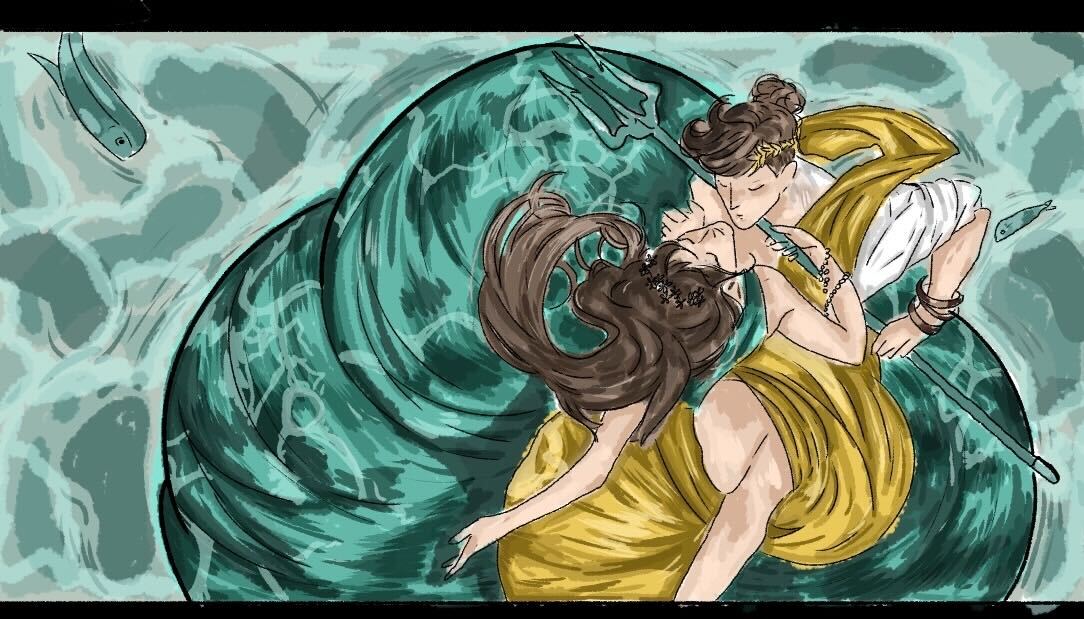

Editor’s Note: This article was edited on April 6, 2026 to include a new graphic. This article contains spoilers for “The Trident and the Pearl.”
Sarah K. L. Wilson’s debut romantasy novel, “The Trident and the Pearl,” hit shelves on Feb. 24, filled with tension, revenge plots and twists no one could have seen coming.
The story followed protagonist Queen Coralys of the Crocus Isles, who began the novel praying to the gods for the first time in her life when her islands were destroyed by a devastating hurricane that killed her husband. To save her island, the gods decried that she must marry the first man to set foot on the docks, leave her life as queen and live with her new husband. Coralys agreed, marrying a mysterious fisherman and became set on seeking revenge on the god of the sea, Okeanos, for all that he took from her. With her new husband, who also seems to have enemies of his own, the two must find a way to navigate their new marriage with their combined baggage of secrets in tow for the war on the horizon.
“The Trident and the Pearl” was not a terrible book. The story was quite descriptive, providing good imagery on the locations, how characters looked and deep description of how Coralys felt every instance. In that regard, the writing was distinct and gave readers a chance to truly imagine every aspect of the book.
Though the book could’ve been a hit, a reprieve from the typical faeries and fae stories overrunning the fantasy genre, the execution of its plot wasn’t there at all. Issues with character development, world-building, the story’s predictability and more led to a mediocre novel that failed to bring the whimsical feeling of the fantasy genre.
Coralys was one of the worst things about this book, which isn’t said lightly. She was first described as a powerful queen who makes good decisions on behalf of her nation and people, as seen from the very beginning when she agreed to marry to save her people; however, any good decisions ended there.
Throughout the entirety of the story, Coralys made terrible decisions, lacked common sense and actively allowed herself to be betrayed and manipulated. She trusted obviously bad characters and was surprised when they eventually betrayed her, despite stating she shouldn’t trust them upon meeting them. Coralys was blinded by her vengeance, and wound up doing more harm than good. It was upsetting for a genre that in the last several years has produced powerful, brave, intelligent and inspiring female characters who challenged the worlds they lived in to have a book like “The Trident and the Pearl” come into the mix.
Additionally, the fisherman who married Coralys turned out to be the god of sea, Okeanos, who was blamed for the hurricane storm that destroyed the Crocus Isles and killed Coralys’ first husband. Despite this, he deserved none of the bad things that continuously happened to him. From the get-go, he was a sweet, loveable character who was kind to Coralys and a dreamer of an impossible safe haven for his people. He didn’t deserve how badly Coralys treated him because of the secrets he kept, especially since he just showed up to help her. He treated her with patience and grace, yet she betrayed him in the end, making several bad decisions that ended up hurting him. Compared to Coralys, Okeanos was the only enjoyable character in the entire book.
Another issue with the book was that it stayed in the same location for nearly the entire plot. There were times when the characters traveled to one place or another, but travel stayed within the same two or three locations the entire time. As the characters of the book went nowhere, neither did the plot, as the stagnant scenery made “The Trident and the Pearl” seem as if nothing of importance happened. The second major plot point, when Coralys murdered Okeanos, didn’t happen until the book moved to an entirely different location, before only staying for a few chapters and swiftly moved back to Okeanos’ island. The lack of movement was infuriating as the novel lacked major world-building and became sluggish, creating a book that eventually lost readers’ interest.
Poor world-building was not only seen in the lack of setting in “The Trident and the Pearl,” but also in its lack of details. There was an order to the magic and system of the gods, but the book never went into further detail beyond throwaway points that were barely brought up. There was some world-building regarding the gods’ territories and relationships, but there was never enough context about the gods other than that they were powerful and greedy. This trope was too repetitive from other fantasy novels, and was not brought up until halfway through the book to conveniently tie up plot holes throughout.
While some of the writing was well-done and used lots of imagery, the other half was, again, slow. Many of the scenes were confusing, focusing too much on creating pretty writing rather than a consistent narrative. The last four chapters were confusing, and it was unclear what the actual ending was and what decisions were being made. The final chapters go back and forth, making it seem as if one thing is happening, before being suddenly retracted and rehashed by the author. The ending happened in the same place as the rest of the book, went over the same plot point multiple times and concluded with no way of knowing what could’ve possibly happened.
“The Trident and the Pearl” began as a seemingly great idea as it appears quite interesting at first glance, with some very strong plot devices and an overall unique story. However, the execution is horrible — crafting a slow book with an annoying main character, poor world-building and little notable romance, aside from the occasional longing look. There are much better fantasy books to look out for, and this did not shape up to be one of them.
Jocelyn Cosgrove is an Arts & Entertainment Staff Writer. She can be reached at jmcosgro@uci.edu.
Edited by Corinna Chin

