

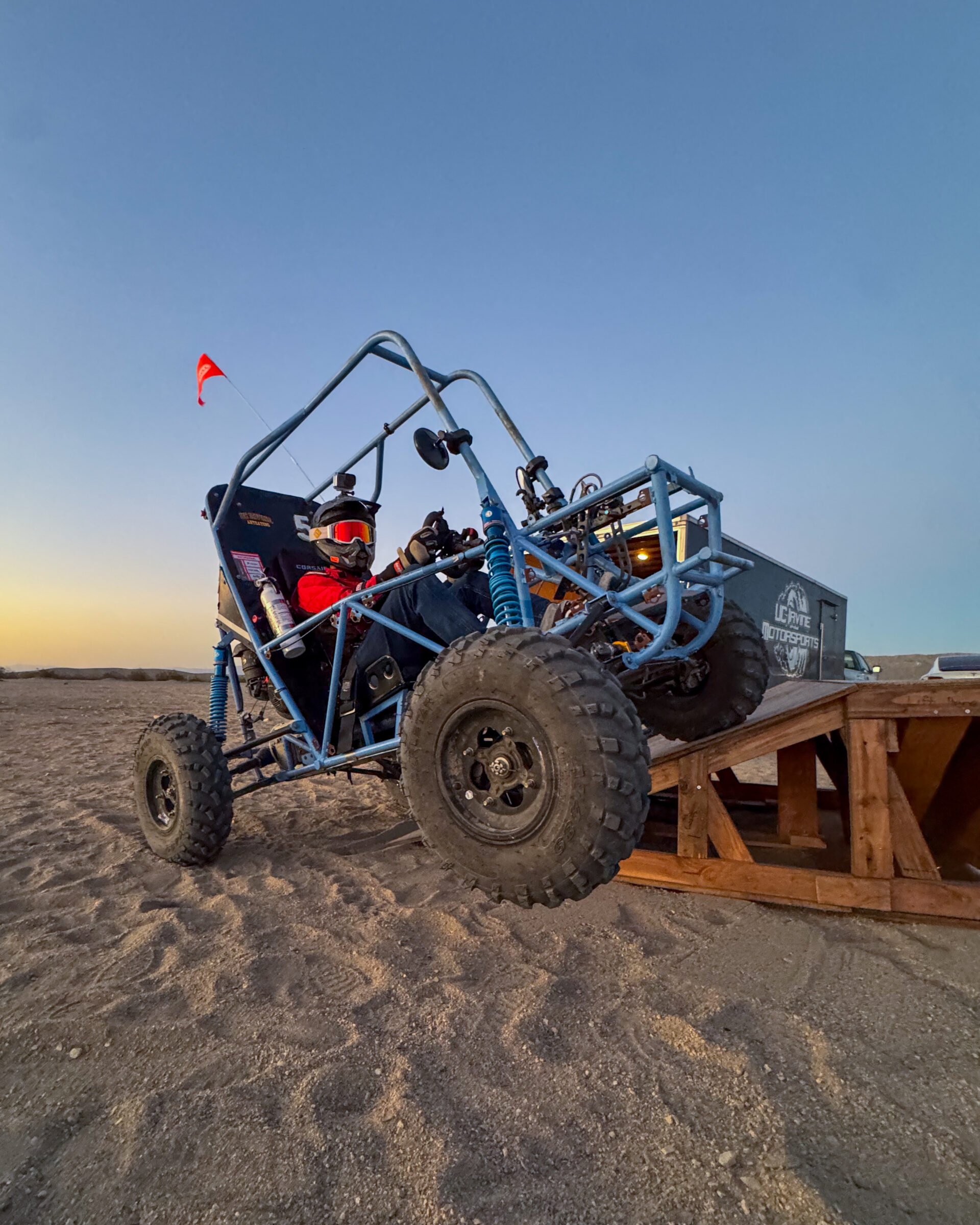

Every year, collegiate engineering teams from across the country design, build and race off-road vehicles as part of the SAE International’s Baja competition. UC Irvine’s team, Anteater Baja Racing, will compete in Oregon from May 7–10 with a custom-built vehicle.
Anteater Baja Racing is composed of multiple subteams, each responsible for a major system of the vehicle: chassis and human interface, suspension and steering, powertrain, braking and project management.
Together, the subteams work to produce a fully functional car that meets competition standards and performs reliably in off-road conditions.
Fourth-year mechanical engineering student Maeve Fishman serves as a chassis and human interface engineer on the team. Her role focuses on designing the car’s structural frame while considering how the driver interacts with the vehicle.
“Every piece of the car gets attached to the chassis in some way, and so it’s kind of the structure of the car, and it also needs to be able to withstand having all that stuff on it and be able to keep the driver and everything safe,” Fishman told New University.
This work includes decisions about steering wheel placement, seat design and overall comfort based on driver feedback during testing. These considerations are especially important in Baja Racing, where drivers must navigate uneven terrain for extended periods of time.
In addition to technical responsibilities, Fishman said Baja Racing provides opportunities to apply classroom concepts in ways traditional coursework doesn’t always allow.
“I was welding yesterday, and I was learning from someone else who has more welding experience,” Fishman said. “It’s basically just taking everything that you learned in your classes for engineering and putting it under a microscope in a specific situation and seeing how we apply it.”
Fishman also emphasized the team’s collaborative culture, noting that students are encouraged to ask questions and learn from one another across subteams.
“I’ll be like, ‘What is this?’ and it might be a super obvious question to them, but I never feel dumb for asking any of them,” Fishman said. “There’s a lot of opportunity to work and do what you’re interested in.”
Beyond the chassis, other subteams focus on systems that determine how the vehicle moves and handles off-road conditions.
Fourth-year mechanical engineering student Julia McWilliams serves as both a suspension engineer and a project manager.
As a suspension engineer, McWilliams works on the system that connects the vehicle’s frame to its wheels. Suspension design starts by analyzing how the wheel behaves at three key points: when the car is sitting normally on the ground, when the suspension is compressed and when the suspension is fully extended.
Because the wheels are constantly moving during a race, the suspension has to function properly in all three positions. According to McWilliams, even a fraction of an inch of misalignment can heavily impact a car’s performance like how sharply the car turns, how stable it feels and how much impact the driver experiences when going over rough terrain.
Design work begins with simple digital sketches that allow engineers to adjust many variables at once. While some measurements work well on their own, they can’t always be optimized at the same time, so improving one aspect of the suspensions often means compromising another. Teams are forced to weigh these trade-offs carefully to find the best overall balance.
Once those decisions are made, the sketches are turned into detailed digital models that show the full suspension system. From there, the team builds a small prototype to test one side of the car and the engineers check that everything fits and moves as intended.
McWilliams explained that, even after careful modeling, some issues only appear when parts are physically built and assembled.
“Even though you think there’s no interference, [there] can still be interference in real life. So, once we build our prototype and verify that there’s no inferences and everything works properly, then we build the full assembly and then we integrate it onto our chassis,” McWilliams said.
As project manager, McWilliams works alongside two other project managers to keep the team organized and handle scheduling, budgeting and coordination between subteams.
Part of McWilliams’ role involves preparing the competition’s business presentation, a required component of the Baja Racing competition that evaluates teams beyond their technical designs.
Each year, teams are given a prompt and asked to pitch their vehicle to meet a hypothetical client’s needs. This year’s scenario focused on designing an off-road vehicle for a company managing a large resort property.
Separate from the business presentation, the team is also responsible for securing its own funding. Anteater Baja Racing raises money through sponsorships, donations through ZotFunder — which brought in $6,390 this year — and grants.
With support from roughly 20 sponsors, contributions range from direct financial support to part or machining services, which help offset the high costs of building the vehicle and preparing it for competition.
With the competition in May approaching, the team is continuing to test and refine their car ahead of the race in Oregon. Second-year environmental engineering student Aman Rampure explained that the team typically tests their vehicle two to three times a month.
As a testing and operations engineer, Rampure said most test sessions take place in Lot 16H behind the Biological Sciences buildings, where the team runs acceleration, braking and handling drills.
When possible, the team also travels about two hours inland to the Stoddard Valley Off-Highway Vehicle Area in Barstow to test the car on more rugged terrain.
“When we do go to the desert, it’s an all-day thing,” Rampure said. “We’re trying to replicate competition scenarios with acceleration and brake testing as well as dynamic testing, [such as] car pulls, hill climbs and handling events. We try to push our car to its limits to make sure it doesn’t fail in competition, but also push our drivers to make sure they’re ready for anything.”
While preparation intensifies in the months leading up to the competition, the team is also looking ahead to its next build. Anteater Baja Racing accepts new members each spring, opening applications to students interested in gaining hands-on engineering experience with or without prior automotive knowledge. Forms are posted to the organization’s website and Instagram.
Mya Romero is a Features Intern for the winter 2026 quarter. She can be reached at myajr@uci.edu.
Edited by Avery Rosas, Joshua Gonzales

