

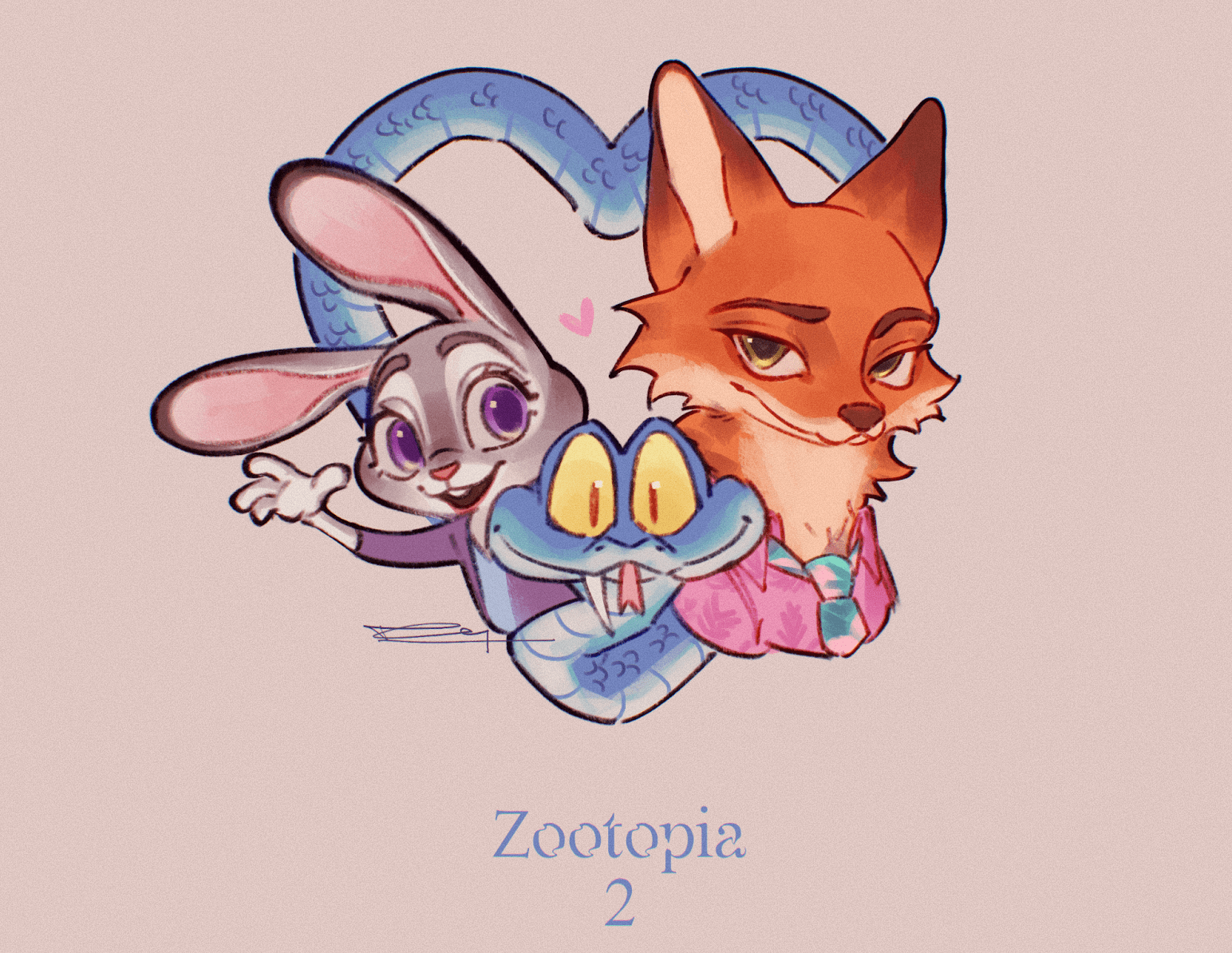

Beloved anthropomorphic bunny and fox cop duo Judy Hopps and Nick Wilde returned to theaters with the release of “Zootopia 2” on Nov. 26. For the first time in nine years, audiences tuned in for another twisty — albeit not-so-arguably identical to the first — crime adventure.
The movie kicks off right where the first ended. Hopps and Wilde, now officially Zootopia Police Department (ZPD) partners, make a turbulent pair, which bleeds into their work as they attempt to bust an anteater’s smuggling ring. After a humorous ZPD-sponsored partner therapy session scene, Hopps schemes to infiltrate the Zootenial Gala upon reasonable suspicion that a snake may be present. Snakes are shunned creatures within Zootopia’s society.
In typical Zootopia fashion, Hopps and Wilde get tangled up in a web of events that force them into getting up close and personal with Zootopia’s criminal underworld. The main antagonists are the Lynxley family, who are descendants of the so-called founder of Zootopia, Ebenezer Lynxley. Because of a misunderstanding that paints them as criminals, Hopps and Wilde spend a good portion of the movie as fugitives. They are in pursuit of a viper named Gary De’Snake, who stole a journal at the gala. On their journey, they begin to uncover a larger conspiracy at play — one that is embedded in both Zootopia’s oppression of reptiles and the founding of the city itself.
Hopps and Wild’s relationship is a subplot that is a powerful undercurrent amid all the action. Hopps — a headstrong idealist — naturally butts heads with Wilde, who leans more pragmatic and cynical. The tension between them bubbles over while they are climbing a mountain to reach a lodge in search of evidence concerning snakes in Zootopia. At the climax of their spat, the carrot pen Hopps gifted Wilde — symbolic of their partnership — falls from the mountain and breaks open.
It is heart-wrenching to witness their mutual expression of initial surprise and the moment when Hopps continues her trek up the mountain in resignation. In this moment, the widening fissure between the pair is as tangible as the fractured pen at the foot of the mountain. The specter that haunts their partnership finally comes to a dramatic head; they are irreconcilably different.
Soon after, they are separated when Wilde is arrested, though he escapes with Nibbles Maplestick, a beaver they met earlier. Hopps falls into league with De’Snake and Pawbert Lynxley, a purportedly “nice” Lynxley.
Eventually, Hopps discovers the truth at the heart of the conspiracy: The true founder of Zootopia is Agnes De’Snake, Gary De’Snake’s predecessor. However, the Lynxleys took the credit through a series of blood-soaked schemes that put them at the top and reptiles at the bottom.
At this point, the plot of the movie begins to appear indistinguishable from the first, save for different characters. Pawbert Lynxley is the Dawn Bellweather of “Zootopia 2,” double-crossing Hopps and leading to a final two-versus-one fight between the bunny-fox duo and the betrayer.
However, it is rewarding to see Hopps and Wilde put aside their differences. In a tear-inducing scene, Wilde concedes that Hopps is the best thing that has ever happened to him, and Hopps says that no one matters more to her than him. This alone almost makes up for the recycled plot.
This familiar plot structure continues when the pair, this time with rejuvenated morale, tie up the loose ends of their quest. Good prevails as conspiracies are exposed and wrongs are righted. The truth of Zootopia’s founding comes out, justice is served and reptiles are reintegrated into society.
If audience members were still bummed about the carrot pen, that was fixed too. However, the button-activated recording inside is replaced with a sweeter message, in which Wilde states that he loves Hopps.
While “Zootopia 2” was an entertaining watch, it is distractingly similar to the first movie, which did the same thing but arguably better. Sequels do tend to have trouble living up to their predecessors. Because of this, it may not have been the ideal choice for the filmmakers to follow the plotline of the first movie this closely. Despite this, it is worthwhile to see further development of Hopps and Wilde’s dynamic.
The post-credits scene features a feather falling next to Hopps’ carrot pen. It is a safe bet that this foreshadows the third installment in the Zootopia universe: Birds are oppressed, and Hopps and Wilde become fugitives during their investigation. If the redundancy has reached this point, producers might as well recycle Awkwafina as a voice actress for a quirky animal character, too. The duo gets into a dramatic argument over their personality differences. The awkward underdog character betrays them. Hopps and Wilde reconcile and the truth is exposed.
Nonetheless, the “Zootopia” franchise is uplifting, with themes that tackle oppression in ways that are accessible to its central audience — kids. While it makes these themes accessible, there has been valid criticism that its use of animals and the predator-and-prey analogy comes off as wincingly sloppy and derivative of real-world racism, which is important to keep in mind while digesting this media.
While the analogy is a weak spot of “Zootopia” to be wary of, and one that should continue to be discussed, “Zootopia 2” handles other aspects well. For instance, it contains scenes that are disarmingly poignant for all, with the world of Zootopia being colorful and full of heart, and the multidimensional Hopps and Wilde having great chemistry as a crime-fighting pair.
Tessa Kang is an Arts & Entertainment Staff Writer. She can be reached at tokang@uci.edu.
Edited by Kailee Kim

