


“[In 2012,] the foundation of engineering here at UCI was theoretical,” Edward Lau, a lab manager at the Henry Samueli School of Engineering, told New University.
Lau stated that a contemporary nationwide emphasis on theoretical engineering led to an observed decline in the retention of engineering undergraduates. Responding to this concern, UCI introduced “Engineering 7a and 7b,” or “Introduction to Engineering I and II,” in 2012.
“Introduction to Engineering I and II” introduces “engineering disciplines and the design process,” as the catalogue describes. Both count for two credits annually in the fall and winter quarters.
Each part of the series consists of a single design project. During this fall quarter, Engineering 7a students will construct a functioning, remote-controlled rover.
“All they are provided is, you know, the wheels, the motors, the gears. They have to build, design and test a chassis, [a steering] that works for them, you know, size tires they’re going to use,” lab manager Jacob Chutney told New University. “For the final course, it’s got to be able to go up an incline, go over bumps, so they got to — they got to worry about clearance, things like that.”
There are no prerequisite courses, though the course is restricted to engineering majors. The elective was built to offer incoming engineering students an early experience with a practical engineering project.
Lab managers Lau and Chutney introduce students to many practical aspects of engineering.
“A lot of students that take this Engineering 7 class have never really touched a power tool or a bandsaw or sanders, belt sanders, things like that, where Ed [Lau] and I, during one of the weeks of class, give detailed instruction of how to use each tool, each machine,” Chutney said.
In the program’s early years, students built quadcopters and hovercraft, Lau recalled, but switched to the current RC rovers five years ago. The simpler design allowed for students to focus on the underlying principles which facilitated remote learning conditions.
Chutney displayed an example of a finished rover.
“This may not look like much, but it was engineered,” Chutney said.
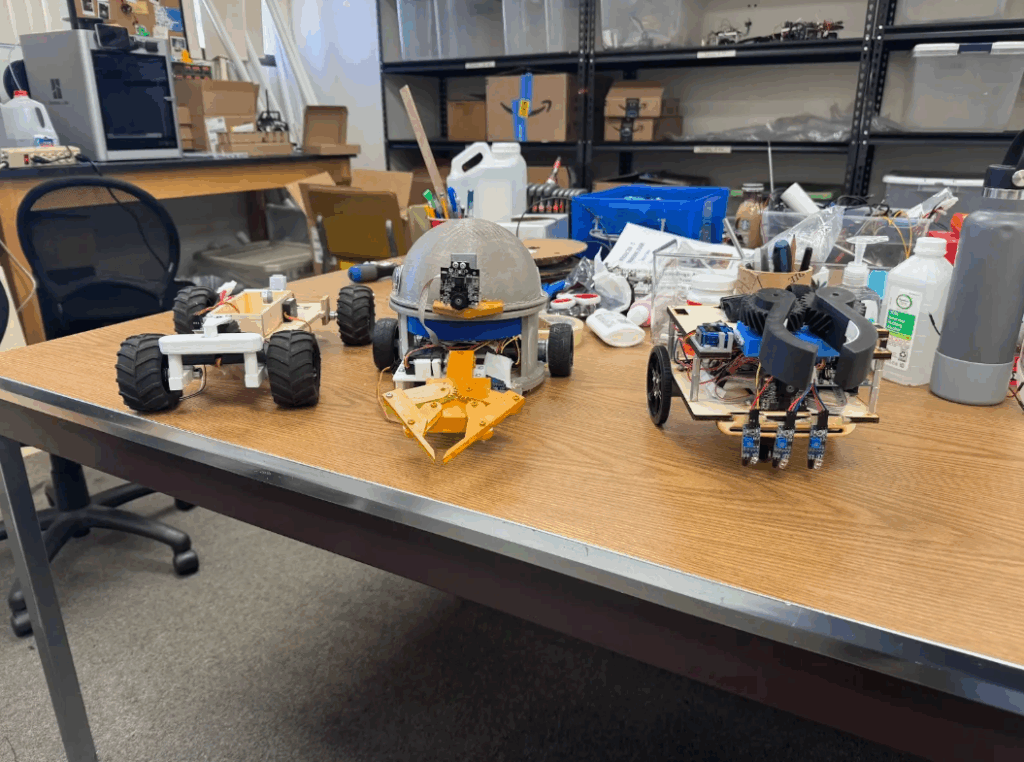
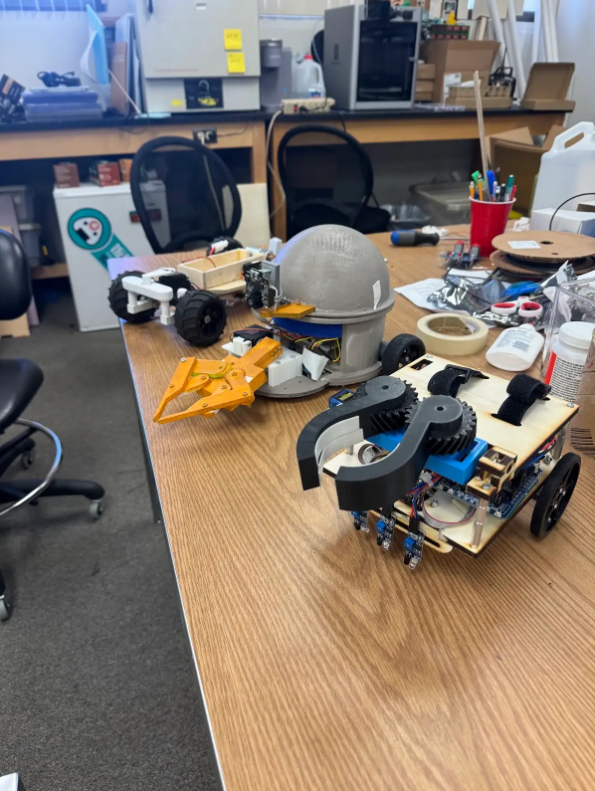
Photo(s) provided by Jacob Chutney | Henry Samueli School of Engineering
The elective has proved popular in the engineering department, both managers affirmed, reviving greater student interest in design projects. “Engineering 7a” has 384 seats in the fall 2025 Schedule of Classes — a marked increase from the steady 240 of the previous three years.
“Bottom line is since the start of this program, retention of students has most definitely increased. Engineering students stay engineering students, and their ability to navigate and solving problems and how it relates to them getting employment, there’s a direct correlation,” Lau said.
“Engineering 7a” leads into the following 7b, as students’ interest in the course series factor into a high follow-through rate.
“We rarely have students that don’t take both quarters of the class,” Lau said.
During 7b, students develop autonomous rovers, building off of their experiences in 7a.
“Now [in 7b], they’re going to get different components, things that are programmable. Now we’re getting into the computer side of it, electrical side of it. Where [the rover] now doesn’t have a remote,” Chutney said.
Students have to program their rover to navigate a final course that ends with the rover grabbing a red cup. The autonomous rover project invites students to work creatively on a design and challenges them to overcome more advanced engineering problems, according to Chutney.
“Engineering 7b” also includes alternative options for students, such as developing a fitness tracker or a lab-on-a-chip.
The courses place a large emphasis on collaboration, which the lab managers consider a notable benefit. Both quarter-long projects are conducted in small groups, pushing students to learn to work as a team in overcoming engineering challenges.
According to Chutney, Engineering 7 also generates early student interest in other engineering design projects, such as the UCI Rocket Project or UCI’s Race Car Engineering Projects.
“It’s not just facing books, facing computers 24/7. They have something they have an outlet to
practice these engineering theories on something real that’s not just an idea anymore,” Lau said.
John Trytten is a Features Intern for the summer 2025 quarter. He can be reached at tryttenj@uci.edu.
Edited by Alyssa Villagonzalo and Annabelle Aguirre