

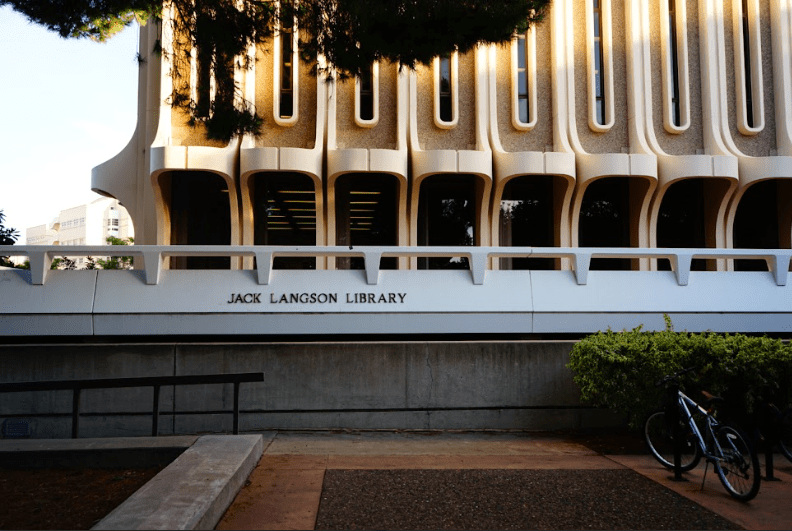

The main floor of Langson Library currently hosts an exhibition celebrating the 60th anniversary of UC Irvine. Scans and copies of significant documents appear in the commemorative exhibition; the historic originals are housed just three floors above.
The fifth floor of Langson Library hosts the main office and reading room of UCI’s Special Collections & Archives. Open by appointment to any researcher, the archives contain a trove of materials for preservation, reference and consultation.
“Our mission is to preserve, so ensure the long-term care of materials, and also share materials for the benefit of the UCI community and also broader local communities and our researchers,” Rare Books and Special Collections Librarian Anastasia Armendariz told New University.
Most of the archive’s materials come from broad-ranging donations rather than specific purchases.
“That can mean everything from paper-based files, to books, to born-digital media, photographs, diaries, newspapers from the campus communities and beyond,” Armendariz said.
Almost any format that can be preserved can be found in the archives.
“There’s films, videos, lots of photos, even images of, like, three-dimensional objects and ephemera,” Armendariz said, “which are materials that weren’t made to last, but people have collected, so, like, tickets, postcards, those kind of things.”
The Special Collections & Archives dates back to the university’s founding in 1965 and has expanded organically over the intervening 60 years that the main-floor exhibit currently celebrates.
“It was oftentimes faculty members or librarians who were like, ‘I have all these flyers that students have posted. Would [the archives] be interested in these?’” Armendariz said. “Perhaps a faculty member is retiring, and they have all their papers and research, and it’s like, ‘Oh, maybe other people in that field will want to refer to that.’”
Armendariz said that one of her main responsibilities as a rare books librarian is curatorial work.
“We monitor for environmental controls; unlike the kind of general circulating stacks, a lot of the materials we care for are either old, or perhaps if not old, might be more unique, or there’s fewer of them or they might be made of more fragile materials,” Armendariz said.
Besides curating and expanding the special collections, Armendariz assists researchers — a core part of her work.
“Researchers can be anyone from a first-year undergrad at UCI, to our faculty, to an aunt or uncle in the community nearby, to long-tenured researchers who might be coming in from overseas to review materials,” Armendariz said.
The archives are open to anyone and contain materials of relevance to almost any field, Armendariz said. She walked through a variety of hypothetical projects and materials that might bring undergraduate students from different schools to the archives.
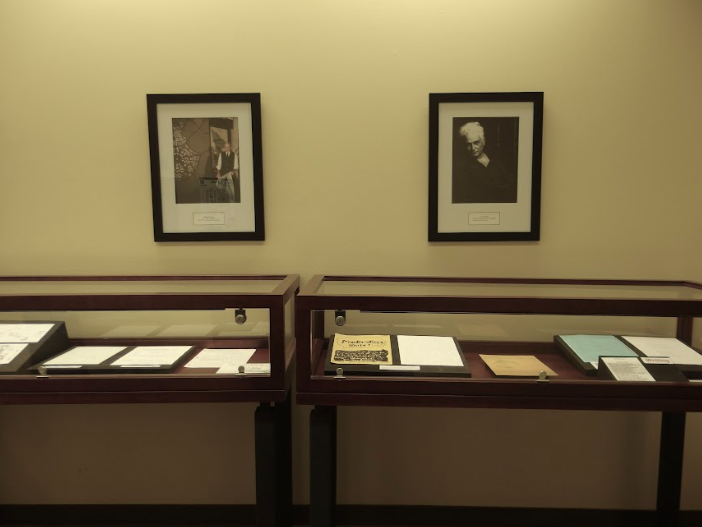
The archives have a history of working with the Humanities Core program and offer primary sources for students working on research projects such as consulting the first edition of a novel or reading historical letters, Armendariz said.
Archives aren’t just for the humanities, though; Armendariz elaborated on various points of interest for STEM majors.
“You’ll probably recognize some of these names from building names, but — Rowland or Reines — those are Nobel Prize-winning faculty members who have given their papers in the sciences [to the archives], including even Nobel Prize medals,” Armendariz said. “If you ever want to say, like, ‘I held a Nobel Prize,’ we’re down for that experience.”
The donated papers include the scientists’ personal notes, course slides and published material.
For pre-med students, Armendariz cited histories of anatomy and various papers from doctors and physicians exploring the nature of the field.
On the topic of the arts, Armendariz mentioned faculty papers, dance and performing arts collections, though the librarian’s self-professed favorite entries were the collections’ artist books.
“If you haven’t heard that term, artist books kind of sit between, like, you know, the book with pages that you open and more of an art object,” Armendariz said. “We have an artist book called ‘Mixed Messages’ that is literally made out of eggshells, and the artist printed, like, love letters from different lovers on it, to comment on the fragility of relationships.”
Though requests for material should be submitted two days in advance, Armendariz said that librarians and archivists are always able to assist students with the research process and guide them through navigating the archives.
Operating hours for the rest of the summer are subject to change. With more donated materials constantly entering the archives, certain collections will be relocated during the summer to a space in the Science Library. All schedule impacts will be noted on the Special Collections & Archives website as they occur.
In parting, Armendariz encouraged researchers to experiment with the archives, suggesting once more that they contain materials for every field of interest.
“The examples I gave are just not even a drop in the bucket of what we cover, and you can also always email us if you’re like, ‘I read this piece and I don’t know where to go, but I’m curious,’” Armendariz said.
Students can find more information on the UCI Libraries website and the Special Collections & Archives webpage.
“It can be fun to explore and just be surprised by what you might find,” Armendariz said.
John Trytten is a Features Intern for the summer 2025 quarter. He can be reached at tryttenj@uci.edu.
Edited by Peyton Arthur, Kailee Kim and Joshua Gonzales

