

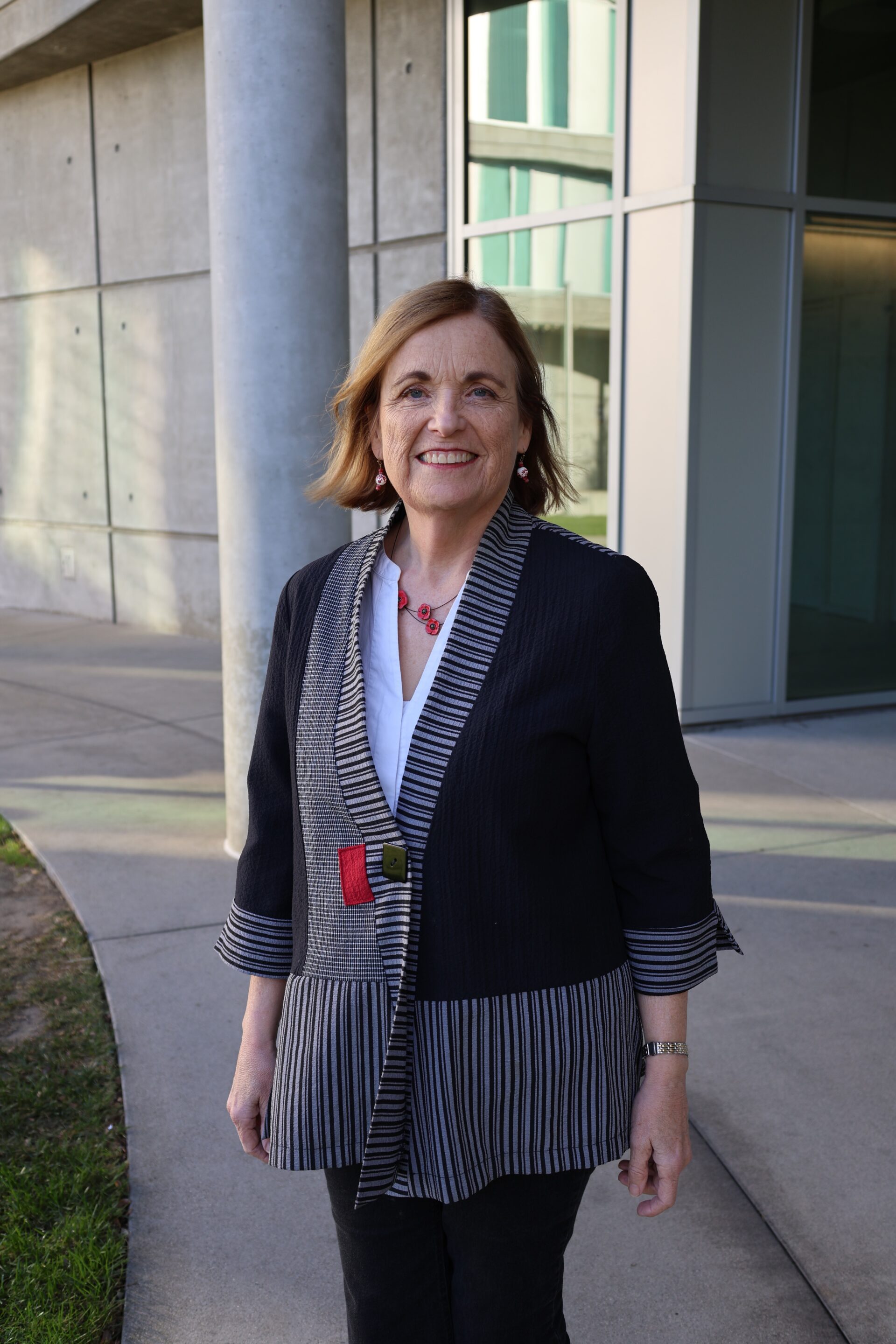

For Laura O’Connor, retiring and moving out of her office at 144 Murray Krieger Hall means dealing with the large collection of books she’s amassed over her 28 years as an associate professor of English at UC Irvine. Among conference posters, art prints and knick knacks like her little piece of bog oak, O’Connor has a case that offers books for anyone to take as they leave.
O’Connor said pruning down her collection has been difficult.
“Your books are part of you,” O’Connor told New University. “Having to kind of shut up a library feels different than shutting up a lab. And I think many people find that hard.”
Originally from Ireland, O’Connor taught a number of courses on Irish literature, poetry and literature of partition. She started working at UCI after obtaining her Ph.D. at Columbia University, where she studied from 1990 to 1997.
Her time there helped her connect with graduate students at the start of her career. Connecting with undergraduates was more difficult, as O’Connor’s undergraduate years at St. Patrick’s College of Education entailed a very different experience than UCI.
“It was more of a learning curve for undergrads, and that was partly because not only had I, well, at the college I went to — which was a college of education — everybody there was kind of being, quote, unquote, trained to be a teacher,” O’Connor said. “It was just a very different subculture.”
To her surprise, O’Connor said it was her identity as a first-generation student that helped her connect with students.
“Initially, I thought, well, I can’t really help students navigate this culture because I can hardly navigate it myself,” O’Connor said.
Once she began sharing with classes that she was first-generation, her students started reaching out to her to talk about their own experiences and struggles.
“I think what being first-gen for me enabled me to do was to give students a sense that I was on their side,” O’Connor said.
When teaching Irish literature, she often covered texts like James Joyce’s “A Portrait of the Artist as a Young Man,” wherein the pivotal character experiences religious turmoil.
O’Connor said students from all types of cultural backgrounds could relate.
“Looking at what Joyce was doing was a great way to articulate not exactly what they were feeling, but in processing what he was going through would, it would see, I think an issue like that would become a little less overwhelming,” O’Connor said. “You know, this is just part of what we have to negotiate in life.”
Taped on her office door is a poster of a map of Dublin featuring photographs of places the titular character of “Ulysses” — another Joyce text O’Connor taught — visits.
For her, the poster not only encouraged students to further connect with the text but also served as a reminder of her home country.
“It’s for students. It’s kind of there to maybe make them curious about this novel, ‘Ulysses,’” O’Connor said. “But it’s also a reminder. It’s my entry to my workplace in Southern California. But there’s a reference to Dublin where I was born.”
Because UCI students typically lack prior immersion in Irish culture and history, teaching Irish literature exposed O’Connor to a variety of perspectives from different cultural contexts.
“I like the fact that they remake the texts and find things in it that I wouldn’t see myself, even though I’ve read the text loads of times,” O’Connor said. “Their kind of curiosity and questions about things would often raise a whole lot of questions in my mind that otherwise wouldn’t have happened.”
While O’Connor never anticipated becoming a professor, teaching was something she wanted to pursue since childhood. She spent most of her 20s teaching elementary school in Ireland, where she grew up.
O’Connor said teaching college students was somewhat easier, because the level at which she had to commit to her primary schoolers was almost akin to that of a parent’s.
“I need to make them excited about the material,” O’Connor said. “But I don’t need to think about discipline at all. Or you know, I’m not always kind of managing people.”
O’Connor — who mostly taught upper-division courses — was able to know her students well and said some of her most memorable moments as a professor were when her entire class shared laughter with each other.
“A real kind of belly laugh,” O’Connor said. “I have those images, but I can’t remember what we were laughing about, just a certain kind of sense of shared joy.”
After retiring, O’Connor plans to travel to Ireland, among other places, and try her hand at art. She looks forward to exploring things that she was too busy to do before, such as environmental activism and poster-making.
She also has tentative ideas to co-teach a course with one of her colleagues on the “Black and Green Atlantic” to discuss the relationship between slavery and the indentured servant class, which includes Irish workers.
However, there are a lot of things she’ll miss about being a professor.
“I’ll miss the connection with younger people. That’s for sure,” O’Connor said. “I’ll miss the sense of sharing texts. Like it’s going to be really strange to go to a bookstore and not to think, ‘Oh, that might be a great text to teach.’”
O’Connor will also miss her office, where she felt at home. Musing on the process of emptying it out, she said there was something symbolic about leaving the space behind.
“Both the books inside the office and these conference posters, and so on, represent a body of knowledge that I’ve built over the years that I’ve passed on to students,” O’Connor said. “And I’ll no longer be passing it on. I’m withdrawing. I’m literally retiring, as in drawing back. And the office does represent that.”
Zoë Chang is a Features Intern for the spring 2025 quarter. She can be reached at zoeac@uci.edu.
Edited by Kaelyn Kwon and Mia Noergaard.

