

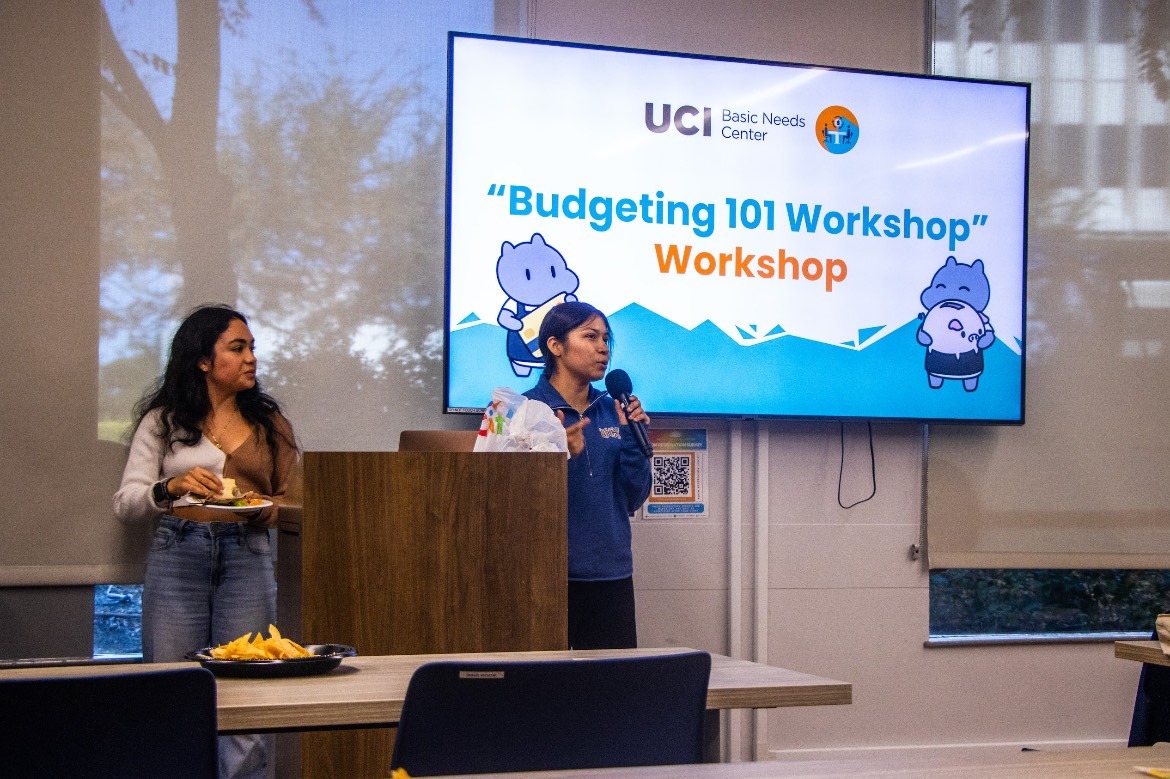

The UC Irvine Basic Needs Center and the Associated Students of the University of California, Irvine (ASUCI) partnered to inform students about the importance of budgeting at a financial wellness workshop “Taco ‘Bout Budgeting” in the Cross-Cultural Center on Nov. 13.
The event provided chicken, beef and vegan tacos with beans, rice and chips for students to enjoy during a budgeting presentation led by ASUCI Financial Wellness Commissioner Catherine Benitez-Diaz and Basic Needs Center’s Financial Wellness Peer Coach Alondra Arevalo.
“[Budgeting] helps you make sure you’re adjusting to your needs,” Arevalo said in the presentation. “Adjusting to your life because life happens.”
Benitez-Diaz began the workshop by asking students what they believe budgeting means. The workshop provided examples of college students’ expenses through budgeting website EveryDollar.
“I think it’s important to bring [financial] topics to college students in a fun, approachable and engaging way,” Benitez-Diaz told New University. “My goal for this workshop [was] for them to have come out encouraged to create a budget.”
Benitez-Diaz and Arevalo imputed different numbers into the website to test alternative budgets and assess what may work for students in the room. A key emphasis was accounting for emergencies.
“Emergencies are a matter of ‘when’ and not ‘if,’” Arevalo said in the presentation. “Things are going to happen.”
According to Benitez-Diaz and Arevalo, financial literacy and wellness are important aspects of student success on campus.
“I think financial literacy is a key part of what can help students be successful in the long run,” Arevalo told New University. “A lot of students don’t know about financial literacy. A lot of students don’t really know how to budget or they don’t know how to prioritize their funds.”
According to the official Federal Student Aid website, financial literacy involves understanding how to earn, manage and invest money to build a successful financial future.
“Budgeting does not have to be restrictive,” Arevalo told New University. “It’s meant to be flexible and move with you. Essentially, it is supposed to adapt to your everyday life and your lifestyle, because everybody’s lifestyle is different.”
Benitez-Diaz and Arevalo offered students five steps to budgeting: income, expenses, income minus expenses, tracking and reconciling. The first and second steps included listing out all streams of income and expenses.
They also advised students to use the income minus expenses equation, where income minus expenses must equal zero. This doesn’t mean every penny must be spent but it does help diagnose where “you will have to rework your budget,” as Benitez-Diaz said in the presentation.
Tracking spending helps students adjust their spending habits, as they can determine where to spend less or more. With reconciliation, the student can allocate any excess money into their savings for any short, medium or long-term financial goals. This step occurs at the end of the month and allows the student to plan for the next month starting from a net budget of zero.
Benitez-Diaz and Arevalo emphasized that budgeting is key to gaining financial literacy. They also said that it is a difficult habit that must be built.
“It’s totally okay if you’re struggling with budgeting,” Arevalo said in the presentation. “It happens to everyone.”
The presenters directed students to financial coaching sessions at the Basic Needs Center to help rework their budgets and understand more about their spending habits.
Budgeting also helps students combat food insecurity. According to a 2023 study, college students are heavily affected by food insecurity surges. Campuses across the U.S. report around 19-56% food insecurity prevalence.
Within the UC’s, 44% of the student population experiences food insecurity, which disproportionately affects students from low-income backgrounds. These students often rely on financial aid to help fund food and housing. According to Feeding America’s 2024 report, “financial insecurity fuels food insecurity.”
In lieu of recent financial aid delays, Benitez-Diaz uses her position as a financial wellness commissioner to help students manage their finances amidst the aid delays.
“In terms of my commission [the] advocacy we’re working on right now is trying to identify how students have been impacted by financial aid delays,” Benitez-Diaz told New University. “A lot of students have been struggling with not receiving their aid on time or having a significant portion of their aid reduced.”
The Basic Needs Center aims to assert students’ basic needs and instill food, housing and financial security. Consultations for basic needs with campus social workers and financial coaching sessions are available during their open hours. The center also assists students in filling out their CalFresh applications to ensure a smooth pathway to food security.
Upcoming events at the Basic Needs Center can be found on UCI Campus Groups or their Instagram page.
Alyssa Villagonzalo is a Features Intern for the fall 2024 quarter. She can be reached at akvillag@uci.edu.
Edited by Kaelyn Kwon.

