

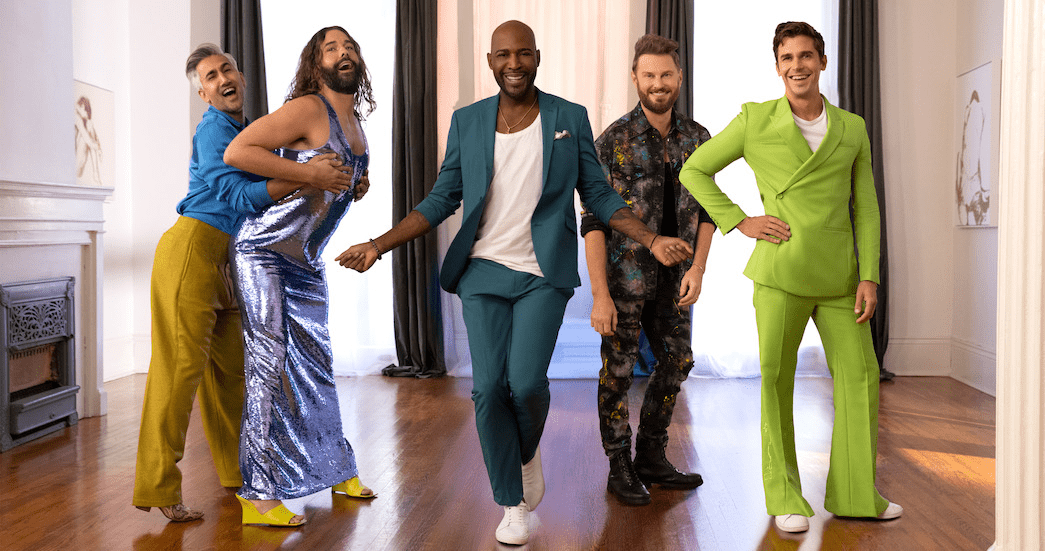

The hit reality TV show, “Queer Eye,” is back with no sign of slowing down. The seventh season is now streaming on Netflix’s top 10 after its release on May 12. The show has aired since Feb. 2018, but still manages to remain heartwarming and engaging. The Fab Five, Jonathan Van Ness, Antoni Porowski, Karamo Brown, Tan France and Bobby Berk, travel to New Orleans to guide seven heroes who deeply struggle with internal conflicts and self-love.
Those chosen for “Queer Eye” are people who give so much of themselves to others that they often forget to take care of themselves. Because of this, they are given life coaching in five areas: grooming, style, cooking, home care and mental health. It is more than a makeover. The Fab Five unravel their personalities and undo all the harmful physical and mental habits that have held them back from success. The show attempts to change the course of these people’s lives in a way that is so satisfying to watch.
Not only does the series help others, “Queer Eye” also celebrates queerness in a way that is rarely available in mainstream media. The five hosts are comfortable with themselves and their sexuality and help others to feel the same. Their approach to self-care allows those they help to discard mainstream narratives and step into themselves and their identity fully. The stylist, France, helps farmer Michael Richard, who works to end food insecurity, find his style through clothing that breaks traditional gender norms. For example, in one look, Richard wears a women’s cardigan over a button-up. The look brings out a new side of his personality that his co-workers never knew existed. After putting on the new outfit, his back straightens with newfound confidence.
Watching people remodel their lives over and over again is inspiring, and it reminds viewers that taking care of your appearance and living space is a therapeutic way to free up space in the mind — an act of self-care.
One hero in episode six, Mary Henderson-Uloho, still had her locks from the 12 years she spent in prison. She explains how her hairstyle protected her from other inmates grabbing onto her hair; shedding those locks allowed her to leave behind the part of her that was stuck in the survival mode of incarceration and step into the life of a free person. This demonstrates how a new haircut can act as a physical manifestation of changing one’s mentality and lifestyle.
The episode with Henderson-Uloho stands out. She represents a large group of people who are often very lost after their release from prison. Her mentality was completely altered by the experience. She closed herself off to individuality and, ultimately, to loving others, including her six children she was forced to leave behind. Viewers watch Henderson-Uloho reunite her family and finally talk to them about what she experienced in a moving way that very few reality TV shows are able to achieve. It is an extremely emotional episode with a very real and serious undertone. However, the Fab Five still manage to keep the energy cheerful throughout.
“Queer Eye” balances emotional growth and lighthearted playfulness. One moment Brown teaches a group of fraternity brothers how to cry in a world plagued by toxic masculinity. In another, Berk or Van Ness teach the heroes how to twerk on literally every surface of the kitchen they can find. Before the tears have dried, laughter will ensue. It is this blend of feelings that causes the show to feel authentic and undeniably charming.
“Queer Eye” also falls into the genre of a self-help series. Each episode ends with tips to help make life easier. They break down topics like how to correctly size one’s bra and demonstrate how to quickly fix a creaking cabinet hinge.
The only negative of this show is that, like much of reality TV, the episodes can start to feel repetitive. There are seven episodes in the seventh season, and each one follows the same exact outline. In order to combat this, the show has reduced the amount of episodes this season and chosen heroes with very interesting stories.
One hero, Ray “Speedy” Walker, is a TikToker paralyzed from the chest down after a life altering car accident. Another, Stephanie Williams, has been deemed the official number one sports superfan of the New Orleans Saints. However, she may have been using this sportsmanship to hide her sexuality. These poignant stories keep nuance despite other similarities from episode to episode. These unique and tear-jerking stories keep the energy up and the emotions flowing.
To say this is a feel-good show would be an understatement. “Queer Eye” makes you feel good through its inspiring and uplifting stories, but it also promotes healthy living, cleanliness, self-care habits and how to be true to oneself. All of these messages are not easy to find in reality television, and it is no wonder the show has been in Netflix’s top 10 since its release date.
Emma McCandless is an Entertainment Staff Writer. She can be reached at emccandl@uci.edu.

