

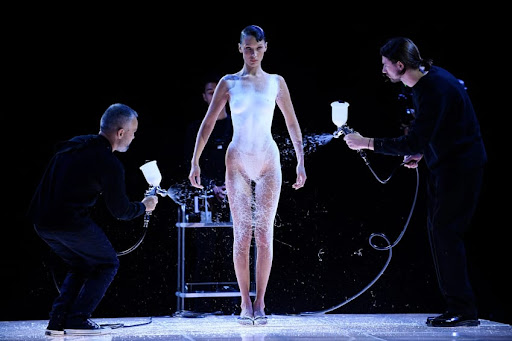

The fashion world is constantly striving to create walking pieces of art that either inspire daily wear clothes or evolve fashion into something greater than it was before. Coperni’s 2023 spring-summer show truly achieved the latter during Paris Fashion Week through its innovative spray-on dress on supermodel Bella Hadid.
The final look was perplexing at first, with Hadid entering the runway wearing nothing but nude underwear. That was when two scientists from London-based company Fabrican latex-spray painted a white dress on the model. Later, Coperni’s head of design Charlotte Raymond molded and cut the dress to produce a skin-tight, off-the-shoulder and high-slit garment for Hadid to model for the audience.
The garment was a stunning image of simple modernity — a common aesthetic for Coperni — but it was also a peak of technological innovation and performance art on the runway. Coperni’s runway showmanship was spectacular, not only due to its humble presentation but due to the collaboration behind this artistic fashion.
The Coperni brand is still fresh to the fashion world as it was founded in 2013 by young French designers Sébastian Meyer and Arnaud Vaillant. They built the brand with the goal of making ”ready-to-wear” clothes that incorporate technological advancements, which is evident in Coperni’s designs thus far. The brand’s name was even attributed to Nicolaus Copernicus — a Renaissance-age astronomer who discovered the heliocentric system that describes the motion of the Earth and the planets in our solar system.
As unique as their finale show was, Coperni is not the first brand to incorporate performances into their exhibits. Alexander McQueen put on a similarly iconic display during his 1999 show, named No. 13, where two robots spray painted a white dress worn by supermodel Shalom Harlow.
Both Coperni and McQueen’s performances fused fashion and technology together, but they also had many differences. McQueen’s performance saw the robots bullet-spraying Harlow’s dress in order to portray shotguns. The designer was inspired by Rebecca Horn’s 1991 installation of “High Moon” in which two guns shot red paint at each other. McQueen clearly tried to invoke feelings of violence and aggression with his show as Harlow was also instructed to act more frenetic as the act progressed.
Coperni’s performance differed from McQueen’s in that individuals built a dress out of thin air with machinery rather than machinery solely decorating a garment. Coperni’s display was also much more delicate, with wisps of latex material winding around Hadid as she elegantly moved her arms in sync with the scientists spraying the dress on her. Instead of finalizing the dress themselves, Vaillant and Meyer made their head of design mold the dress to its final form to underline that making the garment was a team effort.
When one thinks of Versace or Tom Ford, only Gianni Versace or Tom Ford — the creators of those brands — come to mind. The designers, sewers, and other individuals that contribute to the production of a collection are underappreciated. Coperni’s performance, however, brought together Fabrican scientists and Coperni’s head of design to highlight the collaborative process of designing and creating fashion in real-time.
Coperni’s modest exhibit during Paris Fashion Week was a breath of fresh air in comparison to other brands. Many fashion designers came out with wonderful works of art this year, but most of the shows were merely typical, with models wearing designs for others to buy or remake for commercial wear. Coperni’s show took the ego out of style by demanding respect for those who work in the process of creating fashion — where art is forged in new, exciting and invigorating ways.
Skylar Paxton is an Opinion Intern for the fall 2022 quarter. She can be reached at paxtons@uci.edu.

