

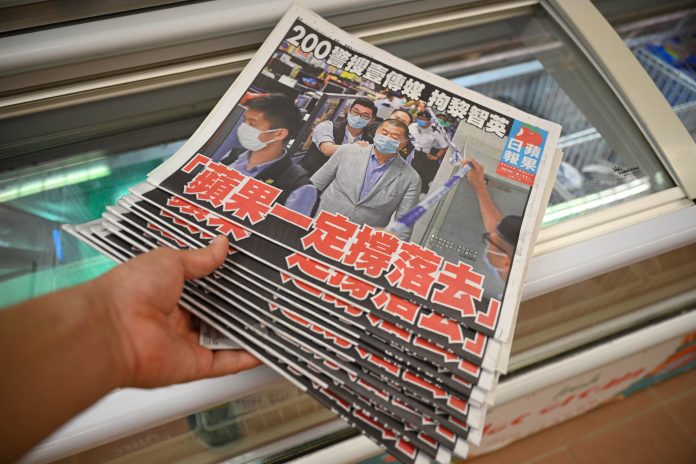

In the wake of the 2019 pro-democracy protests, Hong Kong’s independent media began to disappear. The sources that millions relied on for opposition statements were forced to stop reporting as their leaders were arrested and accused of seditious acts.
This represented a clear effort to dismantle the pro-democracy movement in Hong Kong. The news companies that are currently functioning are forced to self-censor themselves in order to avoid arrest. The removal of many of these pro-democracy outlets is a blatant effort to undermine free press and democracy.
It started with Apple Daily, an independent newspaper founded in 1995 by Jimmy Lai. Mr. Lai, a forcefully anti-communist and anti-government individual, worked to produce media that held government officials accountable while also keeping up on all the latest celebrity scandals. Apple Daily was wildly different than most newspapers, presenting itself in tabloid form with large images and bold fonts plastered across entire pages. The direct and flashy nature of Apple Daily was able to grab readers’ attention quickly, which is arguably why it was the first major member of the Hong Kong press to be taken down.

Photo courtesy of Just Clicks With a Camera.
During the pro-democracy protests, Apple Daily strongly voiced its support for the movement. Mr. Lai even took part in protests himself. This ultimately proved dangerous when Chinese officials later implemented a sweeping national security law, turning Apple Daily into a target. This law from Beijing made it clear that Hong Kong would no longer be hospitable to a free press. The voices of millions had been silenced by citing national security. Journalists pledged to fight hard to keep Hong Kong informed, doing everything they could to produce important stories, but the overreach would ultimately become too much.
A little over a month after the national security law was imposed on Hong Kong by Beijing, Lai was arrested and the office of the Apple Daily was raided for the first time. Signaling the beginning of the end of a free press in Hong Kong. Officers barged into the newsroom on Aug.10, rummaging through desks and seizing materials and computers. While the raid was occurring Apple Daily journalists attempted to livestream from inside the newsroom but were quickly stopped by officers. The journalists then moved to the roof of the office building where they could stream it from a distance, determined to document the events.
The police said they had a warrant to search and seize material from the office as a result of an investigation that showed Apple Daily had published over 30 articles encouraging foreign countries to enact sanctions on Hong Kong and China. There was also a separate warrant directed at Lai for his involvement in encouraging sanctions, therefore breaking the national security law. However, the national security law was so broad that it recognized any attempt to criticize the government as a threat to national security. Meaning that Apple Daily’s coverage of the pro-democracy protests was enough to constitute criminal activity. The new regulations make Hong Kong look more like mainland China each day, lacking a free press and government transparency.
As soon as the officers left, the newsroom was considered a crime scene. But that didn’t stop Apple Daily reporters from releasing articles and videos. Journalists who had their computers seized wrote articles on their smartphones. The newspaper “vowed to carry on and publish as usual” a headline said. The same day they published over a dozen articles and images on their website depicting Lai’s arrest and the police operation.
Apply Daily staff worked diligently for months to keep the newspaper running while many top officials were facing legal battles and jail time. Almost a year after the first raid, on the morning of June 17, Apple Daily was raided once again. This time officers arrested editor-in-chief Ryan Law and four other top directors.
Yet again, Apple Daily staff returned to a newsroom in disarray, but ready and eager to continue reporting.
The next day’s paper sold half a million copies, over five times the normal amount, as Hong Kong’s residents wanted to show their support of Apple Daily. However, later that day many of Apple Daily’s accounts totaling over $500 million, were frozen by the government. The grip that Beijing had on the paper was strong and the end of Apple Daily was near.
The frozen accounts gave Next Digital Media, Apply Daily’s parent company, no choice but to close the publication for good, citing the inability to pay staff. The last newspaper, published on June 23rd with the message “farewell and take care” sold out within hours, selling over one million copies. Apple Daily’s dissolution was a painstaking process that only showed the extent that Beijing officials would go to in order to regain complete control of the island. They were willing to burn the building down to preserve their image.
Apple Daily was only the beginning.
In the following months, similar situations would unfold at many of Hong Kong’s independent media companies. Newsrooms were raided, journalists arrested, and suddenly publication stopped altogether. Online news websites were taken offline, corresponding social media accounts were deleted overnight, and thousands of journalists were left without jobs. The widespread fall of the free press in Hong Kong became painfully clear.
While the free media in Hong Kong continues to collapse, executives from Hong Kong and Beijing continue to defend the measures. Hong Kong’s chief secretary, John Lee, claimed the independent media platforms “unlawfully exploited the media as a tool to pursue their political or personal gains,” in a recent letter to the Wall Street Journal.
Executives from Hong Kong and Beijing can continue to deny their goal to take away freedoms, but that doesn’t make it any less true. The collapse of the free press was done in an attempt to increase government oversight while reducing the rights of citizens. Even more worrisome, individuals and corporations at all levels now will be unable to voice their concerns and opinions of the government freely.
Hong Kong used to have the most free and vibrant media in all of Asia, now residents are forced to consume state-sponsored media. The large media corporations that remain, such as South China Morning Post owned by a mainland China tech giant, almost always take a pro-government approach. Refusing to participate in any investigative journalism that may cause them to uncover something they won’t like.
Hong Kong’s continuing trend away from democratic principles can be seen in other aspects of life. Hong Kong’s largest independent trade union, The Hong Kong Confederation of Trade Unions, was forced to disband due to ongoing “political uncertainty.” Even major international newspapers such as the New York Times and The Washington Post have decided to leave Hong Kong for Seoul, where they will be able to continue reporting without the worry of China’s overreach. More and more individuals and companies are starting to see Hong Kong as inhabitable, forcing relocation.
Until the international community can pressure China to recognize Hong Kong’s autonomy that was promised, Hong Kong will continue to become more difficult to differentiate from mainland China. While some differentiation still exists, it could be soon that Hong Kong is just a continuation of the mainland, lacking autonomy, transparency, and liberties.
Claire Schad is an Opinion Staff Writer. She can be reached at schadc@uci.edu.

Interested in becoming an intern or a contributing writer for the Opinion section?
Contact us at opinion@newuniversity.org!