

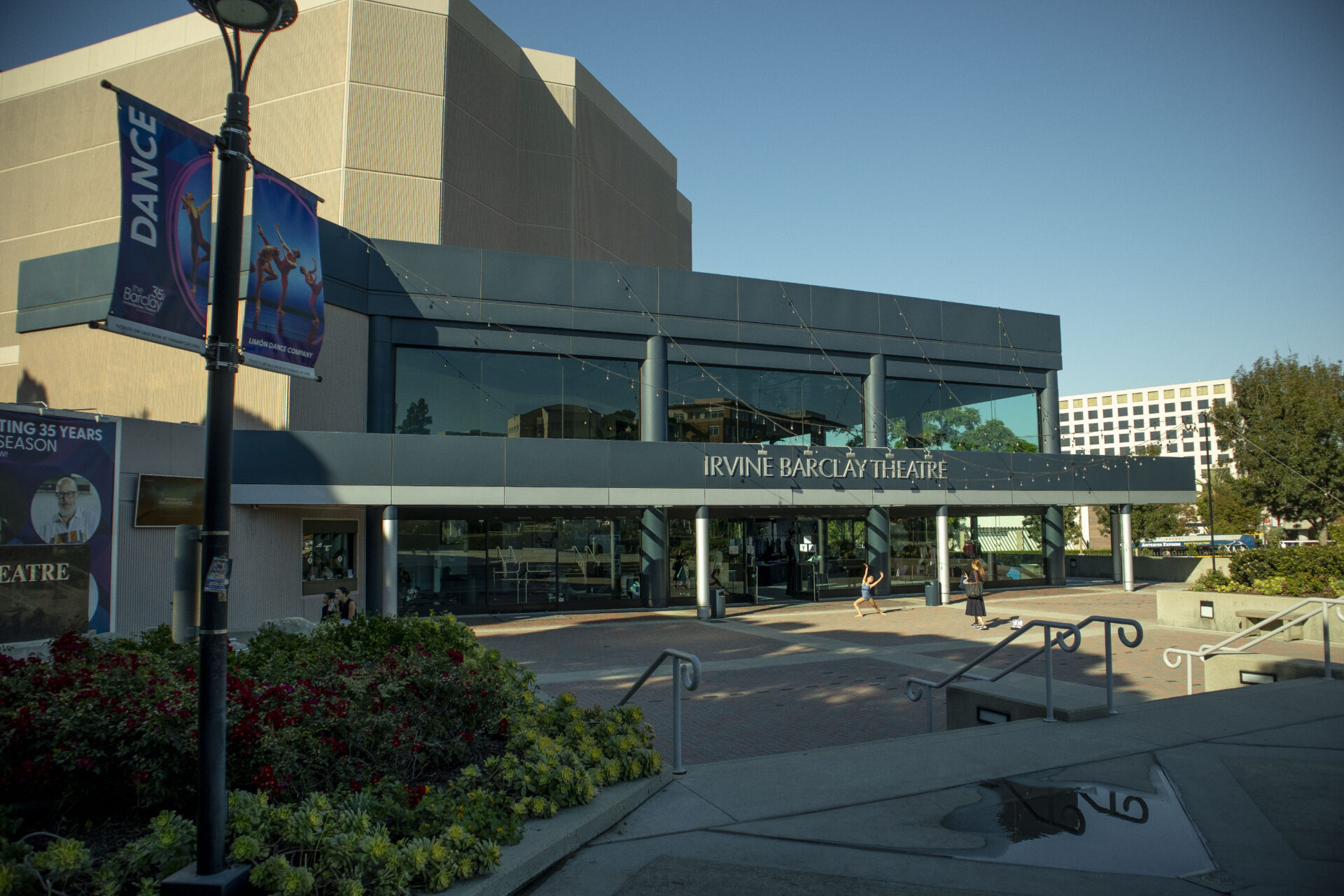

UC Irvine Law collaborated with TorkLaw, a national personal injury law firm with an office in Irvine, to host the 16th Annual Supreme Court Term in Review at the Irvine Barclay Theatre on July 7. The event reviewed the Supreme Court’s key cases decided in the most recent term.
Before the event began, audiences checked in outside the Irvine Barclay Theatre. Lines formed in front of the desks with blue tablecloths, with a UC Irvine Law logo on each of them. Staff in professional attire stood at the back, admitting those with reservations.
The audience included a wide range of ages, from students to working professionals and retirees, filling almost two-thirds of the 585 seats in the orchestra.
At the center of the stage, a large projection screen showed the event information, along with an image of the U.S. Supreme Court. Under the screen, five panelists with professional clothing sat on the white armchairs arranged as a semi-circle.
The panelists included three professors from UC Irvine Law: Chancellor’s Professor of Law Mario Barnes, Professor Robert S. Chang and Assistant Professor Ji Seon Song. The remaining two speakers were USC Gould School of Law Professor Courtney Cahill and King & Spalding attorney Paul Watford, a partner in their Los Angeles office. UCI Law Dean and Chancellor’s Professor of Law Austen Parrish delivered the opening remarks.
The discussion analyzed the statistics of the Supreme Court’s 2025 term. There were 66 majority opinions, 61 of them from federal courts. The 6-3 decisions nearly doubled from last term, going from 15.2% to almost 30%, suggesting that the court is more polarized. About 44% of cases were unanimous decisions.
The main cases and analyses included: Carpenter v. United States on privacy concern in the digital age in relation to the Fourth Amendment, individual rights such as birthright citizenship in the Fourteenth Amendment within cases such as United States v. Wong Kim Ark in 1898, and transgender rights in West Virginia v. B.P.J.
Panelists also raised several concerns about the shadow docket, claiming that orders are now often issued without full briefing and with little or no written explanation.
“The Supreme Court has played an important part in the role in our lives,” Parrish told New University. “No matter of your political perspective, hearing from experts on different perspectives is helpful.”
After the event, audience members slowly filtered out of the theatre. Some of them headed to the exit, while others stayed in the lobby, gathering around the table, exchanging thoughts and networking with each other.
Many viewed the event as an opportunity for future legal careers. Recent UC San Diego graduate and prospective UCI Law student Sarah Pulido said one of the reasons she attended the event was to network with law professionals and admissions officers. She described the event as a mini legal education.
“When [the admissions officer] reads my application, they can see that I had an interest in learning about the Supreme Court for the last term, and also that I have the initiative to attend these events,” Pulido told New University.
Beyond drawing attendees, the event also showed the partnership between UC Irvine Law and the legal community.
Chief Operating Officer of TorkLaw Jim Anderson talked about the benefits of the partnership with UC Irvine Law.
“We have benefited from the UCI program with staffing and being able to recruit from an institution that we trust and have produced great students, and then eventually attorneys, and so we’ve had some great hires out of UCI,” Anderson told New University.
For the organizers, the event connects the legal community with the public through legal education.
“It’s fun to, even going back several years now, just to see how the event has evolved through different leadership and how the heart of it has stayed the same to the benefit of the community, not just even just the law school, but the wider community,” Anderson said. He discussed the firm’s long-standing support, noting that they sponsored UC Irvine for seven or eight years.
“I think what this event does is it brings it to a personal level, and where you, as a student, can recognize that you can affect change in your community and in your country,” Anderson said.
Parrish shared a similar view, highlighting the educational value of the event and higher education for the community.
“One of the things that universities do, and one of the things the law schools [have] done, is to educate not just in degree-granting programs, but also provide community programs where people from the community come in and maybe hear something from a different perspective,” Parrish said.
Chloe Mo is a Features intern for the summer 2026 quarter. She can be reached at chloem7@uci.edu.
Edited by Ennes Kahf and Geneses Navarro.
Interested in becoming an intern or a contributing writer for the City News section?
Contact us at citynews@newuniversity.org!