

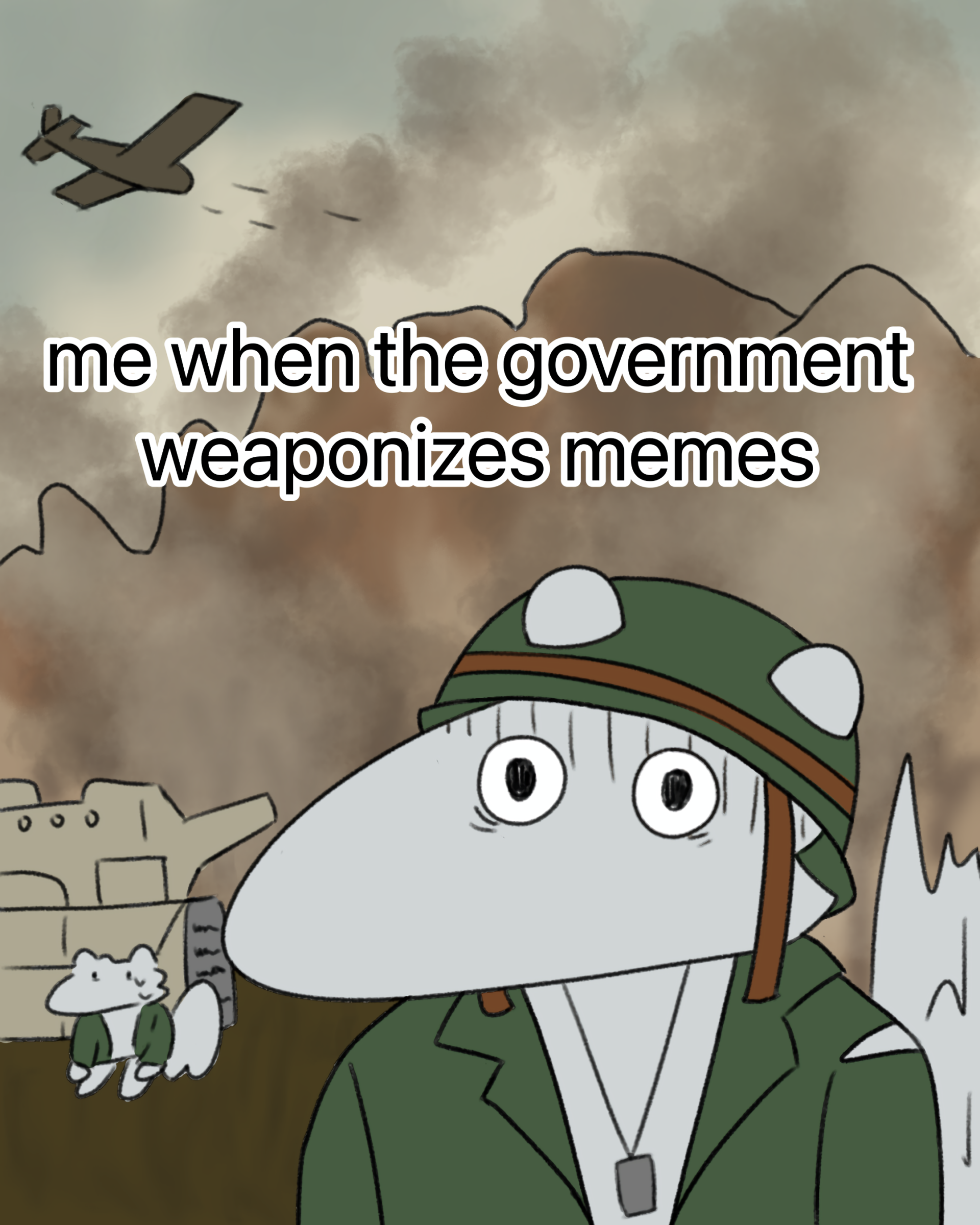


The face of propaganda shifts as times change, and governments have always manipulated the media to achieve their own goals. During World War II, it was radio. During the Vietnam War, it was government television. Today, it is social media. Social media is currently the most cost-effective way to reach the largest number of people, and it’s vital to keep in mind that a platform of this scale can never remain apolitical.
Social media and internet culture have always played a crucial role in politics, especially since the advent of widespread and accessible artificial intelligence. Younger generations, especially Generation Z, don’t actively follow traditional news broadcasts, leading a majority of Gen Z adults to get their news off of social media. Oftentimes, high-profile headlines come in an unexpected format — memes.
Memes surrounding current events often seem innocuous; after all, in the midst of a 24/7 news cycle and a torrent of negativity, they feel like a harmless respite. However, memes, being both ubiquitous and accessible, are being taken advantage of and used to further political biases.
The media has been used to shape and manipulate public opinion throughout history. Print, video and radio have all been used in propaganda techniques for centuries. Nazi Germany made radios more affordable so that the public could tune in to government-sanctioned war broadcasts, and the United States government partnered with Disney to create a children’s broadcast of an anti-Nazi Donald Duck.
That same method of propaganda can be observed today, except rather than being transmitted through print or television, it is delivered through memes. The official name for this is memetic warfare, a method of informational and psychological warfare that primarily utilizes memes in order to sway public opinion on political issues. And while this method of warfare might not be as well known to the public, it is very visible in current strategic planning. An article in the official NATO strategic magazine, written by alt-right public figure Jeff Giesea, insists that it is “time to embrace memetic warfare.”
Giesea goes on to discuss the unique strengths of memetic warfare. He describes past methods of digital warfare as having one goal: to control data. Memetic warfare is different — the objective is not to control data, but to control dialogue. This is essentially where memetic warfare excels compared to past forms of propaganda; it has the ability to join the dialogue and influence the narrative.
Memes have the unique ability to reach an audience disconnected from traditional media, and when controlled, serve as a propaganda technique that is much more covert. Propaganda funneled through television, cinema and traditional print is approached with skepticism by younger audiences. After all, they fit a pre-existing notion of what propaganda should look like.
However, when that same propaganda is presented through memes and internet discourse, it often flies under the radar because the internet is often perceived as being a collective community rather than a commodity that can be bought, used and infiltrated.
Memes capitalize on high emotion content and are especially effective vehicles for emotional contagion, making them an ideal format for political content and propaganda. This, combined with aggressive platform algorithms, can amplify social media’s echo chamber effect.
It might be easy to dismiss this as a hypothetical. After all, memes aren’t exactly created by some foreign government to sway the American public — except, in some cases, they are. One of the most famous usages of memetic warfare was during the Russian invasion of Ukraine in 2022.
When anti-Ukrainian posts and videos began to rapidly surface on social media, further inspection showed that the posts always referenced the same fabricated evidence, were posted by freshly created accounts and were only posted on Russian working days. The posts were eventually traced back to the Internet Research Agency (IRA), the pro-Putin Russian agency that was also accused of influencing the 2016 United States presidential election.
While this doesn’t mean that everything on social media is created with an ulterior motive, it does point out the need for younger audiences to more critically analyze the media they constantly consume. Propaganda is not something confined to history books. It changes with the times, and often goes unnoticed.
Shanaaz Faisal is an Opinion Intern for the summer 2026 quarter. She can be reached at shanaazf@uci.edu.
Edited by Ruby Goodwin and Riley Schnittger

Interested in becoming an intern or a contributing writer for the Opinion section?
Contact us at opinion@newuniversity.org!