

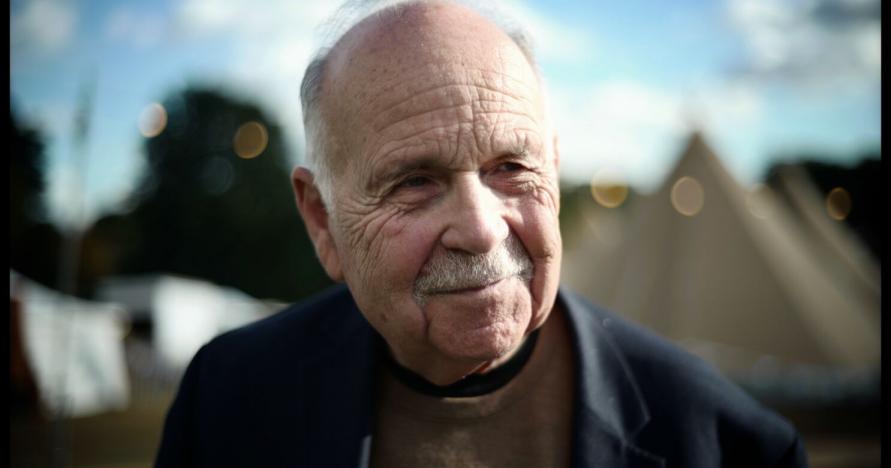


A law professor at the University of Florida Stanley Fish came to UCI to give a talk titled “Impossible Things: Blind Submission, Anti-professionalism, Interdisciplinarity, Consciousness Raising, Transparency and Artificial Intelligence” on Sept. 27.
An introduction was given by a faculty member of the English department Julia Lupton, before Fish was given the floor.
Fish started off the talk by reading the poem “On a Drop of Dew” by Andrew Marvell, which is a piece of writing he believed captures the essence of his talk. He compared the drop of dew to knowledge trying to be unrestrained.
After the reading, he began speaking about blind submission: the process of stripping an author’s name from a piece before sending it to a publisher. He explained that blind submission is an impossible thing because it goes against the natural law of intelligence through stripping away the names of scholars who may have more to offer over someone who is a newcomer.
“Blind submission is a social justice experiment that we should be wary of because it elevates adversity over insight,” Fish said.
He went on to list the ideas of legal realism, interdisciplinarity, conscious raising, transparency and artificial intelligence as limiting knowledge by giving it restraints.
Fish then spoke about anti-professionalism, which he defined as focusing and improving one aspect of a structure or institution, which then creates difficulties and problems in another area.
By creating these problems, Fish argued that the idea of anti-professionalism being beneficial is also an impossible thing.
He then switched to speaking about interdisciplinarity.
“Interdisciplinarity is anti-professionalism’s cousin,” said Fish. He explained how interdisciplinarity uses ideas from one area and applies it to another area, which he likened to appropriation.
He also spoke about consciousness raising.
“Consciousness raising begins by declaring that our sense of what is possible is determined by deep structures of education, political system and trend social attitudes,” Fisher said.
He explained how this idea is a way to “live life with resignation and obedience,” which should be an impossible thing as human beings.
On the topic of transparency, Fish described it as a way to “democratize information that is necessary to a free society populated by free citizens.”
He argued against this idea by asking the question, “Free to do what?”
Fish posited that making this information free allows it to become more manipulated and misunderstood, and therefore transparency as beneficial is an impossible thing.
Fish then discussed how artificial intelligence deals with raw data, and that raw data has no direction or meaning. Humans allow this direction and meaning to occur by interpreting and analyzing the information. He also argued that artificial intelligence can never equate to real intelligence.
In the last portion of the event, Fish revisited the poem and analyzed it. He explained how the drop of dew is avoiding being captured by the audience, which is a reflection of how knowledge tries to avoid being captured by the constraints that Fish addressed in his talk.
He then gave time for questions, and a small debate broke out. A faculty member of the English department, Oren Izenberg, challenged Fisher by stating that he believes blind submission can be beneficial since it promotes diversity.
Lupton also added to Izenberg’s argument by giving the example of blind submission in an orchestra. She went on to explain how, by taking away the artist’s name, judges can focus solely on the music.
Fisher continued to defend his claim against blind submission by restating how it does nothing to make the academic world better, and he ended the talk by stating that he believes blind submission is a way to promote a political agenda in the academic world.
Despite the disagreements, staff, faculty and students applauded Fish for sharing his arguments against the ideals of blind submission, anti-professionalism, interdisciplinarity, consciousness-raising, transparency and artificial intelligence.
Sabrina Contreras is a Staff Writer. She can be reached at sabriec1@uci.edu.

Interested in becoming an intern or a contributing writer for the Campus News section?
Contact us at campusnews@newuniversity.org!