


Students at University of California, Irvine (UCI) participated in the fourth annual 24-Hour Film Dash — a campus competition that challenges groups to write, film and edit a short film within 24 hours — on April 10.
At 4 p.m. in the McCormick Screening Room, each group received a mystery bag containing two lines of dialogue, a prop and a set of rules — all of which had to be incorporated into their final film.
This year’s dialogue options were: “I can’t believe this is happening again,” and “Maybe that’s all it ever was?” Their prop was a Rubik’s Cube.
“Every year it’s different. We’ve had rubber chickens, flutes, coconuts,” event coordinator and UCI Film and Media Studies (FMS) alumnus Nikki Normandia said. “We kind of just try to figure out something we can buy in bulk to some degree, depending on how many groups we have.”
According to Normandia, a record 88 students registered to form 16 groups of up to six people in this year’s competition.
One group consisted of five first-time participants and one returning participant; the six were connected through a chain of mutual acquaintances but had never worked together before. At 4:03 p.m., the group stood huddled outside the McCormick Screening Room, talking over each other.
“We need a goal, [an] obstacle [and a] solution,” third-year FMS student Peyton Stewart said.
Ideas circulated.
Fourth-year sociology major Rachal Tsan suggested something playful, to which Stewart responded with a request to avoid themes of breakups or friendships.
“What if the Rubik’s Cube, they think it’s something else, and it’s actually just the Rubik’s Cube? That’s all that ever was,” third-year FMS major Emma Thompson said.
Tsan then introduced the idea of geocaching, an activity where people use coordinates to locate hidden objects in unexpected places.
After 20 minutes of brainstorming, the group decided to form their storyline around the line “Maybe that’s all it ever was.”
The team also came to the conclusion that aiming for a more cinematically driven film rather than a dialogue-driven film would not only speed up production with less dialogue to determine, but with the submission limited to under six minutes, there wasn’t enough time to develop a complex storyline.
With the cinematographic direction of third-year FMS and literary journalism student Jeslin Alvarez, and a rough idea of what the group wanted the story to look like, they began thinking about locations — more specifically — what to do with their remaining daylight.
Already 4:30 p.m., they had only a few hours left of daylight to film. The team had to quickly decide what scenes would need to be filmed outside, especially since it was supposed to rain the following day on April 11, and if they would want a sunset shot.
They decided on filming a sunset shot at Laguna Beach that same day on April 10, writing a short script overnight and filming in Fullerton the next morning.
The next problem was gear. Only fourth-year FMS students Safi Al-Amin and Tsan had camera equipment of their own, but the team soon realized that they needed more.
They began to walk and talk, and on their way to rent a tripod and headphones from the Science Library, roles naturally took shape:
Thompson directed; Tsan and third-year FMS and drama student Ally Williams acted; Williams also contributed as a script writer with Stewart; Stewart additionally served as editor alongside Al-Amin, who handled sound; Alvarez was the group’s cinematographer.
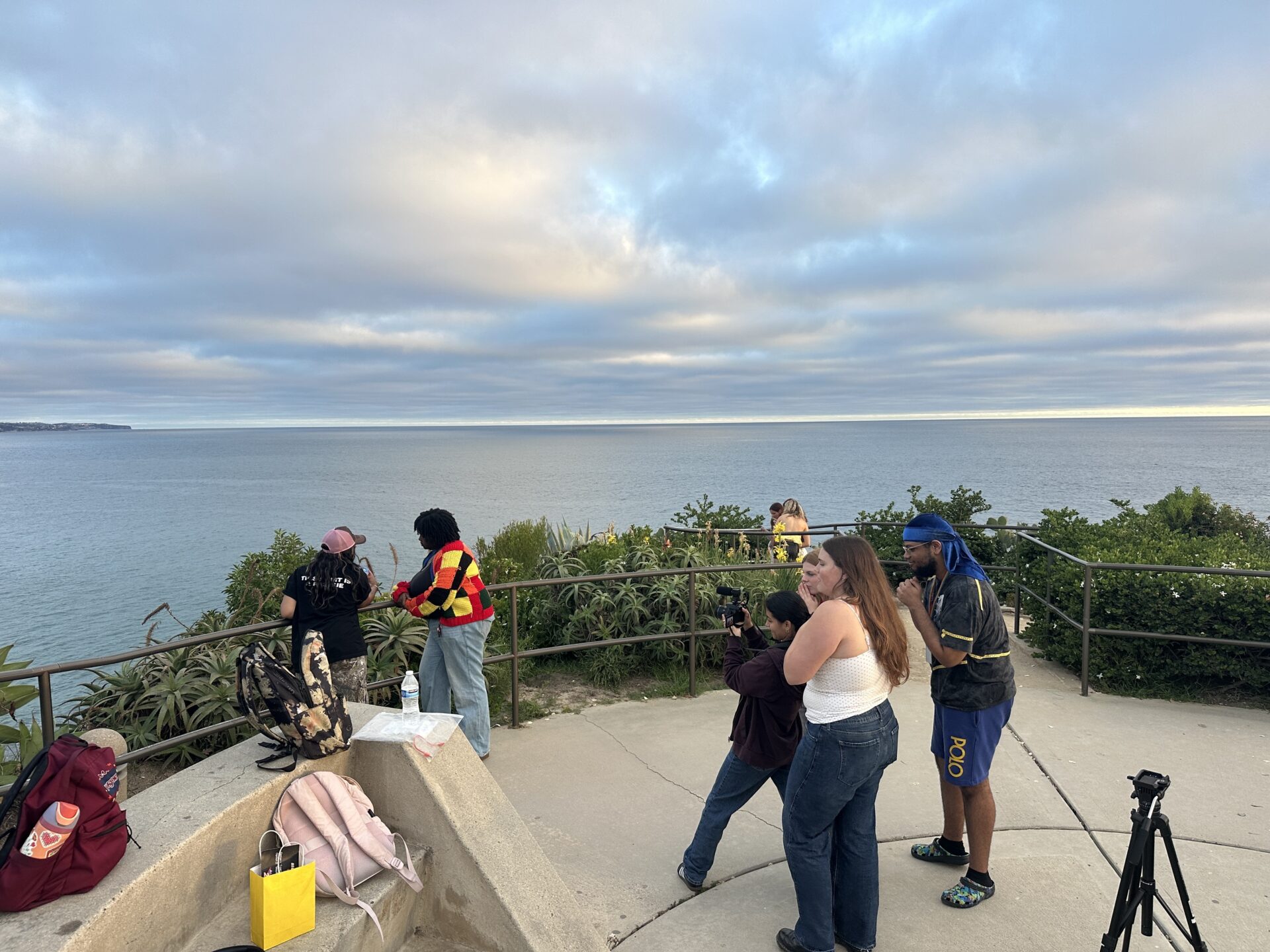
After gathering the necessary equipment, the group immediately drove to Crescent Bay Point Park in Laguna Beach, Calif.
The group arrived two hours before sunset and quickly shifted towards preparations. While setting up the equipment, they began refining their concept: two friends — Rachal and Ally — meet up for coffee, find coordinates for geocaching, and set off on an adventure.
Rachal is under a time constraint and had to leave for work, creating tension between continuing the search with Ally and returning to reality. As the pair rushes through the series of clues hidden at each stop, they discovered small trinkets and new coordinates that push them to the next location. Rachal ultimately chooses to call off from work and commit to the adventure.
The journey leads to a final geocache containing a Rubik’s Cube that says “enjoy the view.” The friends look up and realize that the purpose of the search was not the object itself, but the places it led them.
The film ends with a montage-style reflection of each location they visited — a flower field, a bridge overlooking train tracks and Crescent Bay Point Park — reframing the story as an appreciation of the journey rather than the destination.
Instead of following a traditional production process, the group built much of the narrative around footage they had already captured. After filming the sunset shot, Stewart, alongside Williams, wrote portions of the script in reverse, shaping it to fit what had already been filmed instead of filming to match a finished script. Ultimately, they decided to use the line “I can’t believe this is happening again.”
At 7 a.m. on April 11, the group met in Fullerton to complete the remaining shots. Quick decisions and constant adjustments were made as they moved through each location.
The group finished filming around noon and immediately shifted into post-production. Working off a hotspot to edit in a nearby coffee shop, Stewart and Al-Amin worked quickly to cut and organize the footage as the 4 p.m. deadline approached — finishing with only minutes to spare.
The creative, all-consuming event was a learning experience for the group. Incorporating everyone’s ideas, managing stress levels and knowing when to step back were some of the challenges the group faced, along with a few technical bumps.
The group’s production process mirrored the premise of their own film, as they found themselves navigating a rapidly changing plan while adapting to time constraints. In many ways, the experience reinforced the story’s central idea of valuing the process over the final result.
In the end, the team reflected on the challenge of creating a film within 24 hours as tiring and chaotic, but also extremely rewarding.
A screening of the 16 groups’ films occurred on Friday, April 17, in the McCormick Screening Room where it all began. “Cuben Missile Crisis” took Most Creative and “Sorry for This” won Best Picture.
Mya Romero is a Features Staff Writer for the spring 2026 quarter. She can be reached at myajr@uci.edu
Edited by Avery Rosas and Geneses Navarro.

