




Editor’s Note: This review contains spoilers for “Killing Eve.”
Nearly two years after the ending of Season 3, the fourth and final season of “Killing Eve” aired on Feb. 27. Sandra Oh and Jodie Comer revised their roles of Eve Polastri and Oksana “Villanelle” Astankova for one last romantically murderous escapade.
The third season finished on a hopeful note as Eve and Villanelle turned back to face one another after deciding to depart for good, never to look back. The romantic tension between the two has been palpable since the beginning of the first season, but Eve and Villanelle proved time and time again to be star-crossed lovers. However, as the third season came to a close, audience members were able to experience a true heart-to-heart connection and a glimmer of hope for what may come.
Season 4 jumps forward in time from the previous season, with Eve and Villanelle in very different places in their lives, seemingly moved on from their confusing romance. Mere minutes into the season, it is revealed that the vigilante, motorcycle-clad, gun-wielding figure out for revenge that was assumed to be Villanelle is in fact Eve living out the darker, wilder side of her that Villanelle evoked in her. Villanelle is living in her own opposite extreme, toned-down, seeking change within the church to prove that she is not inherently evil to herself, to Eve, and to the world.
Unconsciously acting out elements of one another brought in each others’ presence, Villanelle and Eve are desperately trying to do what they promised they’d do in the last season’s end — forget each other and move on. However, they are still clearly stuck reminiscing on their significant bond.
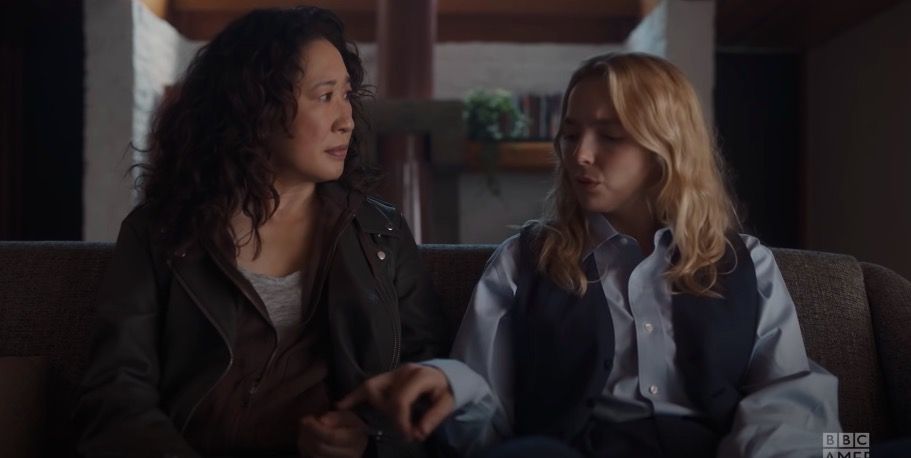
They say opposites attract, and Eve and Villanelle are no exception to that rule. However, the opposition allows them to unleash elements of good and evil in one another. Previously on adverse sides of the spectrum, both become much more morally ambiguous as Villanelle tries to reject what is inherently evil within her and Eve severs ties with her innate goodness. Their continued proximity to each other inspires them to become more whole, more true to themselves and uncover what has been buried under their years of life experience without knowing one another.
Discussed honestly for the first time at the end of the last season when Eve and Villanelle dance with one another, Eve tells Villanelle that if they were to commit to their relationship, they’d “consume each other;” but, they also realize that they are the only people they can trust and understand.
The end of the previous season did not close with a gripping cliffhanger. It, instead, looks at longing on the wary faces of two exhausted women. Their connection to one another, finally out in the open, offers this season up for a full-fledged relationship to bloom. While they begin Season 4 distanced and act “out of character,” it is safe to assume that this shock is temporary in contrast with what the audience expects.
Even in separation, Eve and Villanelle are constantly thinking of one another, proceeding with the other person in mind. When Villanelle gets baptized, she saves a seat for Eve, desperately wanting Eve to take note of her change in behavior — possibly to see her in a new light that is not all evil and perhaps a little bit more “Eve.” Meanwhile, Eve is out hunting down members of The Twelve, an ambiguous crime organization the show has followed since the beginning, and is doing everything in her power to get answers — even if it means shooting the new mayor of Russia and Villanelle’s previous boss under The Twelve, Konstantin Vasiliev, in the hand.
Still, the two are connected on a fundamental level — the need for motivation from the other to continue existing — in their attempts to escape their past lives or get revenge for the events that have occurred.. There will always be an essential longing between Eve and Villanelle, and this season makes the possibility of a relationship seem even more impossible with the opening episodes. However, this impossibility is a ruse to make an imminent relationship more shocking and also a warning sign for the final moments of the season.
In an interview with TVLine, Oh and Comer spoke about the ferocity and passion between the characters that they play.
“Two sparks that can barely be in the same room together … it’s just too much energy,” Oh said.
When Eve and Villanelle finally share a passionate kiss in the middle of the street during the last episode, they hold each other like they’ve been waiting their whole lives for that moment. Their embrace is helpless and desperate, and they giggle with immaturity and punch-drunken devotion.
Moments of tenderness come so rarely, and audiences are never made to feel confident that an act of kindness and sincerity won’t turn into a merciless bloodbath. However, when it comes to moments with Eve and Villanelle, their intimacy is warm, pure and whole in a sense that feels so real. Everything about “Killing Eve” is extraordinarily violent and supremely peculiar, but these two woman fit together like pieces of a puzzle.
“You know, a proper romance is always doomed,” Oh said about Eve and Villanelle’s relationship possibility. “Storytelling-wise, that’s why it’s a romance. That’s why it doesn’t necessarily turn into a relationship.”
In the final episode, Eve and Villanelle are able to truly spend meaningful time together, and they immediately begin to reflect the married couple they despised — albeit with a little more cynicism and a lot more dysfunction. They are perpetually weighing out if love is enough to make their horrible history fade away.
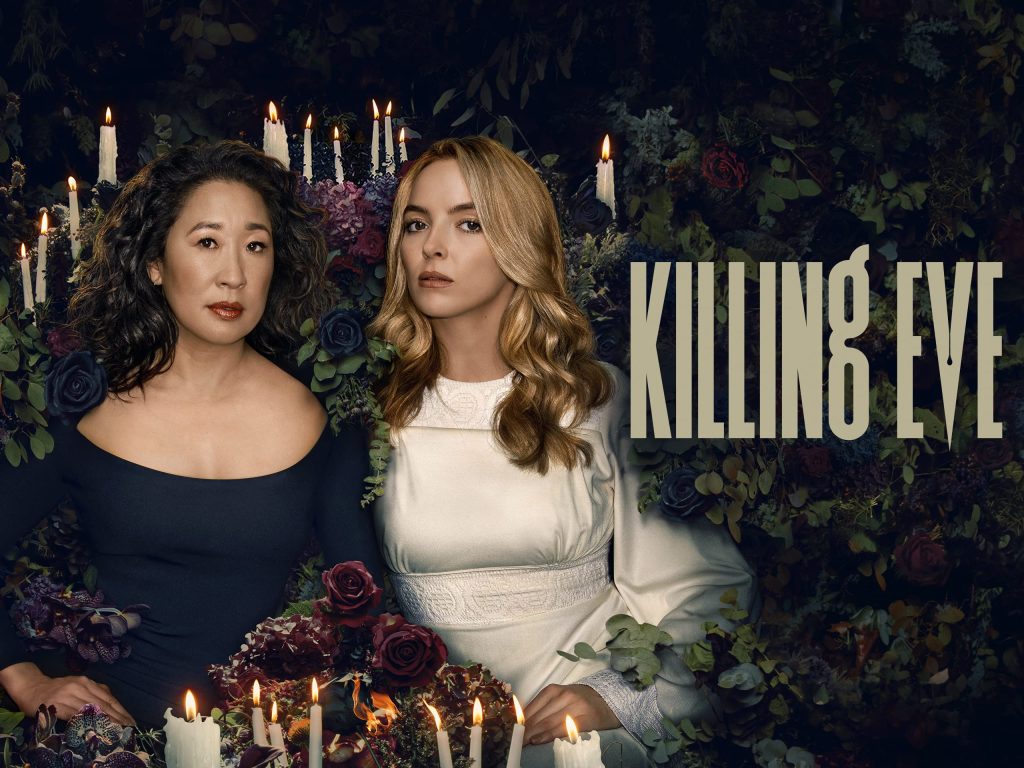
In a beautiful metaphor about Kintsiji, the Japanese art form of gluing broken pots back together with gold, Eve speaks on her and Villanelle’s rocky relationship with fondness, finally admitting her truest feelings and expressive forgiveness for their messy past; “it’s a way of bonding, to create something new.”
A show of extremes, taking emotions like jealousy to the extent of slitting someone else’s throat, the final moments of victory could not last until the episode came to a close. When Villanelle is brutally shot and killed, Oh’s insight becomes much darker.
This season of “Killing Eve” ends in tragedy, which is unfortunate considering fans were so hopeful for a happy ending of a well-rounded show with queer leading ladies. The abruptness and finality of Villanelle’s death was unsurprising yet also shocking.
The show’s blatant coldness when it comes to happy endings made Villanelle’s death feel cheap, like any other and the simplicity of the kill of a trained, flamboyant assassin was heartbreaking and unbelievable, which made the ending so disappointing and uncharacteristic of previous dramatic, overly macabre kills. Villanelle deserved better, or at the very least, a fabulous death.
Even with the show’s lack of regard for human life and love, Eve and Villanelle still seemed utterly invincible, untouchable by the world. Nonetheless, the series as a whole is brilliant, and it is one of the best examples of lesbian representation on television today. It is absolutely a must-see for anyone interested in mysterious thriller dramas with just a touch of romance and comedy to lighten the mood.
Season 4 of “Killing Eve” is available for streaming on AMC+ and each episode is available for purchase on Amazon Prime Video. To catch up on Seasons 1-3, the show is also available on Hulu.
Lillian Dunn is an Entertainment Staff Writer for the spring 2022 quarter. She can be reached at lbdunn@uci.edu.

Lillian Beatrice Dunn is an Arts & Entertainment Editor for the New University, majoring in Literary Journalism and minoring in Queer Studies and Creative Writing. She has over 50 published pieces, including interviews with indie band Small Crush and dark-pop princess Ashley Sienna. She has freelanced for OUT FRONT Magazine and the LA Dance Chronicle and has previously held staff writer positions at Her Campus UCI and Fever Dreams Magazine.