

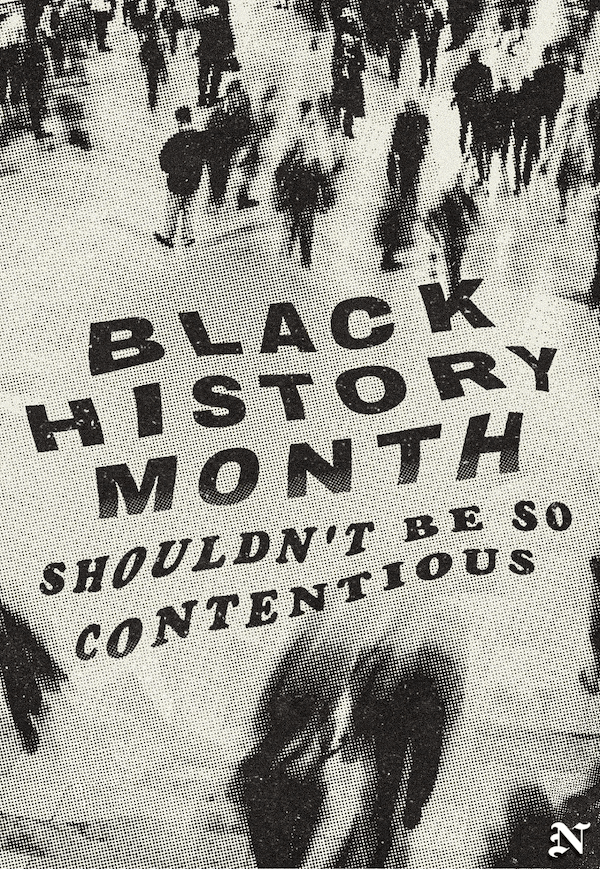

During the month of February, there seems to be a revival of the conversation over whether Black History Month should even exist. Of course it should.
Especially in the context of our education system, Black History Month is regarded by some of its detractors as one-dimensional and limited in scope. Often, American history highlights only “the good ones,” or the pacifists, such as Martin Luther King Jr. or Jackie Robinson, and pays very little homage to more radical Black figures like Malcolm X or Angela Davis, thus sanitizing Black history in order to make it palatable to white America. Additionally, there are people in the Black community who feel that singling out Black history for just one month — the shortest month of the year, no less — only serves to downplay its significance and contribute to its erasure in virtually every other month of the year. The remainder of which, by default, are in service to white history.
Those on the outside looking in — aka non-Black people — might also take issue with singling-out Black history. Aren’t race-specific commemorations counter to American values and ideals, focusing too much on our differences rather than what we share in common? Why isn’t there a history month for white people or Asian-Americans? Isn’t Black history simply American history?
These are nice sentiments, but the truth of the matter is that there is no single, shared experience through this country’s history, nor its present. One’s experience in America is largely dependent on the color of their skin. While many of us are able to enjoy the immense sense of freedom and dignity endowed to us in this country, we cannot ignore the socioeconomic disparities and the social structures that persist in oppressing certain minorities — particularly the Black community. Part of the point in highlighting Black history is to reinforce, however, that the color of one’s skin doesn’t have to define or limit one’s experience.
At times like these, where race relations are tense and the threat of historical erasure looms, it is vital to promote these discussions and continue to honor Black achievement. In theory, color blindness seems like a commendable idea and something to strive for, but we do not have that luxury here in America. Though Black Americans are indeed Americans, the assertion that we should abandon all notions of race in the discussion of American history would undermine everything that is worth celebrating about Black history. To imply that a singular American identity ought to come before a Black identity is frankly, insulting.
Let’s not allow the recent backlash against Black History Month and the right wing’s weaponization of “critical race theory” to distract us from the purpose of Black History Month — which is not to scold the American people and our institutions for their shortcomings, of which there were and continue to be many. Rather, we do it to honor the excellence of many great Black American scholars, activists, athletes, artists and agents of social change in the midst of racism and inequality.
This commemorative month exists for good reason, and to do away with it would only further inflame race relations. It is a time to allow the Black community to regain control over their narrative, and to instill future generations with a sense of pride and self-worth. The celebration of Black History Month will invariably mean a great deal to some, and less to others. While it can be a difficult subject matter to navigate, especially as an observer with no personal claim to such history, there should be no question that it is sacred and here to stay.
Melissa Newell is an Opinion Intern for the winter 2022 quarter. She can be reached at mrnewell@uci.edu.

Interested in becoming an intern or a contributing writer for the Opinion section?
Contact us at opinion@newuniversity.org!