


Wes Anderson returned on Oct. 22 with his eccentric visual and narrative style in his new film “The French Dispatch of the Liberty, Kansas Evening Sun.” The film consists of three different storylines involving the production of an American newspaper’s last issue in France and received high praise from critics for its star-studded cast and Anderson’s distinct aesthetic, but its tone separates it from other lighthearted films at the cinema.
The film begins with the death of Arthur Howitzer Jr. (Bill Murray), the editor of the newspaper “The French Dispatch.” According to his will, the publication should terminate after a final issue comprising three past articles is printed. The first article, titled “The Concrete Masterpiece,” follows Moses Rosenthaler (Benicio del Toro), an artist serving a prison sentence for murder who happens to produce an abstract nude portrait of prison officer Simone (Léa Seydoux). His art becomes a sensation, but he struggles with a lack of inspiration. The second article, titled “Revisions to a Manifesto,” follows Lucinda Krementz (Frances McDormand), a journalist covering a student protest that escalates into a revolution. Despite her insistence to maintain journalistic integrity, she becomes involved in a romantic relationship with the revolt’s leader Zeffirelli (Timothée Chalamet). The third article, titled “The Private Dining Room of the Police Commissioner,” follows Roebuck Wright (Jeffrey Wright), who attended a private dinner with the local police that was interrupted by a kidnapping.
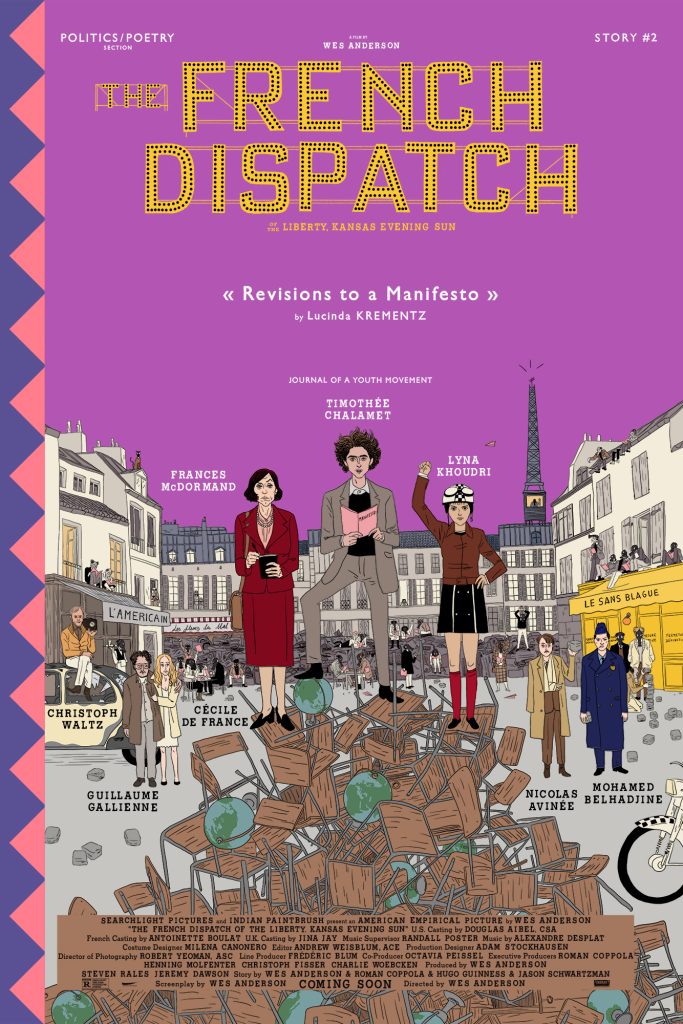
Anderson’s unique camerawork and artistic color palette is prevalent throughout all three stories as he illustrates a narrative unlike any other. In the first few minutes of the film, it is made apparent through the bright, pastel color palette and slow motion that this is a Wes Anderson production, which was perhaps the most captivating part of the film. Stylistically, the film is innovative and brilliant. Anderson plays with framing, image composition and aspect ratios as he moves between colored film to black and white. He makes use of fixed shots to capture action, and the juxtaposition of stillness and movement creates an intriguing effect. His use of graphic design and typography to illustrate the introduction of each story, which simultaneously acted as a magazine section, was a brilliant touch that added to the film’s overall aesthetic.
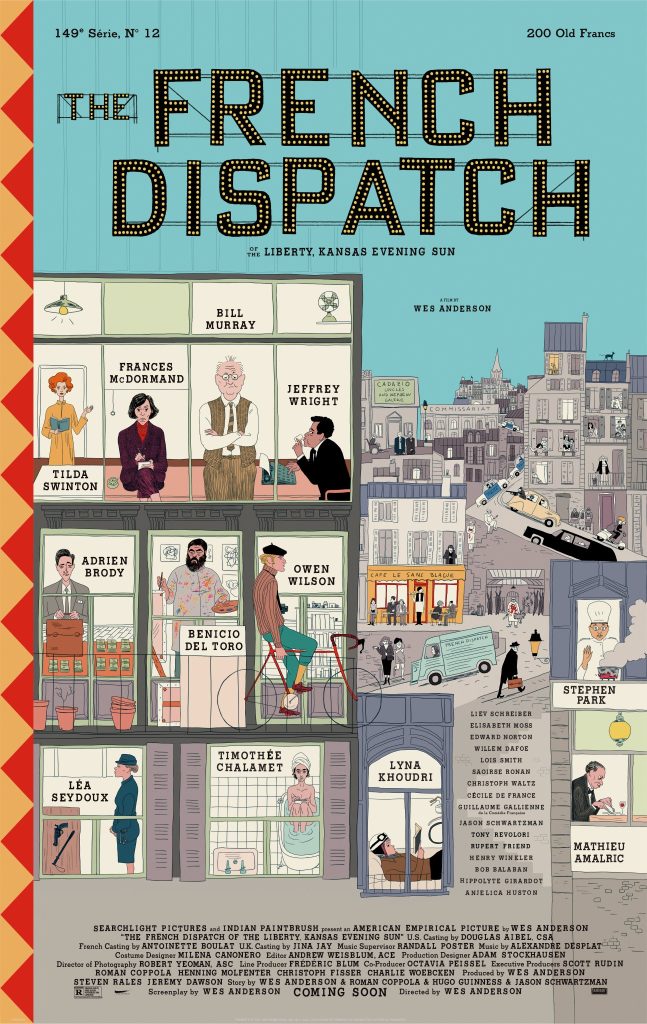
The cast is composed of well-known, award-winning actors, who portray their roles perfectly, bringing the story to life. Bill Murray and Owen Wilson, who have a long history of collaborating with Anderson, play the paper’s editor and a staff writer, respectively. Their characters are based on real people who worked for “The New Yorker.” Every role in the film seemed to be filled by critically acclaimed actors: Tilda Swinton, Benicio del Toro, Léa Seydoux, Timothée Chalamet, Frances McDormand and Mathieu Amalric are merely a fraction of the cast. The cast list, alongside Anderson’s distinct aesthetic, is what makes the film especially intriguing to viewers.
That being said, the film is not a lighthearted watch. The three stories are only loosely connected in that they are articles being published in a magazine. Otherwise, they are entirely stand-alone stories. At times, it may seem difficult to understand just what Anderson is trying to convey, because the stories are told in ambiguous ways. Furthermore, it may be difficult for viewers to connect to any of the characters, as each story provides little time for viewers to sympathize with anyone. The ideas he explores — such as loneliness, family and love — are interesting, but oftentimes Anderson’s message may be rather unclear to the average viewer.
Perhaps it wasn’t supposed to be the average moviegoer’s cup of tea. Perhaps to Anderson, it was meant to be a passion project, a medium for him to express his love for journalism and filmmaking. Perhaps the film wasn’t created for the sake of sales or popularity, but for his own expression instead. Even if one finds the film to be boring, Anderson’s clear passion is, without a doubt, worth appreciating.
With its stunning visuals and brilliant themes, “The French Dispatch” is not a bad movie. It appeals to mainly Anderson fans, and ordinary viewers may find it hard to understand or even find enjoyable due to its confusing storylines and abundance of hidden meanings. If you’re looking for a simple film to pay half your attention towards, then “The French Dispatch” may not be for you. However, if you are a longtime Anderson fan or cinematography enthusiast who wants an aesthetically unique piece of art that explores deeper topics, then this will satisfy your wishes.
Grace Tu is an Entertainment Intern for the fall 2021 quarter. She can be reached at tug2@uci.edu.

