

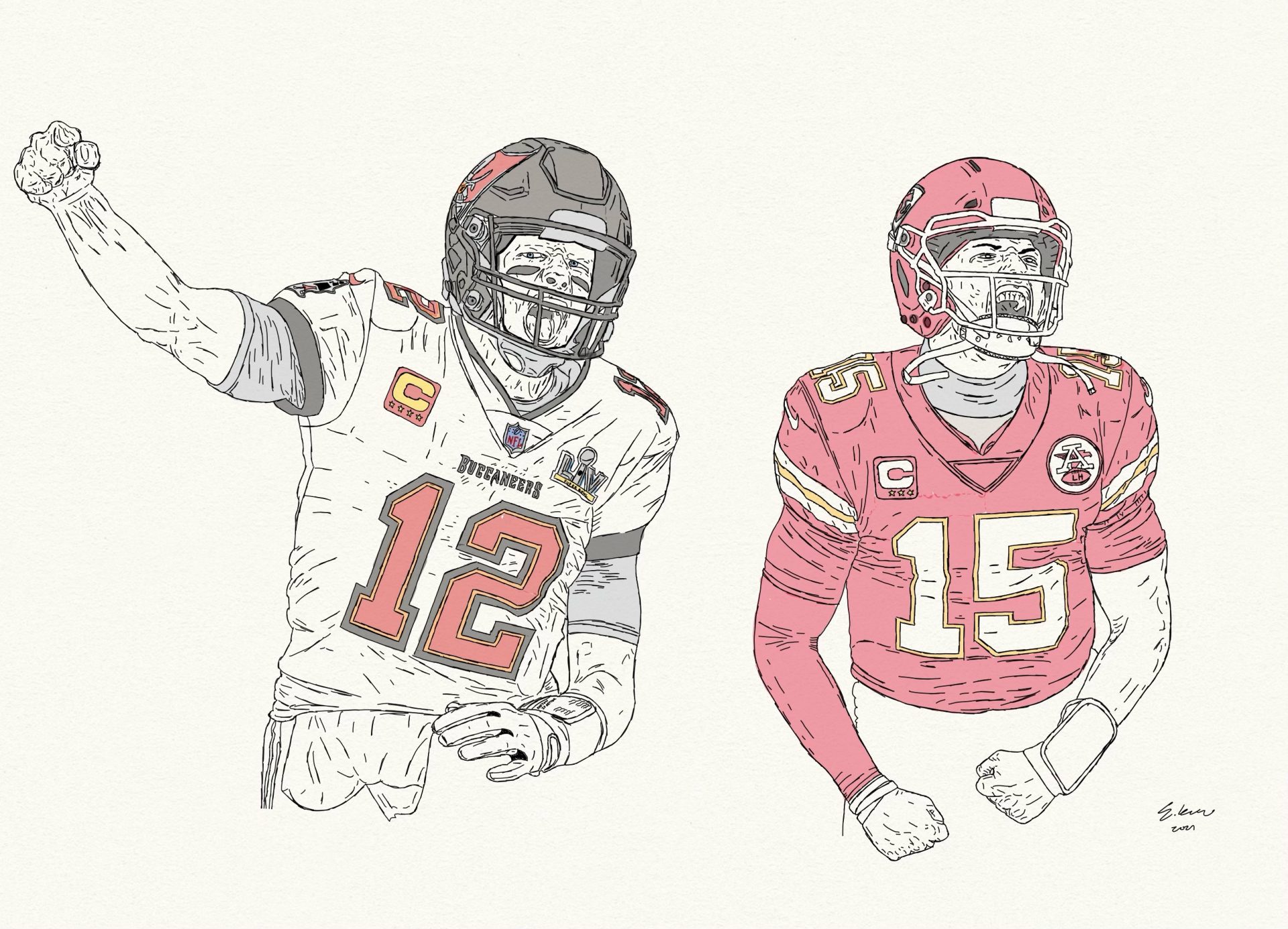

The Tampa Bay Buccaneers (14-5) faced off against the defending champion Kansas City Chiefs (16-2) in Tampa, Florida this past Sunday, Feb. 7. The game marked the 55th Super Bowl in NFL history; it was the first Super Bowl where one of the competing teams hosted the contest. All Super Bowls have their own level of intrigue, but this year’s game had special implications. It featured Tom Brady and Patrick Mahomes, two of the NFL’s most impressive athletes facing off in football’s biggest game. But for Brady and Mahomes, it was a long journey to the top.
Brady had the opposite start of a five-star recruit. He started playing football at Junipero Serra High School in San Mateo, California. He was the backup quarterback his freshman year and didn’t take a single snap all season. The team still finished 0-8. By the time his second year began, he became the starter after the previous starter quit. It was the first time Brady had ever played football in his life. However, he found his love in it immediately — it turned out that he was good at it.
When Brady finally committed to the University of Michigan, there were seven quarterbacks ahead of him on the depth chart. However, it only took a year before he was pushing senior Brian Griese for his job. After Griese led Michigan to a National Championship, Brady set his sights to win his own. He won the starting job his junior year, winning 10 out of his last 11 games. Michigan fans adored Brady, deeming him as “The Comeback Kid.” But as the next season rolled around, there was new competition: Drew Henson.
Henson was perhaps the most highly qualified athlete ever to come to Michigan. He could throw, he could run and he could explode in every physical athletic category. He was everything that scouts felt Brady wasn’t. After Henson’s slow start against rival Michigan State, Brady led the Wolverines back from 17 points down, the first of many comebacks in years to come. One win after another, Brady proved his belief in his teammates and himself.
In the final game of the season, Brady led the Wolverines to upset Alabama in a 35-34 OT win in the Orange Bowl, capping off a historic and tumultuous year. “What better way to go out as a fifth-year senior than an Orange Bowl Victory,” Brady said in a postgame interview in front of a mesmerized national audience.
Brady’s success at Michigan was a great story. However, in the mind of scouts, “a story” is just where it ended. Listed on Brady’s draft report was that he had a poor build; was skinny; lacked great physical stature, strength, mobility, the ability to avoid the rush and a strong arm; he couldn’t drive the ball downfield; he didn’t throw a really tight spiral; he was a system-type player who could get exposed if forced to ad-lib; and he got knocked down easily.
NFL Films sat Brady down and read him these exact descriptions. “That kinda gets me fired up … what the hell do these people know? That sounds like Joe Montana right there,” he said in response to the report.
Some scouts did vouch for Brady’s “intangibles” coming into the draft, but it was clear none of them knew what he would become. Despite some warning signs, nobody would admit defeat on their reports of Brady.
On draft day, six quarterbacks — Chad Pennington, Giovanni Carmazzi, Chris Redman, Tamaurice “Tee” Martin, Marc Bulger and Spergon Wynn — were taken before Brady in the 2000 NFL Draft. Now coined “The Brady 6,” these players represented Brady’s status as he entered the NFL since they laid the foundation for Brady’s drive in years to come. He was selected as a compensatory pick, 199th overall, in the sixth round of the 2000 NFL Draft by the New England Patriots. Today, executives, coaches, players and fans read these names with absolute disbelief, a constant reminder of Brady’s beginning.
When Brady first entered the league, he found himself in the same spot as a freshman in high school — a regular guy and nothing phased him. During training camp of his rookie season, Brady approached the owner of the team, Robert Kraft. He looked him in the eye with laser-like intensity and said, “Mr. Kraft, I want to introduce myself. I’m Tom Brady, and I’m the best decision this organization has ever made.”
Right away, Brady was met with another challenging task: winning the starting job again. But after veteran quarterback Drew Bledsoe went down with an injury during week two, Brady took to the field. Since Sept. 23, 2001, Brady has never been asked to come off the field again.
20 years later, six Super Bowl championships, three Most Valuable Player Awards, 14 Pro Bowl selections and countless other records, Brady has achieved it all. He owned the AFC East, winning 17 out of the 18 years he played in New England. Other than the outlier year he missed due to a season-ending ACL tear during week one, Brady became one of the most unlikely sports legends in history. As someone who was constantly told that he was too slow, too frail and unimpressive, he rose above the rest.
At 43 years old, Brady stands alone as the oldest quarterback to appear in a Super Bowl. He seems to hold every major record including the most quarterback playoff wins at 34, more than double his childhood hero Joe Montana and his second all-time 16 wins. It demonstrates how Brady continues to venture into unmarked territory, and he shows no sign of stopping. Brady’s longevity will be inevitably etched in his long line of football nirvana. But at its core, Brady will be remembered as a player who not only believed in himself but also in his teammates at every turn. It’s not surprising why everyone within the NFL reveres him; he demands excellence.
The Chiefs’ quarterback Patrick Mahomes was perhaps the opposite of Brady. Mahomes’ father was a pitcher who played in the MLB for 11 years. Mahomes had a great athletic profile. He had a big arm and a big body, making him strong and tough. He played baseball in high school like his father, and he also had roots in basketball. He was voted “Most Athletic” in his senior year. His fastball could clock into the mid-1990s. But Mahomes’ true love was football.
Despite his undefeated district championship and 65 touchdowns during his senior year, Mahomes was ranked a three-star recruit heading into college. He only received three offers from three universities: Rice, Houston and Texas Tech. He eventually chose Texas Tech, hurting his coinciding MLB draft stock. Mahomes was later selected in the 37th round of the MLB draft, partly due to teams’ concerns about him playing football; however, Mahomes stood by his decision.
Mahomes didn’t start until his sophomore year at Texas Tech. By the time his junior season came, Mahomes announced that he would leave the baseball team to focus solely on football. In that same year of 2016, Mahomes broke multiple NCAA records in his famous battle against fellow quarterback Baker Mayfield. He threw for 734 passing yards and his team had 819 in total offense in an eventual loss to Oklahoma, 66-59. Both are NCAA all-time records.
Unlike Brady, Mahomes had a strong profile coming into the NFL draft because of his elite physical tools. Many analysts argued that he should be a first-round pick as the draft inched closer and pressure heightened. However, Mahomes is far from just a talented player. He is revered by his teammates at every level, and he works harder than the competition — something that wouldn’t take long for the world to witness. It’s hard to know which other teams contemplated on Mahomes, but there was one in particular that eagerly wanted him. The Kansas City Chiefs traded substantial draft capital in order to trade up and select Mahomes with the 10th pick in the 2017 NFL draft.
The problem for Mahomes was that the Chiefs were already a playoff team when he suited up to practice for the first time in August. They had veteran coach Andy Reid, one of the game’s most legendary offensive minds; Travis Kelce and Tyreek Hill, two of the best pass catchers in the league; and quarterback Alex Smith, who had just led the Chiefs to a playoff appearance in three out of four seasons prior. However, the executives in the organization had a different plan for the future, and Smith immediately felt the pressure of losing his job. Mahomes got a chance to learn under Smith and Reid for a whole season. “I told Patrick [Mahomes] that he could buy [Smith] a castle and it wouldn’t pay for the experience that he was able to have working with Alex [Smith] and his introduction into the National Football League,” Reid said about Smith’s influence on Mahomes.
After another disappointing playoff run for Smith and the Chiefs on Jan. 30, 2018, General Manager Brett Veach announced that they were trading Smith to Washington, giving the offensive reins to an energized Mahomes.
In that same season, Mahomes won the league MVP, setting the NFL and American sports on fire. He led the Chiefs to a 12-4 record and a division title before losing to Brady, who beat him twice that season. Mahomes proved that the next year would be different. The MVP meant a lot to him, but the goal was to always win a championship.
In week 14 of 2019, Mahomes went into Foxborough, MA; he beat Brady and the Patriots. Mahomes went on to lead the Chiefs to a Super Bowl win over the San Francisco 49ers in a thrilling fourth quarter comeback. Mahomes, who is the youngest Super Bowl MVP ever, was surrounded by his teammates, coaches and fans. “We never give up,” he said in his trademarked promise. But Brady’s Patriots lost to the Titans, whom the Chiefs eventually defeated, leaving the world without another Brady vs. Mahomes playoff showdown — until now.
Mahomes’ rise to the top of the NFL was very similar to Brady’s. As soon as they took over, it was clear that they were different from the rest. They were not “just a guy” anymore. They were no longer too frail, or only three-star — they were the best.
Mahomes now has 45 wins and only 11 losses in his young career as a starter. He is widely regarded as the NFL’s best player, and he has seemed to rise above every challenge that he has faced. Even quarterback legends like Dan Marino, Peyton Manning and Aaron Rodgers all struggled to do what Mahomes has already achieved — winning a Super Bowl ring early in their career.
Mahomes attempted to lead the Chiefs to win back-to-back Super Bowls on Sunday, joining only seven other teams in NFL history to do so. Brady led one of those teams, the Patriots, to back-to-back Super Bowls two separate times. The win also maintained Brady’s title as one of three quarterbacks to win two Super Bowls in their first four seasons.
Mahomes has accomplished so much for his age, and he is on a trajectory of dominance not yet seen in the NFL. Mahomes’ statistics, athleticism and strength are all advertised as his best attributes. However, Mahomes’ ability to lead and respond in times of adversity is what has separated him from his competitors. Talent is abundant in the NFL, but there are no championships won without heart and hard work — and Mahomes has both.
But Mahomes will have to wait another year to be on top, battling travel and a depleted roster. Brady’s seventh Super Bowl win will put him on an almost inconceivable level, immortalizing him for football fans. Since Brady’s 28-3 comeback win in the 2017 Super Bowl, it has been a popular opinion that he is football’s greatest player. Two years later, Brady added another championship with his win over Sean McVay’s Rams, putting him at six Super Bowl victories. The only argument against Brady was that he was playing under one of the greatest coaches of all time, Bill Belichick. The Patriots had ownership, management and coaching at the highest level, which always supplied Brady with the best opportunity to win.
However, Brady had no hesitations putting his legacy at risk leaving by the safety net of New England; he, once again, bet himself against everyone else. Here’s what Brady’s seventh Super Bowl win means.
Brady is now the undisputed greatest player football has ever seen by a margin, seemingly unreachable. He is chasing things bigger than football: Babe Ruth, Michael Jordan and Muhammad Ali. There is no longer a mark on Brady’s dominance, longevity and drive to better those around him. He crushed the only argument his naysayers were scrambling to prove. What’s left of his doubters is this: “He got lucky.”
Mahomes, on the other hand, will have to regroup for another chance at championship glory. The loss hurts, but it doesn’t change his ultimate trajectory. He will continue to dominate the NFL at his own discretion. For Mahomes, there are brighter days ahead; nobody can win them all.
Super Bowl LV marked the fifth time that Brady and Mahomes faced off on the field. Brady currently leads the matchup 3-2 with his win on Sunday; however, don’t expect this to be the last time the two meet.
Mahomes’ stretch over the last three years is perhaps the most dominant individual run in NFL history. But as it turns out, when the NFL’s most unstoppable force meets the NFL’s most immovable object, Brady still reigns supreme — even at 43 years young.
Matthew Zeko is a Sports Intern for the 2021 Winter Quarter. He can be reached at mzeko@uci.edu.

