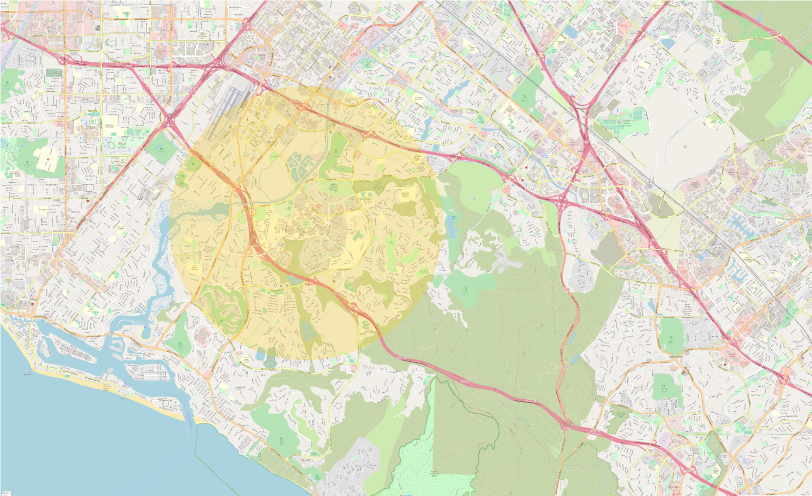
As another fall quarter begins, a sore reminder of the horrors that is Orange County transportation runs parallel — an annual promise well kept.
UCI’s two-mile radius, beginning at the center of Aldrich Park, makes it so that students who reside within it are ineligible to purchase a commuter parking permit. The radius spans multiple neighborhoods, including all of UCI, Westpark, Turtle Rock and parts of Newport Beach. Because the size of the radius is not district- or neighborhood-based, there are homes unqualified for a commuter permit that directly border qualifying homes.
As a result, students who reside in the arbitrarily marked neighborhoods have to find an alternative way of getting to school if they do not wish to pay the $15 permit rate UCI charges for daily general parking. For most, that means relying on the Orange County Transportation Authority (OCTA).
UCI claims that the radius is in place to reduce traffic congestion and the university’s carbon footprint as part of a general sustainable transportation plan. While the idea of reducing local traffic volume and emission levels is admirable, it brings to question the validity of UCI and Orange County’s supposed sustainability initiatives.
Notorious for car-dependent infrastructure and unwalkable cities, Orange County has become a hellscape for car-less residents. Examples of anti-transit practices are all over most OC cities, but municipalities such as Irvine are the worst offenders.
For example, it takes well over an hour for a UCI student to get from UCI’s campus to the Irvine Spectrum Center using OCTA’s public transit system. In contrast, the same trip would take just about 15 minutes by car. Inter-city transit from UCI is even more impractical, with a 23-mile trip to Buena Park’s Beach Boulevard taking nearly three hours one way using OCTA. The same trip via car is typically under a 30-minute drive.
As far as Irvine’s 53-year history spans, car accessibility has been the focal point of all municipal transportation design. Freeway access has always been a main emphasis for Irvine, as the 405 and I-5 Freeways are the main connectors between Irvine and greater Southern California. Of course, Orange County traffic is also infamous for these freeways constantly being jammed at peak hours as commuters travel in and out of one of the largest business counties in the state. This issue is especially prevalent at UCI, where students routinely face hour-long commutes or more just to attend classes.
The simple fix here is an actual robust transit system that spans all of Orange County, similar to the three massive public transit systems that span most of the Bay Area. OCTA is a shell of what public transit should look like, especially for one of the largest counties in the third-largest state in the nation. Expanding access to lines that connect all cities without any transfers would be an immediate relief to both UCI community members and the general OC public.
OCTA itself is not totally blameless and the transit authority should not take much of the criticism that public transit advocates push upon it. Across the nation, public transit initiatives are being halted as efforts to keep cars and highways as the sole method of transportation remain prevalent.
In conjunction with an investment in public transit, UCI should continue its initiatives to build housing on campus to reduce the number of vehicles coming onto campus each day. The university should also spearhead local and regional efforts to build the already mentioned transit infrastructure necessary to bring its students to school from off-campus residences efficiently and at a low cost at the point of service.
Despite calls for more parking structures and spaces to be constructed, the issue of parking at UCI is not simply a supply problem. It will require a concerted effort by the state, county and university to alleviate the issues of congestion, lack of adequate on-campus housing and inaccessible transportation around both UCI and Orange County.
Editor’s note: Editorials should not be interpreted to reflect the opinion, thoughts or beliefs of any individual New University editor, staff member or affiliate.