
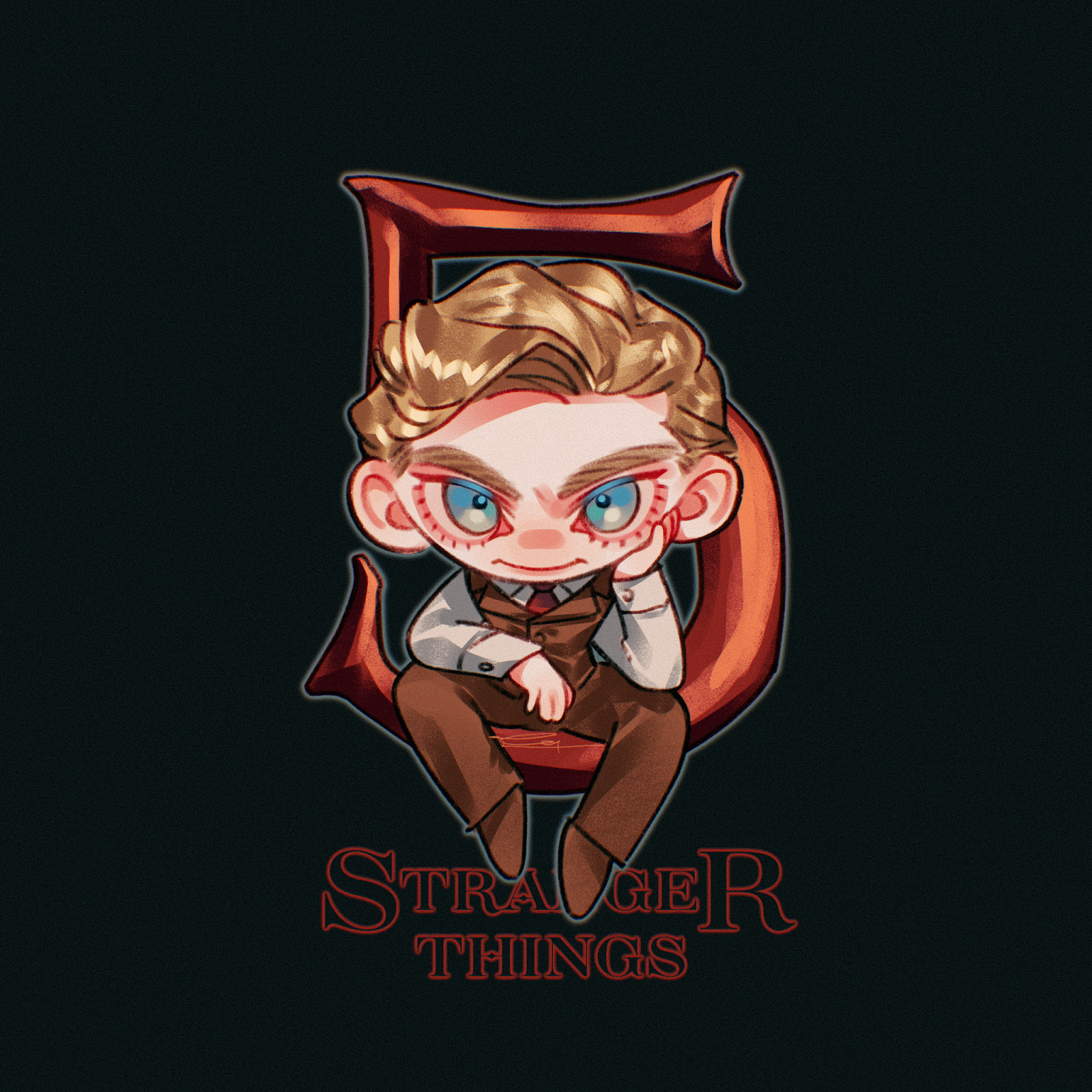

Editor’s Note: This article contains spoilers for “Stranger Things” season five.
It’s not uncommon for television series like “The Simpsons” to decline the longer they’re on air, but no one could’ve imagined that Matt Duffer and Ross Duffer’s “Stranger Things” would meet this same fate. Considering the cultural impact of this Netflix original series, it’s hard to believe that its fifth and final season — concluded on Dec. 31, 2025 — is simply bad.
Season five is set in November 1987, around 18 months after the events of season four, where Hawkins was ravaged by the opening of rifts that lead to the Upside Down. In order to end the suffering that has plagued Hawkins since season one, the cast of heroes must find and kill the missing Vecna (Jamie Campbell Bower). When the anniversary of Will Byers’s (Noah Schnapp) disappearance approaches, Vecna’s old tactics resurface as children across town begin to vanish. As the final battle with Vecna draws nearer, the cast’s mission is complicated by the town’s military quarantine, which has forced Eleven (Millie Bobby Brown) back into hiding.
Although season four established Vecna as a character foil for Eleven, season five disregards this relationship and recenters the story around Byers. Instead of exploring Vecna in terms of Eleven’s potential to act malicious and monstrous, this connection is omitted and Vecna is reframed as a victim to parallel Byers. As a result, Eleven’s character feels like an afterthought, sidelining her in a season that should have been the culmination of her story with Vecna and the Upside Down. Meanwhile, Byers’ plot feels recycled, underdeveloped and rushed in comparison to the one previously explored with Eleven.
At the same time, the story immediately backtracks the cliffhanger set up in season four. Rather than seeing the direct fallout of the rifts leading to the Upside Down, the timeskip to 1987 conveniently sweeps this issue under the rug and disregards the emotional weight of Max Mayfield’s (Sadie Sink) sacrifice at the end of season four.
These foundational problems are accompanied by an abundance of “second-screen” dialogue — a practice that forgoes complex, subtextual writing for simplicity and exposition. Throughout the season, characters regularly narrate their plans, actions and even personal growth to follow this simplicity and tailor the season toward a casual viewing experience. To supplement this lost complexity, season five amps up the comedy. There are cliche high school banter and dirty jokes galore, which makes the dialogue feel cringe-worthy at times.
In an attempt to mask these flaws, season five clings to the beloved character dynamics between Dustin Henderson (Gaten Matarazzo) and Steve Harrington (Joe Keery) as well as Jim Hopper (David Harbour) and Eleven. On the one hand, Henderson and Harrington’s tension surrounding Eddie Munson’s (Joseph Quinn) death in season four feels extremely contrived, relying on Harrington being unnecessarily harsh and argumentative in a way that is very out of character. On the other hand, Hopper and Eleven find themselves falling back into their roles of overprotective father and sheltered daughter, retreading a conflict that’s already been thoroughly explored.
Rather than building upon these beloved characters, they’ve ultimately succumbed to flanderization or becoming caricatures of their old selves. Their dynamics ultimately become reliant on the strong chemistry between actors, otherwise coming off as tricks of nostalgia to remind viewers of earlier, better seasons.
Meanwhile, new dynamics are introduced as well, such as Byers and Robin Buckley (Maya Hawke). These two are meant to parallel one another, with Byers beginning to see himself in Buckley’s journey as a queer woman. Buckley acts as the catalyst that pushes Byers to further explore his own queer identity, leading to one of the most emotional moments of the season — a scene in episode four that culminates Byers’ journey to self-acceptance at that point in the series.
Byers’ queer journey is one of the most interesting taken throughout the season, but it doesn’t necessarily justify his dynamic with Buckley. In Buckley’s case, she lacks an arc of her own, feeling like a mere device meant to propel Byers’ storyline. Meanwhile, the rest of Byers’ development is hindered by Noah Schnapp’s arguably lackluster performance. Oftentimes, Schnapp’s line delivery feels awkward and dull, failing to capture the emotion required for pivotal scenes — like Byers’ coming-out scene in episode seven.
Perhaps the worst part of season five is its decision to retcon the Upside Down, deconstructing the notion that it’s a dark echo of Hawkins, but rather a wormhole. In making this retcon, “Stranger Things” ignores that its horror was built off of ambiguity. The Upside Down and its subsequent monsters played off the natural fear of the unknown; the terror that comes with seeing something so familiar, yet so unexplainably and horrifyingly foreign.
By incessantly expanding the lore of the Upside Down, the ambiguity that made it so horrifying is erased, instead feeling like full-blown science fiction. This heavy-handed transition into sci-fi is unequivocally present in the series finale. The confrontation between the heroes and Vecna lacks the emotional depth and intimacy of previous season finales. Instead, it manifests as a huge-scale CGI battle that feels less like the small-town horror story the series started as and more like an excuse to gloat the blockbuster budget.
If this sense of horror wasn’t already eradicated, it’s further buried by season five’s reluctance to kill off main characters. Rather than committing to a main character’s death — a persistent issue with the series — this season settles for death fake-outs. This entails constant scenarios where characters are put in near-death situations but are never actually killed. In turn, season five cheaply elicits the suspense and terror of a character’s death, but never has to explore the ramifications of actually killing someone.
Since this philosophy is one that’s been entertained throughout the series’ entirety, it’s resulted in another one of season five’s issues: the cast is too big. There are so many characters that it’s simply impossible to grow attached to all of them, as the constant shift from character to character leaves viewers always wanting a bit more time with everybody on screen. This is further complicated by the heavy focus on previously minuscule characters, such as Holly Wheeler (Nell Fisher). Though she’s an admittedly interesting addition, she takes a large amount of screen time away from characters like Eleven.
While “Stranger Things” season five might not be the sole perpetrator of the series’ decline, it surely solidifies it. It’s undeniable that the first few seasons are among Netflix’s most influential original series, but its current quality makes the future of the franchise rather bleak.
Travis Foley is an Arts & Entertainment Apprentice for the winter 2026 quarter. He can be reached at tdfoley@uci.edu.
Edited by Riley Schnittger

