
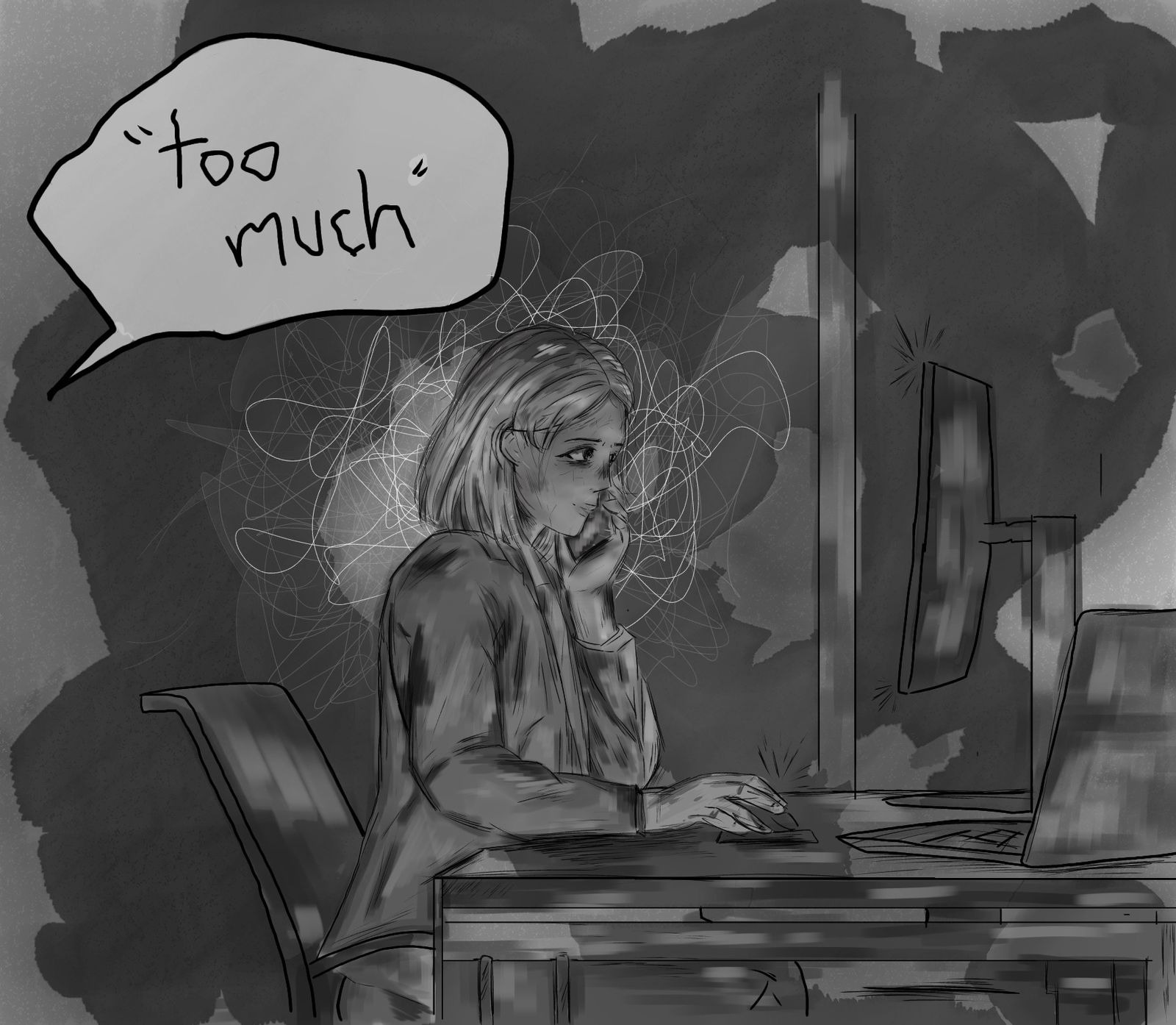

The workplace expects women to be accommodating and overly collaborative. Yet, women are penalized more than men for failing to act this way. Many women are taught to avoid taking up space in the workplace and to contain certain emotions — or risk losing the respect of their coworkers. In other words, there is a tolerable level of emotion and ambition — anything beyond that level is deemed as excessive. If women dare to go beyond, they are considered too loud, too intense and too much.
Likability labour is a term that describes the disproportionate pressure for women to be likable, especially in the workplace. This likability is not about kindness, but using phrases like “I might be wrong but” to soften their authority. A study found that women are twice as likely as men to be called bossy at work — even when both genders exhibit similar behaviors. While bossiness is generally perceived negatively, the consequences on reputation are more severe for women.
This difference in gendered perception represents a double standard in accepted assertiveness. While assertive behavior from men is framed as leadership, the same behavior in women is often framed as aggression or bossiness.
Although there are more women emerging in powerful positions, women are far from dominating them. A study conducted by the Linkedin Economic Graph showed that only 30.6% of leadership positions are held by women. Women who want to advance in their careers are often told to emulate men’s leadership styles to succeed. However, research has found that this may lead to women being seen as unlikable, limiting potential promotion opportunities. On the other hand, when men take on leadership roles, they are more likely to be evaluated as competent because they exhibit these traits that are consistent with gender stereotypes regarding masculinity.
This paradox exposes a system that sets women up to fail. They are expected to lead like men but are punished for doing so. Women are not failing to lead — rather, they are navigating a contradictory workplace culture that rewards masculinity with promotions while demanding women remain palatable to everybody and put themselves second.
The policing of women’s workplace behavior does not stop at their level of assertiveness; it also extends to their expression of anger and sadness. Just as women are taught to soften their confidence, they are additionally taught to hide their emotions to retain respect. There is a careful balance between not overstepping power and not appearing too fragile in the workplace. While ambition is labeled as aggressive, emotion is labeled as excess.
Women have long been perceived as more emotional than men, a stereotype that frames their feelings as irrational and unstable. The expression of anger in women is interpreted differently than in men. In work settings for instance, anger in men is usually read as passion for their craft or a conviction for perfection, while anger in women is perceived as a loss of control at their place of work.
Similarly, sadness or vulnerability is tolerated only enough to signal warmth and openness, but not enough to disrupt productivity or the comfort of their coworkers. This emotional double standard mirrors the workplace leadership bind. When women suppress emotion and try to command with callousness, they are seen as cold or detached. However, if they do express emotions, they are seen as unfit to lead.
Studies on workplace bias have found that women who display emotion are judged as less competent even when their performance remains unchanged. Men expressing the same emotion, particularly anger, are more likely to be granted authority and legitimacy.
These impossible expectations — requiring women to be agreeable and accommodating while remaining calm and selfless — are rooted in decades of workplace gender norms that associate femininity with emotional labor. Women are expected to manage the needs of others, yet are simultaneously punished for expressing emotional needs of their own. Due to these unfair standards, emotional expression for women at work is not about authenticity but about containment.
Deanza Andriansyah is an Opinion Staff Writer. She can be reached at dandrian@uci.edu.

