


Though I never personally watched any portion of “The Vampire Diaries,” I was part of the young adult book and television show fandoms a few years back, so I’ve had some preconceptions about the franchise. Essentially, “The Vampire Diaries” seems like pure sex, drama and intrigue with a dominant Hot Topic touch — dark and edgy, fitting the vampire vibe.
Dark and edgy can also fit the fairy vibe, especially when it comes to redefining the colorful and glittery cartoon “Winx Club” for a new audience. However, Netflix’s six-episode reboot, “Winx Club, Fate: The Winx Saga,” is dark and edgy to a fault, contributing to the show’s downfall.
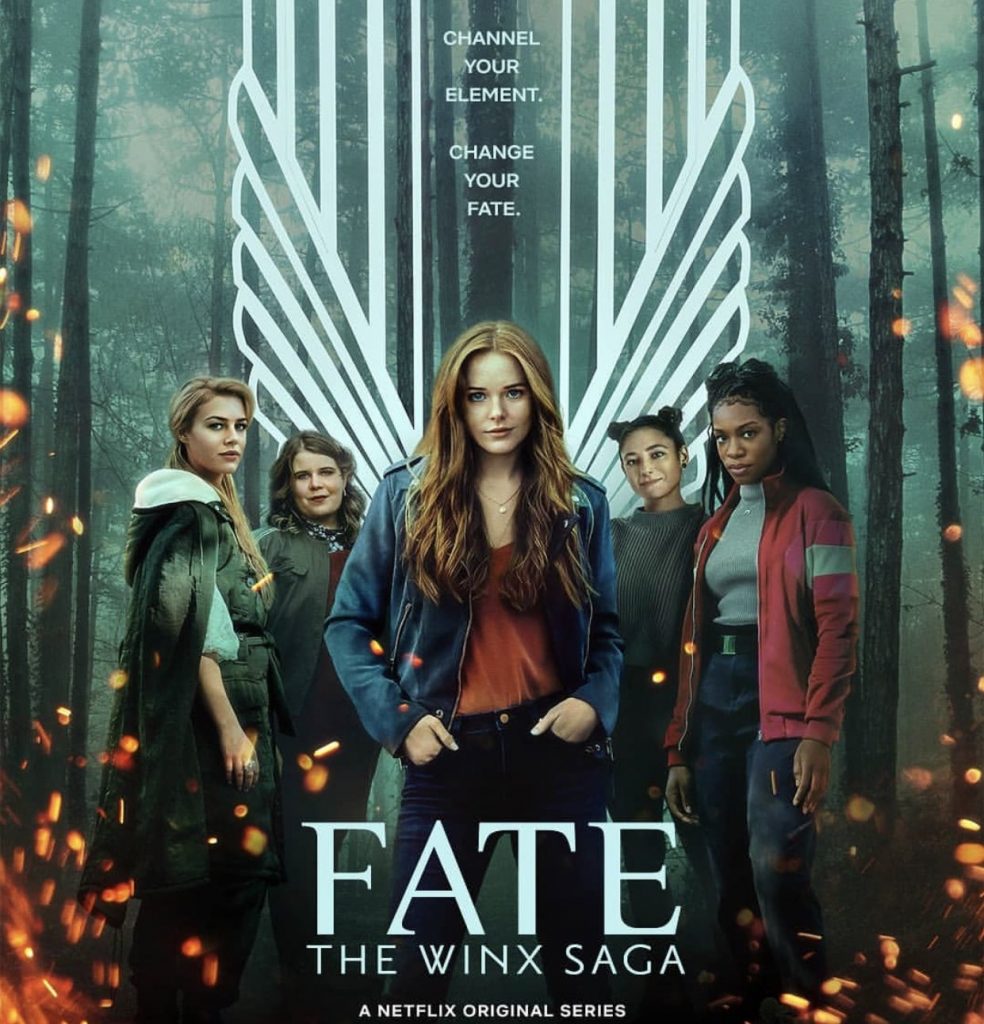
Drama and intrigue surround the main plot: the secrets of an elder fairy generation threaten to be exposed by the resurgence of monsters called “Burned Ones” and the younger generation — Bloom, Stella, Aisha, Terra, Musa and Beatrix — must stop the monsters. The story, full of edginess and angst, somewhat holds viewers’ attention as plot and moral questions unravel, but the characters discourage anybody from continuing the series.
The show’s characters embody edginess. Not only are they drably dressed in muted colors, they’re also loners with varying inner-conflicts. Beatrix has villainous ambitions; Bloom has secrets from her past; Terra has been bullied for her outer appearance; Musa, an empath, senses everybody’s emotions; and Stella was initially taught to power her magic by channeling negative emotions. The water fairy Aisha acts as the show’s only somewhat solid character. Their overly exaggerated edgy personalities almost caricature them into shallow tropes. At the very least, the female characters have some semblance of personality, but the men act only as plot devices to advance the girls’ development.
Fellow classmate Sky is only used as a romantic object. His relationship with Stella and eventual romantic interest in Bloom only serve to accentuate Stella’s growth as she breaks free from her past relationships. Though usually seen as a pair, Sky’s only defining trait is his romantic life while Stella’s princess shtick helps her stand out from the other fairies — a trait necessary for viewers to be able to distinguish the girls from one another.
The characters’ dark personalities distinguish them from the original “Winx Club.” The cartoon characters are quite tolerant of one another, whereas their live-action counterparts are bratty and shallow. The term “Winx” collectively refers to the protagonists, but since the heroes of the live adaptation only seem unified in their edginess, the new rendition lacks the original’s deep understanding and appreciation of friendship.
“Fate” also lacks another aspect of the original’s characters: their racial diversity. Musa, an Asian fairy, becomes white in Netflix’s adaptation, whereas Flora, a Latina fairy, is replaced by Terra, a white fairy. Whitewashing Flora and Musa is especially insulting because the characters were originally inspired by Jennifer Lopez and Lucy Liu, respectively. In whitewashing the pair, the reboot implicitly disregards the discrimination (and sexualization) that both Lopez and Liu suffer as women of color in American entertainment.
The adaptation’s only non-white character, Aisha, is depicted as Black, thankfully remaining faithful to the original. Aisha may seem like the show’s only non-caricature, but she’s unfortunately reduced to Bloom’s confidant. Bloom soliloquizes her feelings to Aisha, who only serves as the audience’s eyes into Bloom’s character, thus losing her potential to become an actually well-written character.
Netflix’s adaptation truly lacks respect for people of color and in general, any color at all. The almost fully white cast is set against the show’s drab, muted forest tones — another complete contrast from the original “Winx Club,” and the reboot’s main turn-off.
One of the greatest appeals of the original show was its colorful, whimsical and glittery aesthetic. Flora serves as a cottagecore icon, Tecna (who does not appear in “Fate”) plays with glitchcore, and the franchise itself is the epitome of a fairy world wherein magic flows through its inhabitants’ veins. “Winx Club” serves as fashion and even lifestyle inspiration: our daily lives can be as magical as that of fairies.
The cartoon’s beautiful aesthetic and strong character development manifest in the characters’ colorful fairy wings — but “Fate” immediately points out that its fairies lack wings. Ironically, the name “Winx” is derived from the word “wings.” In stripping the fairies of their wings, Netflix distances its reboot from the design and character core of its source material. Different designs of wings signify the characters’ new transformations and developed powers; the wings signify growth. Though the adaptation may only see the original wings as detracting from its dark aesthetic, removing the fairy wings also erases an avenue of character growth.
Still, “Fate” has been received well by some viewers. The secrets of the older generation frame the protagonists’ decisions in determining the future — a plot that not only creates suspense for the next season but also resounds with the present. However, considering the reboot’s weak characters and disrespect for the source material in its lack of aesthetic homage, the show’s potential feels like a promise that will not be fulfilled. Unfortunately, no fairy magic can help the show’s poor quality.
Beatrice Malvar is an Entertainment Staff Writer. She can be reached at bmalvar@uci.edu.

