
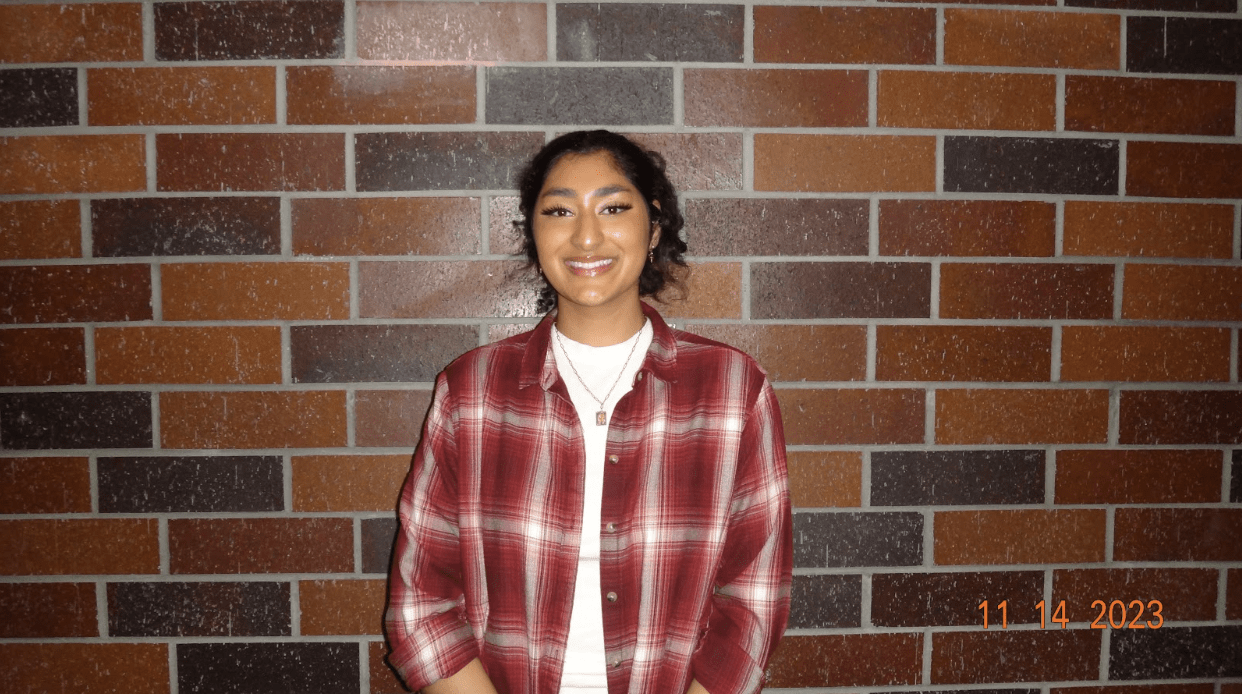


Third-year computer science student Ananya Kashyap uses singing as an escape. When she is frustrated with schoolwork, or when she feels emotionally overwhelmed, she sings. However, vocalizing on a whim is not merely a casual hobby for Kashyap. She has perfected her craft with vocal training in Indian and Western music, participating in performances and being the music director of UCI’s Haath A Cappella group.
Kashyap’s beginnings with singing started when she moved from Seattle to India at age five.
“In India, it’s pretty typical for girls to pursue music, especially from the region that they’re from — all of my cousins have pursued some form of cultural art,” Kashyap said in an interview with the New University.
During the 10 years she lived in South India, Kashyap took an interest in the Carnatic music scene, prevalent to her family because of their origins in the Indian state of Tamil Nadu. Although Carnatic music is centered around Indian classical music, the genre emphasizes vocalization and requires instruments to be played in a style similar to singing.
At age 12, Kashyap started professional vocal training for Carnatic music, singing in Tamil and other languages such as Sanskrit and Telugu. However, she struggled to continue Carnatic vocal lessons when, at 15, she moved back to Seattle, where she began to also train in Western music.
“I was trying to apply techniques from Carnatic music to Western music, and it just wouldn’t work,” Kashyap said. “That learning period was testing my passion for both.”
Kashyap directed her focus to Western vocal training, practicing Carnatic music intermittently to preserve her culture. With her vocal coach in Seattle, she learned about the anatomy of tongue placement, the larynx, vocal cords and more. She also discovered her singing was of the mezzo style, a mix between the medium-low range of alto and the high range of soprano.
Kashyap felt her singing style was not suitable for American pop music, such as radio hits from Ariana Grande and Ed Sheeran. Instead, she utilized her voice for powerhouse music, incorporating the vocal palettes of artists like Whitney Houston, Adele and Ella Fitzgerald.
When Kashyap came to UCI in Sept. 2021, she came across two organizations at the Anteater Involvement Fair that furthered her interest in singing: the Open Jam Club and the Haath A Cappella group. She joined both during the first four weeks of the fall quarter.
“I thought it would be a really good opportunity to step out of my comfort zone, both personally and on a stage,” Kashyap said.
Kashyap described Open Jam Club as a low-stakes environment. At Open Jam sessions, students performed with an instrument or sang with no judgment from peers, who ranged from all levels of music expertise. However, Kashyap was nervous to sing on her own, and even more so in front of other people. She had only sung in groups during occasional Carnatic music performances.
At Kashyap’s first Open Jam session, she performed “Remedy” by Adele.
“I remember I was terrified,” Kashyap stated. “My hands were shaking. I had adrenaline coursing through my veins. I had a cotton mouth because of the adrenaline!”
Regardless of her unease, along with the fear of botching her performance, Kashyap received tremendous applause from Open Jam Club members, who commended her successfully vigorous rendition.
Kashyap performed at more Open Jam Club sessions to practice her confidence on stage, feeling validated by the support and ingenuity of the club. One of her most cherished moments in Open Jam Club was when the members, clapped to encourage Kashyap, who forgot the lyrics to “Rolling in the Deep” on stage, to continue singing.
Kashyap reclaimed her cultural roots through music when she became a member of Haath A Cappella, UCI’s co-ed South Asian acapella team that specializes in a fusion of Western and South Asian music.
“I thought it would be a really good chance to meet people who look like me but also love to sing,” Kashyap affirmed.
In part, Kashyap also joined Haath A Cappella because of her love of the “Pitch Perfect” movie, as well the Pentatonix acapella group. “The feeling of everyone contributing to something that sounds very cohesive, as a whole, was so appealing,” Kashyap said.
Like her first experience at Open Jam, she felt vulnerable at her audition for Haath A Cappella, believing she put herself in a position to be “scrutinized and possibly rejected.” However, she was offered a callback audition where she had to sing an Indian song, choosing to sing “Shobillu Saptaswara.”
Kashyap was placed in the tenor section of Haath A Cappella due to the lack of male tenor members. Although she is more of a mezzo than a tenor, Kashyap altered her singing range to fit the vocal composition of the group, helping her become flexible with various singing styles.
By her second year at UCI, Kashyap became the assistant director of Haath, becoming the music director during her third year. She was chosen not only because of the circumstances of the Haath directors graduating, but also due to her flexibility with vocal ranges and Carnatic vocal training.
As a director, Kashyap reads Indian sheet music, assigns parts to the team’s music sections that are most appropriate for their voices and creates mixes of Western and South Asian music. For mixes, Kashyap finds tonally similar songs, despite the distinctiveness of English and South Asian languages like Hindi and Tamil. She also chooses South Asian songs that are easy for the acappella team to learn by ear, considering that not every member has a background where they can read sheet music proficiently. Last year, Kashyap and her team finished a mix of Zayn’s “Dusk Till Dawn (feat. Sia)” and Arjit Singh’s “Phir Mohabbat.”
Kashyap and Haath A Cappella compete in regional competitions, where her leadership as a director, as well as her position as a tenor, is showcased through the group’s outstanding performances of her mixes.
“Nothing beats the feeling of all your hard work coming to fruition, and watching everyone in the group bring your vision to life,” Kashyap said.
Aside from her involvement in UCI music organizations, she owns an Instagram singing account. She posts song covers to be “okay with imperfections [in her vocals],” which is what she strays away from in Haath A Cappella and other professional music endeavors. The account is essentially a way to practice singing solo on a public platform, apart from her roles in Open Jam Club and Haath A Cappella.
Kashyap’s passion for singing crosses ethnic borders, and since finding different avenues of reflecting her interests, she has only progressed in her strengths as an individual singer, acappella member and vocal director.
“Music has always been a huge part of my life,” Kashyap said. “I want it to continue being a big part of my life, and I’m really glad I’m able to do that here at UCI.”
Ingrid Avancena is an Entertainment Intern for the fall 2023 quarter. She can be reached at avanceni@uci.edu.