
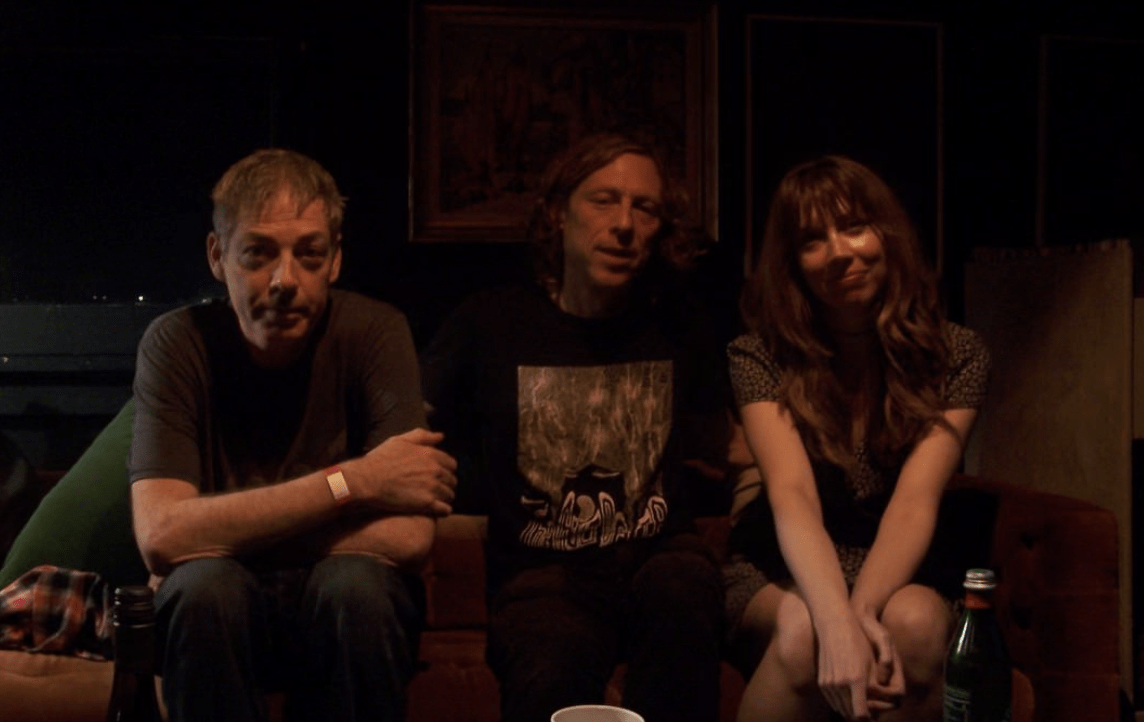


Though San Francisco’s LSD and the Search for God have only released two EPs in their 17 years of existence, the two rank among the greatest shoegaze records of all time and have cemented the band as one of the genre’s most integral. The New University sat down with the quintet before their Oct. 19 set at the Lodge Room in Los Angeles to discuss, among other things, their origins, their next record and liminality.
The band’s current lineup features founding members Chris Fifield and Andy Liszt on guitar and guitar/vocals respectively, as well as longtime drummer Zaied Ali, bassist Frank Campbell, and vocalist Christy England.
When he and England were asked how they joined the band, Campbell answered, “I responded to a Craigslist ad … Zaied was looking for someone to play music with. We connected that way. Then LSD needed a bass player, he threw my name out there, I said yes to the opportunity, and here I am.”
“Yeah, [Christy, Frank and I] were making music prior to this, so I figured we already had a shared music communication language that we could bring to [the band],” Ali added.
It appears that these contributions have not been restricted to the stage and have extended to the studio. The band’s bio on the venue’s website states that “a new record is currently in the works,” which will be the band’s first release since their critically acclaimed EP “Heaven is a Place” in 2016.
Expanding on this, Liszt said,“Zaied, Chris and I started recording it in probably 2019. We’ve tracked probably three or four songs but may do them again now that we have a different bass player. It’ll probably be somewhere around five [or] nine songs. If it’s five, then it’ll be an EP, and if it’s more, then it won’t.”
One could argue that a big part of the band’s pull, and the genre’s in general, is their enigmatic image. Having only released 2 EPs and choosing to do little interviews contribute to this quality, as does their name: little is known about its origin.
In an interview with The Blog That Celebrates Itself, Liszt cited George Harrison’s “All Things Must Pass” as an album he was enjoying at the time — if not one of his favorites ever. A notorious user of LSD, Harrison’s last words were “Everything else can wait, but the search for God cannot wait, and love one another.”
When asked if, when creating the band’s name, they drew inspiration from this quote, Liszt responded, “I love that quote; I don’t think I knew that quote until right now … But, it’s that book title: ‘LSD and the Search for God,’ by William Braden. There’s all kinds of reasons why I liked it then and why I still like it, including the absurdity of the whole Shakespeare, ‘a rose by any other name …’ kind of thing. I was terrified of the Grateful Dead, I thought My Bloody Valentine was a terrible fucking death metal band or something. Then, you listen to something, it speaks to you, and all of a sudden everything gets …” he trailed off.
“A few people have given [the book] to me, and I haven’t finished it actually, but my understanding is that it’s ultimately an anti-drug, anti-LSD book about exploring—I think he’s a psychiatrist — its uses in psychotherapy and uses similar to that George Harrison quote. So, he and George Harrison can discuss it.” Liszt said.
Not restricted to their name, religious allusions are present in the band’s lyrics and song titles as well. However, the band employs them in a way more aligned with the exploration of reality than the promotion of religion.
“You know, it’s funny,” said Liszt. “I don’t think of our songs as having religious overtones. But, I think one thing in general that’s always been interesting to me — and music has always been an avenue for this my whole life, as a listener or fan and as someone who tries to interpret their experience — is exploring the nature of reality. Who we are, who I am, and what in the world we are doing here has always been something that’s occupied some of my brain space. I didn’t have an overly religious upbringing, per se, but I think that perhaps more of it than religion in itself is what purpose religion does or doesn’t serve in that process.”
Delving further into their origins, Fifield then introduced some guitarists and bands that inspired him as he helped shape the sound of the band, making paramount the distinction between conscious borrowing and unconscious absorption during this process.
“My favorite guitarists originally were Johnny Marr, Bernard Sumner and Robert Smith and, later on, Thurston Moore and Kristin Hersh,” said Fifield. “Anyone that could make a melody a complete sentence and kinda tell a story with it… As far as the influences, I think it’s pretty narrow: I’m always only listening to one thing at a time. For a couple of years, I listened to nothing but Neil Halstead’s solo stuff. Then, there was a time when I listened to nothing but hip-hop because I wanted to hear music that didn’t have guitar…”
“Influence is always kind of a weird thing because I don’t think I ever wanted to sound like a specific band — except for maybe when I was a teenager and wanted to sound like Joy Division,” he continued. “The sound of the band is just a combination of each of us trying to get the best of ourselves.”
This perspective is validated by their unique sound selection. An example of this is a certain guitar tone found at the 3:10 mark of their song “Starting Over.” When asked how he achieved this vacuum-esque guitar tone, Liszt responded, “Ah, the jet engine stuff. I’m guessing what you’re hearing is a lot of compression and a lot of distortion from a patch that I’m getting from a[n Alesis] Quadraverb.”
With the band emerging, in the mid-2000s, long after shoegaze was new but before it could be seen as retro, the time in which they debuted could be deemed liminal. Fifield responded to the proposition of this label while simultaneously describing the state of the genre then.
“This just occurred to me now: I suppose you could take the long view and see that era as a handful of bands sort of keeping something alive so that it could be discovered later, right? Because in that era — though a lot of people of our age loved that music — it was fairly obscure and not really popular. But, if we keep it in the public consciousness, given enough time, more and more people are gonna gravitate towards it and, eventually, it can amass broad listenership.” Fifield said.
To finish out the interview, the band was asked to offer words of advice for the burgeoning next generation.
“Learn how to think for yourself and just fucking do it,” said Liszt.
“Something that took me a while to learn is that it’s the artist, not the tools,” said Ali. “Playing in this band, I get DMed, ‘What gear should I buy?’ That shit doesn’t matter, just start making shit! I actually find that limitation is good! I think that a lot of people that are trying to get into music — older friends of mine or younger kids — think it’s a result of some combination of tools that I have, but I think it has little to do with them.”
“But also, I don’t think the younger generation needs advice,” added Fifield. “This is your world. You guys are doing great in general. I’m quite inspired by the younger generation and what they’re figuring out on their own.
“Yeah, I like that answer,” noted Ali. “Who are we? We don’t know anything.”
“We’re lucky that you guys still want to come around and see us,” said Fifield. “You’re gonna take it from here.”
“I feel similarly, like I’m not really qualified to give advice, but maybe part of that imposter syndrome is something that people who wanna do music can relate to,” contemplated England. “I think you just have to keep doing it and then you’re a musician — as long as you love it.”
LSD and the Search for God’s Fall ‘23 tour has long ended, culminating in a performance at LEVITATION Fest 2023. But, those unable to go then can catch them, as well as Explosions In the Sky, Jan. 30 at the Warfield in San Francisco — a historic venue played by everyone from Charlie Chaplin to Bob Dylan, and all should tune in via Instagram, Facebook or Bandcamp to see how the band navigates an exciting near-future.
June Min is an Arts & Entertainment Staff Writer. He can be reached at junehm@uci.edu.